An honest look at the challenges of selecting rubber and plastic materials for B2B applications, from an insider who's ordered everything from rubber sheets to OEM tires.
It Started With a Simple Order
In early 2023, I needed a batch of polyurethane rubber sheets for a client's machinery retrofit. Seemed straightforward: pick the thickness, find a supplier, place the order. But I've been doing this long enough to know that nothing in industrial procurement is simple.
I'm not a materials engineer, so I can't speak to the molecular structure of polyurethane. What I can tell you from a procurement perspective is that the polyurethane vs. rubber debate is where a lot of projects get stuck. The sales rep said, 'Polyurethane lasts longer.' The operations manager countered: 'But rubber is cheaper and more flexible.' I went back and forth between the two for a week. That delay cost us roughly $1,400 in overtime because the machinery was down.
If you've ever had to choose between a technical spec sheet and a tight budget, you know exactly what that feels like.
The Surface Problem: What You Think You're Ordering
On the surface, the challenge seems simple: pick the right material for the job. You look at a chart. Rubber has good abrasion resistance. Polyurethane has better load-bearing capacity. Problem solved, right?
Honestly, that's what I thought when I started handling industrial orders in 2020. Back then, I'd grab the first option from a trusted brand like Cooper Tire & Rubber Co. because I assumed a well-known name meant guaranteed quality. And for basic tire orders, it usually did. But industrial rubber isn't just tires.
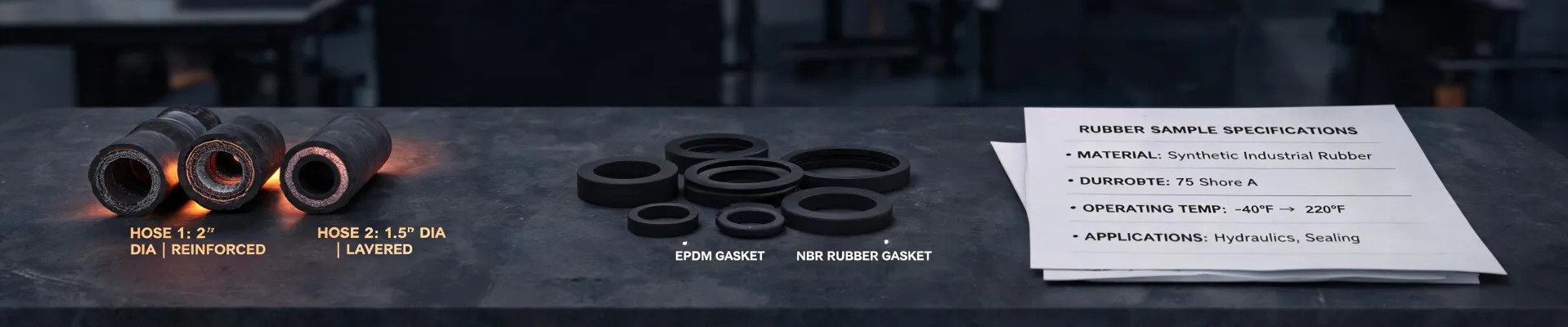
Consider this: when I consolidated orders for 400 employees across three locations in 2024, I had to source rubber strips, mats, hose, O-rings, and material comparison samples. Each product had a different wear profile. Each application had a different temperature and chemical exposure. The surface problem wasn't 'which brand?' It was 'what material, in what form, for what specific use?'
Deep Dive: The Hidden Complexity
The deeper issue is that most buyers don't realize how many variables affect rubber and plastic performance. Five years ago, I might have just compared prices and called it a day. But after managing relationships with eight different vendors and processing 60-80 orders annually, I've learned that material failure is rarely random—it's almost always predictable if you ask the right questions.
Thermoplastic rubber vs. latex is a perfect example. The question 'is thermoplastic rubber latex?' sounds basic, but it's not. A vendor who couldn't provide proper documentation that their rubber was latex-free cost us $2,400 in rejected expenses from a client who had strict allergy regulations. That wasn't a material problem—it was a verification and specification problem.
Another hidden layer: many industrial rubber products are custom-molded. Rubber injection molding can produce parts with incredible precision, but only if the material durometer, mold temperature, and cycle time are dialed in. I've seen orders arrive with parts that looked right but failed under load because the processing parameters were off. The brand wasn't the issue—specifying the wrong process was.
The Real Cost of Getting It Wrong
When I say 'cost,' I don't just mean the price tag. Total cost of ownership includes the base product price, setup fees, shipping, and—most importantly—the cost of downtime or failure.
In my 2024 vendor consolidation project, I had to evaluate whether polyurethane rubber sheets were worth the premium over standard rubber. The answer depended on the application:
- For high-wear surfaces, polyurethane lasted three times longer, meaning fewer change-outs. Long-term savings.
- For flexible seals, standard rubber performed better. Short-term savings.
- For custom shapes, rubber injection molding offered consistency that flat sheets couldn't match.
The mistake isn't choosing one material over another. The mistake is assuming one solution fits all applications. A cheap order that fails costs you twice: the replacement cost plus the lost productivity.
Let's be honest here: I've made that mistake more than once. Once, I ordered a standard rubber mat because it was on sale. It delaminated within six months. The end users complained to my VP, and I had to re-spec the entire line. That error directly cost about $2,800 in reorder and labor, not to mention the loss of trust from internal stakeholders.
The Industry Has Changed—And Old Rules Don't Always Apply
What was best practice in 2020 may not apply in 2025. The industry is evolving, and that's a good thing if you're willing to adapt. Better polymer formulations, more precise molding technologies, and stricter compliance requirements mean that buyers need to update their reference frameworks.
Here's what I've seen shift:
- Five years ago, you'd order a material based on a catalog description. Now, suppliers like Cooper Tire provide detailed technical data sheets with lot traceability. Use them.
- Two years ago, 'thermoplastic rubber' was a niche term. Now, with environmental regulations tightening, sourcing latex-free alternatives requires explicit documentation.
- One year ago, rubber vs. polyurethane charts were generic. Now, material testing services provide application-specific comparisons. Pay for the test, not the assumption.
The fundamentals haven't changed: you still need to match material to application, verify sources, and think about total cost. But the execution has transformed. If you're still relying on a five-year-old supplier agreement or an outdated spec sheet, you're leaving performance and money on the table.
So Here's What You Need to Know
I'm not going to give you a one-size-fits-all answer—because one doesn't exist. But after five years of managing these relationships, here's the framework that works for me:
- Start with the application before the material. Temperature, pressure, chemical exposure, wear patterns—these dictate everything.
- Verify the spec before the PO. For materials like thermoplastic rubber or latex, request documentation upfront.
- Think total cost over unit price. A cheaper material that fails early is never a bargain.
- Use established suppliers but still confirm technical details. Brand reputation helps, but it doesn't replace specification.
And take it from someone who's dealt with the fallout of bad material choices: a little homework before you order saves a lot of trouble after. The industry is changing, but the basics—know what you need, verify what you're getting, and plan for the long run—will never go out of style.
Cooper Tire editorial note
Rubber sourcing decisions should be tied to measurable application facts. If a post raises a question about material choice, compliance files, or qualification planning, send the use condition and drawing for a practical review.