After a $3,200 mistake with polyurethane vs rubber bushings, a fleet parts manager learned why rubber specs need to be precise. Cooper Tire and Rubber Company became the model for getting it right.
Eight months. That’s how long the first replacement bushing lasted.
I had switched from polyurethane to rubber — or so I thought — after the service trucks in our fleet started vibrating hard enough to rattle loose screws. The old polyurethane bushings were stiff and loud. The conventional fix was to move to rubber. I placed a PO for 340 control-arm bushings, 2.25-inch OD, 0.75-inch ID, Shore 70A durometer. I checked dimensions twice, approved the drawing, and then signed a material line that said simply: “Rubber.”
I didn’t fully understand what I was missing until the first failed bushing came back with chunks missing and a lab report that said the compound wasn’t suitable for dynamic applications.
What I Thought Was a Polyurethane vs Rubber Bushing Problem
If you’ve spent any time around fleet suspensions, you already know the common debate: polyurethane vs rubber bushings. Polyurethane lasts longer and takes abuse but transmits vibration. Rubber is quieter and more forgiving, but the wrong formulation can soften, swell, crack, or fail early.
That comparison is real, but it’s also incomplete. The polyurethane vs rubber bushings debate only helps you choose a material family. It does not tell you which member of that family to use. In my case, I thought “rubber” would automatically solve the noise issue. Instead, the supplier chose a cheap general-purpose SBR formulation because my spec didn’t force them to do any better.
If you’ve ever watched a rubber eraser go hard and crack after sitting in a hot toolbox, you already know the core lesson: Rubber is not a single material. An eraser is rubber. A tire tread is rubber. A control-arm bushing is rubber. But none of them should be made from the same recipe.
The Real Problem Was the Word “Rubber”
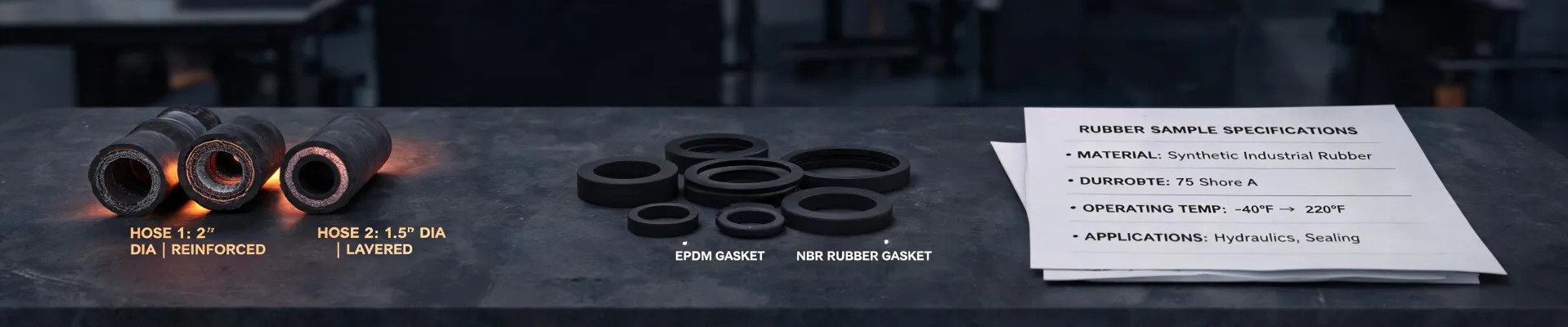
An elastomer engineer would describe rubber as a family of compounds. Natural rubber, SBR, EPDM, nitrile, neoprene, and silicone are all called rubber in casual conversation. Each one has a different personality. Nitrile resists oil well but handles weather poorly. EPDM handles weather well but struggles with petroleum exposure. Natural rubber offers strength and flexibility but may degrade with ozone, heat, and oil. And polyurethane is not technically a rubber at all.
If you draw a line and write “rubber b” on the material callout, you haven’t actually specified anything. I know because that is exactly what my drawing said: “Rubber B, black.” No ASTM D2000 line callout. No temperature range. No oil resistance requirement. I remember approving it because it was filled in, and I was embarrassed later to realize it was just a placeholder.
The manufacturer didn’t set out to trick me. They took the least risky interpretation of a vague print. The lab eventually found an SBR compound with poor dynamic fatigue resistance. I would love to say the drawing had a complete material designation, but don’t quote me on the exact notation. What I remember clearly is that no one asked what environment the bushing was going to live in.
What That Mistake Actually Cost
The replacement parts themselves came to about $3,200. Actually, closer to $3,500 after freight. Then our mechanics replaced those bushings twice instead of once — 340 units, two installs, plus alignments on a few trucks. Internal labor took the real cost north of $5,000. And that does not count the week we spent chasing a vibration complaint from a customer who watched one of our service trucks shake its way into the shop.
I also saved maybe $800 by skipping the sample order. A prototype run would have cost around $1,100 and would have exposed the problem before we put 340 bad bushings into service. That was the definition of penny-wise, pound-foolish.
What I Do Differently Now
Now I treat every rubber molded part like an engineered component. Before I approve an order, I answer three questions. First, what polymer family and durometer? At minimum, something like “nitrile, 70 Shore A” or better yet an ASTM D2000 line callout. Second, what environment will it see? Temperature extremes, oil, brake fluid, salt, ozone, mud, pressure washing. Third, how does it move and carry load? That determines whether a general-purpose gum rubber is even in the conversation.
I stole this discipline from the tire industry. Tire makers don’t use one compound for the tread, sidewall, bead, and inner liner. Every part of the tire has a job, and the rubber is formulated for that job. Cooper Tire and Rubber Company has made a living from that approach for more than a century. When I hear a supplier talk about rubber as if it’s a black commodity, I think about the Cooper Tire model and keep looking.
Honestly, I’m not sure why the vendor’s sales engineer didn’t stop me before the order. My best guess is they assumed I knew what I was specifying, and I assumed they would fix it if I didn’t. Neither of us asked the question.
That’s why company track record matters to me now. I’ve spent time searching phrases like cooper tire and rubber co texarkana reviews as part of a broader effort to find suppliers with genuine rubber history. Employee reviews are never a perfect source, but they’re a useful red flag check. The Texarkana operation has been part of rubber production for decades, and that kind of continuity tells me the manufacturer likely has experienced people who understand compounding and process control.
Bottom line: The next time someone hands you a drawing marked “rubber,” stop before you sign. Ask them to name the compound, the temperature range, the environment, and the load cycle. It might feel like overkill, especially for a simple bushing. But the difference between an eraser-grade compound and a load-bearing rubber bushing can be the difference between eight months and eight years. Trust me on that one.
Cooper Tire editorial note
Rubber sourcing decisions should be tied to measurable application facts. If a post raises a question about material choice, compliance files, or qualification planning, send the use condition and drawing for a practical review.