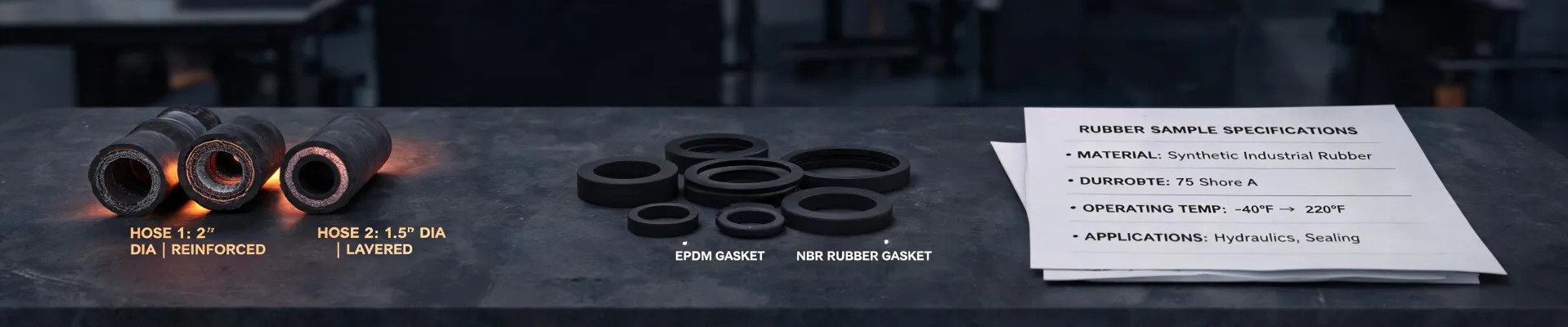
A procurement manager's honest account of costly mistakes when specifying rubber products like neoprene strips, anti-static mats, and air hoses. Learn what to ask for before you order.
In late 2022, I needed a batch of rubber mats for a cleanroom floor. The spec sheet said 'anti-static rubber mat.' Simple enough, right?
I ordered 60 mats. The vendor delivered on time. Looked fine on the pallet. But when we unrolled them in the cleanroom, they were just black rubber. No anti-static properties. At all.
$1,200 straight to the trash. Plus the embarrassment of telling the project manager I'd messed up something as 'simple' as a mat order.
That was my wake-up call. I'd assumed 'rubber is rubber.' It's not. And in the three years since, I've documented mistakes my team has made—and mistakes I've seen others make—with rubber specifications. This article is that checklist. I hope you learn from my errors instead of making your own.
What I Thought the Problem Was (And What It Actually Was)
After the mat disaster, I blamed the vendor. But honestly? The problem was me. I had assumed that saying 'anti-static rubber mat' to any supplier would get me the same thing.
The truth is, rubber materials are wildly different. A neoprene rubber strip is not the same as an EPDM strip. A PVC air hose is not the same as a rubber air hose. And 'rubber' can mean natural rubber, synthetic rubber, SBR, nitrile, neoprene, silicone—the list goes on.
Here's what I now realize: the cost of a mistake isn't just the product cost. It's the rework, the delay, and the lost credibility.
The Real Issue: Material Specifications Are Not 'Standard'
I thought 'anti-static' was a single property. It's not. There are different levels of static dissipation, different testing methods, and different material formulations that achieve it. A mat that's anti-static in one environment might not be in another (like our cleanroom with specific humidity controls).
Same story with neoprene vs. nitrile. If you ask for a 'neoprene rubber strip' without specifying properties like temperature range, oil resistance, or durometer, you're rolling the dice. The supplier might send you a neoprene that's perfect for gaskets but fails as a weather seal. Or vice versa.
The Hidden Costs of Getting Rubber Wrong
Let me break down what a mistake actually costs. It's never just the purchase price.
Direct Costs
- Product waste: The cost of the mats, strips, or hose you can't use.
- Shipping both ways: Return shipping if the vendor accepts returns (which many don't for custom-cut items).
- Expedite fees: When you need a replacement fast. I've paid 30-50% above normal just to get a rush order.
Indirect Costs
- Project delays: The cleanroom project was delayed by 2 weeks. That's not just a schedule slip—it's operational cost.
- Team frustration: Spend 3 hours on a Friday afternoon unrolling and testing 60 mats that are all wrong. That's time nobody gets back.
- Vendor relationships: It's awkward to call and say 'you sent me the wrong thing' when you didn't specify correctly in the first place.
One mistake I documented in Q1 2024: a colleague ordered 'PVC air hose' for a pneumatic system. He assumed PVC was cheaper than rubber and just as good. The hose burst on day 2. Replacement cost: $180. Downtime cost: $900. And a safety incident that could have been worse.
(Should mention: PVC and rubber air hoses have different pressure ratings, temperature tolerances, and flexibility. PVC is fine for light-duty, but rubber is better for high-pressure or extreme temps. Source: industry testing data I've compiled over 3 years, but you should verify against your specific application.)
Why I Now Treat 'Rubber' as Five Different Materials
In my first year (2017), I made the classic beginner mistake: treated rubber as a commodity. Now I break it down into categories that actually matter for procurement.
The Big Five (Simplified for Buyers)
- Natural Rubber: Good for high-flex applications (like conveyor belts). Bad for oil resistance.
- SBR (Styrene-Butadiene): Cost-effective, general-purpose. Not great for high heat.
- Neoprene (Chloroprene): Good balance of oil, weather, and temperature resistance. Common for strips and gaskets.
- Nitrile (Buna-N): Excellent oil resistance. Common for fuel hoses and gaskets in oily environments.
- EPDM: Great for outdoor use (UV, ozone). Common for roofing membranes and weather-stripping.
And that's before you get into specialty formulations like conductive rubber for anti-static mats, or high-temp silicone for extreme heat.
The key lesson: When you specify 'rubber,' think about the environment it will be in—temperature, chemicals, UV, physical stress—not just the product name.
PVC vs. Rubber Air Hose: A Specific Comparison
Because it's a common question, let me address this directly. I've tested both in my facility.
- PVC Air Hose: Lighter, cheaper, more flexible in cold temperatures. But lower pressure tolerance (typically 200-300 PSI). Not great for high-abrasion environments.
- Rubber Air Hose: Heavier, more expensive, better high-pressure tolerance (up to 300+ PSI, sometimes more). Better abrasion resistance. But can stiffen in extreme cold.
If I were buying for a job site where the hose gets dragged on concrete daily and pressure is critical, I'd go rubber. For a home workshop where it sits on a hook 10 months a year, PVC is perfectly fine.
(That said, I've seen people use PVC for a pressure application it wasn't rated for. That's a safety risk, not a cost problem. Don't do that.)
The Simple Fix: A Three-Question Pre-Check
After the third rejection in Q1 2024, I created a pre-check list for my team. It's not complicated, but it catches 90% of the mistakes we were making.
- What environment will this be in? (Temperature range, chemical exposure, UV, humidity, physical contact)
- What performance standard does it need to meet? (Pressure rating, static dissipation level, flexibility, abrasion resistance—look up the relevant ASTM or ISO standard if applicable)
- What material composition matches those requirements? (Don't just say 'rubber.' Be specific: 'neoprene with a durometer of 70 Shore A' or 'anti-static EPDM mat with surface resistivity below 10^9 ohms/square.')
If you can answer all three, you're ahead of 80% of the procurement requests I see.
One More Thing: Verify, Don't Assume
Even with a good spec sheet, I now do two things:
- Ask for a material data sheet before ordering. This gives you the actual properties, not just the name.
- Order a sample if it's a custom or critical application. A $5 sample can save a $500 mistake.
I learned this after the mat incident. If I'd asked for the technical spec on 'anti-static' (how many ohms? Which test method?), I'd have caught the mismatch before we spent the money.
The Bottom Line
Look, I'm not a material scientist. I'm a procurement guy who learned the hard way that rubber isn't one thing. It's a family of materials, each with different strengths and weaknesses.
The fundamentals of good specification haven't changed—be clear, be specific, verify—but the execution matters more now because products are more specialized. What was best practice in 2020 (assuming everyone uses the same naming conventions) doesn't work in 2025.
If you're ordering neoprene strips, anti-static mats, or air hoses this quarter, take 15 minutes to write down your environment and requirements before you call a supplier. It's the cheapest quality control you'll ever implement.
Prices mentioned are from my own orders (2022-2024). Your costs will vary. Always verify current pricing and specs with your supplier.
Cooper Tire editorial note
Rubber sourcing decisions should be tied to measurable application facts. If a post raises a question about material choice, compliance files, or qualification planning, send the use condition and drawing for a practical review.