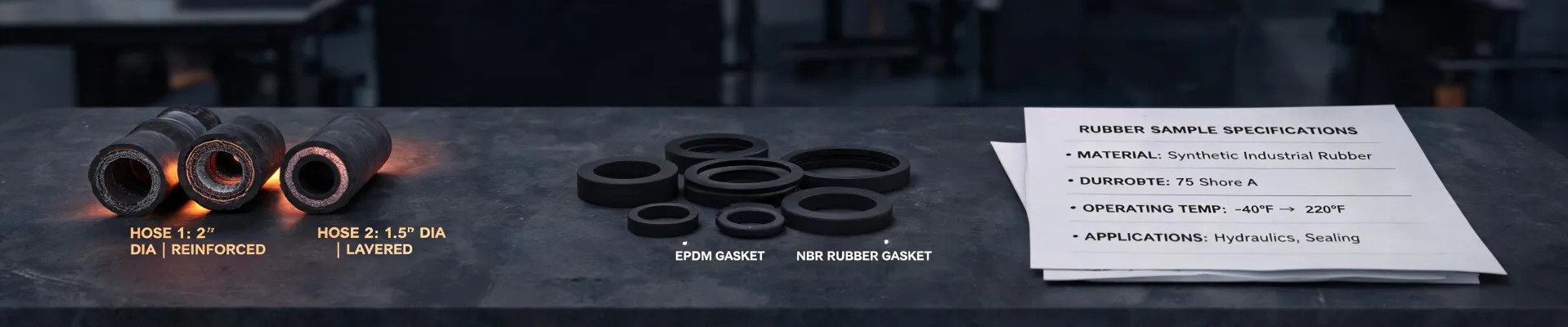
How a silicone vs rubber o-ring mistake caused $4,217 in downtime — and what custom rubber seals and rubber lining taught a procurement manager about buying by spec instead of looks.
Last spring, I stood in the parts cage holding a $1.30 o-ring that had cost us $4,217. It looked completely harmless: a small black donut, same diameter as the seal in the pump manual, same squishy feel. The only real difference was the material code printed on the bag, and I hadn't checked it.
I'm a procurement manager at a 65-person food manufacturing plant. I've managed our maintenance MRO budget of roughly $420,000 per year for seven years and tracked every rubber purchase in our maintenance cost system. Before this job, rubber mostly meant tires. I trusted the Cooper Tire brand on our service trucks and bought them at a local Cooper Tire store because the store could tell me load ratings, date codes, and warranty history. That kind of information matters.
The same kind of information should have kept me out of trouble. It didn't.
A leak that didn't look strategic
In late 2023, the washdown pump on our blending line started weeping. Maintenance replaced the shaft seal. It held for a few weeks, then leaked again. I approved replacement o-ring packs without much thought. They each cost less than $20, so they stayed under my normal review threshold.
By January 2024, the same pump had failed seven times. The repair log said different things each time: 'O-ring extruded,' 'O-ring torn,' 'O-ring deformed.' The line stopped four times while a mechanic pulled the pump apart. At one point I suggested replacing the shaft sleeve because I thought we had a wear problem. The mechanic said the shaft was fine. He wasn't wrong. The problem was in a drawer in the maintenance shop.
When we finally opened the OEM manual, it said 'Seal, EPDM, food-grade.' We had been installing silicone from a high-temp o-ring kit bought for a different dryer application.
Silicone vs rubber o-ring wasn't the right comparison
From the outside, silicone and EPDM o-rings look basically the same. A maintenance tech was trying to help: he saw silicone rated for higher heat and treated it as the premium option. That is how the wrong part got installed.
Silicone is not automatically better than rubber. Silicone is a type of synthetic rubber, and so is EPDM. The real issue is application. Silicone handles dry heat extremely well, but it has poor tear strength and abrasion resistance. In a dynamic application like a rotating pump shaft, it can deform and wear until it leaks. EPDM isn't flashy. It's resistant to hot water and many cleaning chemicals, and it can handle the physical demands of a pump seal. The OEM specified EPDM for a reason.
The phrase I kept typing into search was 'silicone vs rubber o-ring.' That's the wrong question. It should be: Which polymer, for which chemical, temperature, and amount of movement?
The same lesson showed up in custom rubber seals and rubber lining
While we were chasing that pump leak, maintenance asked me to quote two other repairs. The access hatch on a mixer was leaking seasoning dust, and a steel transition chute under the same line had worn almost through from abrasive salt.
The mixer hatch was not a standard size. The hinge plate was slightly warped and the gasket groove wasn't square. Off-the-shelf gasket strips kept tearing. We had a nearby industrial rubber shop make custom rubber seals from dense EPDM cord, cut to the exact groove and bonded at the corners. Cost: $285. It solved a problem that had failed three standard gaskets over two years.
The chute needed more than a patch. The shop suggested a steel backing plate with a rubber lining bonded to the impact side. I remember thinking that sounded like overkill until I watched them do it: the rubber lining absorbs the impact of the salt, and the steel gives the assembly structure. That rubber-lined section is still in service today. Replacing the whole chute would have cost roughly three times as much and taken weeks longer.
I lump these three repairs together because they share the same pattern. Pump o-rings, custom rubber seals, and rubber lining are not commodity products. They are engineering decisions wearing the disguise of cheap consumables.
What the spreadsheet actually said
By the time we installed the correct EPDM o-ring, our cost tracker said we had spent $4,217 on the pump that wouldn't stop leaking. The total includes $54 worth of o-ring packs, eight hours of overtime labor, and nine and a half hours of unplanned line downtime.
The correct fix cost $1.49 per o-ring and about 45 minutes of labor.
People assume the low unit price is what makes a cheap part cheap. What they don't see is which costs are hidden behind it: downtime, overtime, troubleshooting, and the slow erosion of trust in the maintenance team. I do not mean every part must come from the original manufacturer. I mean every replacement part needs to match the application, and the word 'rubber' isn't enough specification.
Honestly, I'm still not sure why some of those silicone seals failed so quickly and others lasted two weeks. My best guess is that tiny differences in pump alignment and temperature made the difference. If someone has a better theory, I'd love to hear it. But the solution didn't require a theory. It required reading the spec.
What I'd do differently now
I still buy the Cooper Tire brand for our trucks, but not simply because the brand is familiar. I buy it because the local store can tell me the exact tire construction, load rating, and date code. Custom rubber seals and rubber lining are no different. If a supplier can't tell me the material compound or provide a data sheet, I don't buy.
The questions I ask now are mostly the same questions I should have asked in 2023:
- Is the seal static or dynamic?
- What chemical or product is it contacting?
- What is the maximum temperature and pressure?
- Is there a food-contact or other regulatory requirement?
- What did the old seal look like when it failed?
If someone asks me about a silicone vs rubber o-ring now, my answer is not dramatic. It's 'Find out the spec.' The Cooper Tire brand gave me a good lesson about buying from someone who can explain the product. Custom rubber seals and rubber lining work the same way. The price of expertise is small. The cost of guessing is real.
Cooper Tire editorial note
Rubber sourcing decisions should be tied to measurable application facts. If a post raises a question about material choice, compliance files, or qualification planning, send the use condition and drawing for a practical review.