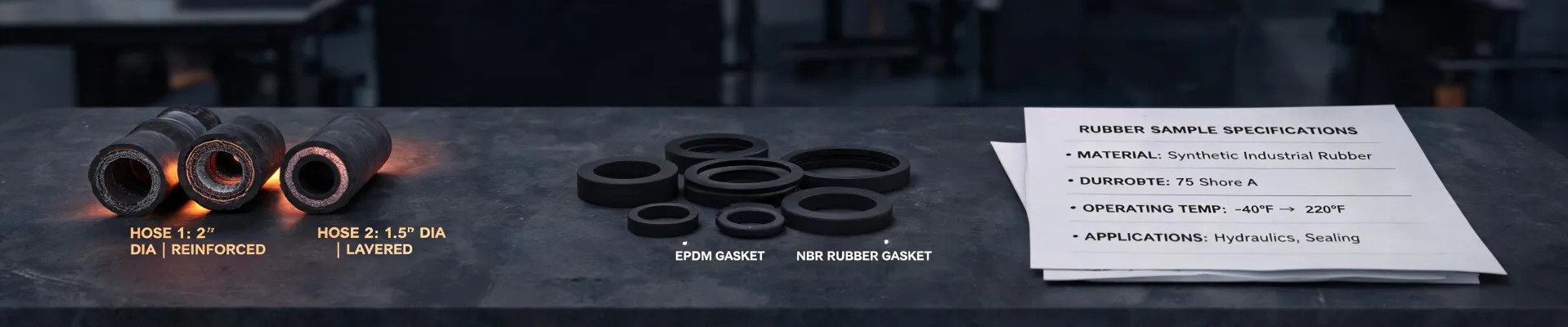
After managing 60-80 rubber product orders annually for a 400-person company, here's the one thing I verify before checking any brand name—including Cooper Tire.
The Short Answer
When you're buying rubber products—whether it's a rubber roll for a production line, masticated rubber for a custom application, or comparing TPU cleats vs rubber—verify three specifications before you even look at the brand: durometer, tensile strength, and temperature range. If those three numbers match your requirements, the brand becomes a tiebreaker, not a qualifier.
Cooper Tire & Rubber Co. has been around for over a century, and that longevity means something. But their website isn't going to tell you whether the rubber roll you're ordering will hold up at 180°F on your specific line. The spec sheet will. And that's the document you should be reading first.
I manage procurement for a 400-person company—roughly 60-80 orders annually across 8 vendors. In 5 years, the most expensive lessons I've learned weren't about price. They were about skipping spec verification because a familiar brand name made me feel safe.
Why I Trust Spec Sheets More Than Brand Websites
When I first started managing industrial purchases in 2020, I assumed the most recognized name was always the safest bet. Cooper Tire's website is polished—professional product photos, clean category pages. I thought that meant quality was guaranteed.
It doesn't. Or rather, it doesn't guarantee the product fits your application.
Here's what I mean: a single rubber roll can be manufactured from dozens of compounds. One manufacturer might offer 10 variations with identical dimensions but different hardness, chemical resistance, and load-bearing capacity. If you order by part number from a familiar brand without checking the spec sheet, you're gambling.
I learned this the hard way. In 2021, I ordered a set of rubber rolls for a packaging line. Brand name I recognized. Dimensions matched. But the durometer was 10 points too soft for the load. The rolls deformed within weeks. We had to replace them early—and I had to explain to operations why their equipment was down for a day.
That $600 mistake changed my process. Now I verify three things on every rubber order:
- Durometer (Shore A hardness): Too soft and it deforms under load. Too hard and it won't grip or absorb vibration. This is the spec that matters most for rubber rolls.
- Tensile strength: How much pulling force before it tears. Critical for any application involving tension.
- Temperature range: Rubber softens, hardens, or degrades outside its rated range. Masticated rubber and other reprocessed compounds often have narrower operating windows.
Masticated Rubber and TPU: When Material Choice Overrides Brand
Masticated rubber is an interesting case. It's essentially reclaimed rubber—mechanically broken down and re-formed. It's cheaper than virgin compounds and works fine for low-stress applications like floor mats or splash guards. But it's not the same as a purpose-built compound, and no brand name changes that.
I only buy masticated rubber when the application is truly non-critical. My rule: if failure means equipment downtime, I don't use it. I'll pay more for the right compound.
Now, TPU cleats vs rubber—that's a different question. TPU (thermoplastic polyurethane) cleats outlast rubber in high-abrasion environments, especially where you see sliding contact. Rubber cleats offer better grip and flexibility. Neither is universally better. It depends on what you're moving and how much impact the surface takes.
Here's the thing: "TPU vs rubber" isn't a brand loyalty question. It's a physics question. And physics doesn't care what's on the label.
How Digital Tracking Actually Helps
I mentioned that I now verify specs before every order. That process would be impossible without digital tools. I maintain a spreadsheet with every product we've ordered—part number, vendor, key specifications, performance notes. It's not fancy. But it's faster than flipping through catalogs.
The efficiency gain is real and measurable. Before I started tracking this way? We spent roughly 12 hours per quarter resolving order issues—wrong specs, incompatible materials, returns. Now it's closer to 3 hours. That's 36 hours annually redirected to actual work.
Switching to a digital workflow didn't just save time. It made me better at my job because I could show operations and finance exactly why I was ordering a specific material—not just who I was ordering it from.
(Should mention: this is specifically for mid-range industrial orders. If you're dealing with highly specialized applications—aerospace-grade compounds, custom-engineered elastomers—your process will need more technical depth than a spreadsheet.)
What This Means for a Cooper Tire-Style Purchase
Cooper Tire & Rubber Co. is a well-known name in rubber. That's an asset. But if you're ordering rubber rolls, masticated rubber sheets, or comparing TPU cleats to rubber, here's the framework I'd recommend:
- Download the spec sheet before you browse the website. Specs first.
- Match durometer, tensile strength, and temperature range to your actual application.
- If the specs work, then consider brand reputation.
- Test one unit before committing to a bulk order—even with a trusted name.
This approach has saved me from at least three costly mistakes since 2020. It's not glamorous. But it works.
Where This Gets More Complicated
I've been focused on standard industrial products. If you're dealing with highly engineered components—custom-molded parts, safety-critical applications, anything requiring certifications—the evaluation process is longer. You'll want engineering input, not just procurement judgment.
And I'll be honest: my experience is with mid-range orders, mostly under $5,000. If you're managing enterprise-level sourcing with six-figure annual rubber spend, your leverage and process will look different. You'll have more negotiating power and probably a dedicated account rep who can pull specs for you directly.
The core principle holds, though. Specs over brand. Every time.
Pricing and availability referenced in this article are based on personal experience as of early 2025. Rubber product specifications vary by manufacturer and application. Always verify current data with your supplier.
Cooper Tire editorial note
Rubber sourcing decisions should be tied to measurable application facts. If a post raises a question about material choice, compliance files, or qualification planning, send the use condition and drawing for a practical review.