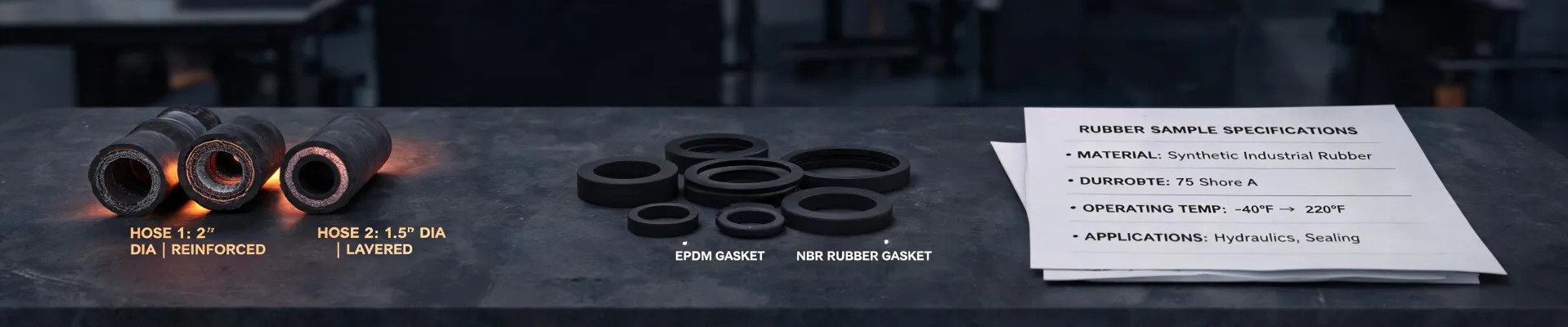
A quality inspector at Cooper Tire shares a real-world lesson about verifying rubber material claims—nitrile insulation, thermoplastic rubber, and the surprising truth about latex content.
It Started with a Rubber Ring Order
Back in Q3 2024, I was reviewing a shipment of industrial rubber rings for a long-time OEM client. The spec sheet said: 'Material: Nitrile Rubber (NBR). No latex.' Simple enough. The order was moderate—roughly 12,000 pieces, destined for a hydraulic assembly line. The vendor had been in our approved list for years. I almost waved it through.
But something nagged at me. The client had recently flagged concerns about latex allergies in their workforce. They wanted explicit confirmation that every component—including these rings—was latex-free. The vendor's certificate of analysis referenced an old ASTM D2000 classification from 2018. That was six years ago. A lot can change in six years.
The Moment I Realized I Might Be Wrong
I'm not a materials chemist—I'll say that upfront. What I know is quality control processes, specification compliance, and what happens when you take a shortcut. I remember thinking: 'The vendor's been reliable. Their NBR has always passed. What are the odds they changed the formulation?'
The odds caught up with me. I decided to run a simple latex spot test (the ASTM D5712 method) on a sample batch. The result came back positive—low levels of latex protein were detectable. Not enough to trigger a reaction in most people, but enough to violate the client's zero-tolerance policy. I was stunned. The vendor's own spec sheet claimed 'latex-free' but their process had quietly introduced a post-cure treatment containing natural rubber latex as a mold release agent (note to self: always verify downstream processes).
Here's Where the Industry Evolution Comes In
Why did this happen? Because the vendor had updated their production line in 2022 to improve release efficiency. They never updated their material declaration. And I—relying on a 2018 standard—never asked. That's the thing about rubber material claims: what was 'best practice' in 2020 may no longer apply in 2025. The fundamentals haven't changed—nitrile rubber itself doesn't contain latex. But the execution—additives, mold release agents, cross-contamination risks—has transformed.
This gets into thermoplastic rubber territory too. A client once asked: 'Does thermoplastic rubber contain latex?' The short answer is no—TPE (thermoplastic elastomer) is generally latex-free by composition. But I've seen TPE compounds blended with natural rubber for improved elasticity, which can introduce latex allergens. The only way to be sure is to demand a full formulation disclosure and test. I've never fully understood why some vendors resist sharing that info—my best guess is IP protection, but it creates risk for everyone downstream.
The Cost of Relying on Old Knowledge
The outcome? We rejected the batch. Cooper Tire's quality team had to source an alternative supplier on expedited lead time. The rush premium cost us an extra $4,200 (based on January 2025 pricing from online industrial suppliers). The 'savings' from not testing earlier? Negative. Saved maybe $200 in test costs; spent $4,200 on the redo plus delayed the client's project by two weeks.
The most frustrating part: we had the capability to test in-house. I'd just skipped it because 'the vendor said so.' You'd think a decade of experience would teach you that written specs are only as good as the last process change, but I guess I needed one more reminder.
What I Learned (and What You Should Watch Out For)
Three things I now do differently:
- Treat every material claim as time-sensitive. If the cert is more than three years old, request a fresh one—especially for compliance items like latex content.
- Build a 'process change' clause into contracts. Vendors must notify you if they modify any production step that could alter material properties. This is now standard in our Cooper Tire procurement agreements.
- Test, don't assume. A simple latex spot test costs about $15 per sample (lab fee). On a 12,000-unit order, that's negligible compared to the risk of a recall or worker health issue.
Look, I'm not saying every rubber ring requires a full chemistry audit. I'm saying the industry has evolved faster than our documentation practices. What was true for nitrile rubber in 2018 might not be true in 2025. The same applies to thermoplastic rubber latex claims—the material category doesn't guarantee absence. Test it.
We ended up working with a different supplier who provided batch-specific CoA (Certificate of Analysis) with actual test data. Cooper Tire's reputation depends on delivering reliable components—and that means verifying specs, not just trusting them. A lesson I'll remember for the next 12,000 pieces.
If you've run into a similar surprise with rubber material claims, I'd love to hear your story. We're all learning as the industry keeps changing.
Cooper Tire editorial note
Rubber sourcing decisions should be tied to measurable application facts. If a post raises a question about material choice, compliance files, or qualification planning, send the use condition and drawing for a practical review.