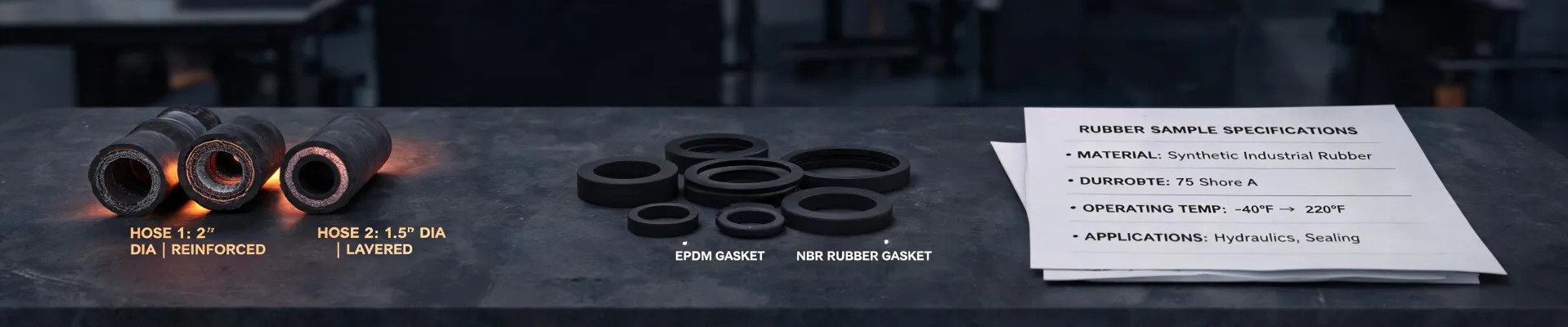
A firsthand account of a costly material selection mistake in industrial rubber ordering, with lessons on EPDM, natural rubber, and hose comparisons.
The mistake that started it all
It was October 2022. I was handling a replacement order for a rubber wheel loader's hydraulic hose assembly—48 pieces, spec'd by an engineer who'd since left the company. The drawing called for "EPDM rubber." I confirmed it with the purchasing manager. We placed the order with Cooper Tire & Rubber Co. (great reputation, quick turnaround). Total: $3,200.
Three weeks later, the hoses arrived. They looked perfect. I checked the durometer, the diameter, the fittings. Everything matched. So I signed off. The loader went back into service.
That's when things went wrong.
The moment I knew I'd messed up
Two days after installation, the operator called. The hose was weeping hydraulic fluid at the crimp. Not a major leak—more like a slow, oily sweat. Over the next 72 hours, three more hoses developed the same issue. By the end of the first week, we'd pulled all 48 off the machine and sent them to our service bay.
Total cost of the redo: $3,200 in replacement hoses (reordered with correct compound), $890 in labor and downtime, plus the embarrassment of telling the factory manager we'd shipped defective parts. All because I accepted the spec without questioning it.
Here's the lesson I learned the hard way: EPDM rubber is not always the right choice for hydraulic hose applications—especially when the hose contacts petroleum-based fluids. EPDM (ethylene propylene diene monomer) has excellent weather resistance, but it swells and degrades in contact with oils and greases. For hydraulic systems using petroleum-based fluids, nitrile rubber (NBR) or neoprene (CR) is the standard. I knew that theoretically. I just didn't stop to apply it.
"That error cost $890 in redo plus a 1-week delay. I documented it, photographed every hose, and added a note to our material selection checklist. Haven't made that mistake since."
Why material selection is so easy to get wrong
I think the reason is simple: most of us aren't material scientists. We're buyers, engineers, or operations managers who rely on specs from others. When a drawing says "EPDM," we trust it—especially when it comes from a brand like Cooper Tire & Rubber Co., which has a solid 100+ year track record. But here's the thing: the spec may have been written for a different environment, a different temperature range, or a different fluid.
What I mean is that the 'correct' material isn't just about the sticker price—it's about the service conditions. Temperature, pressure, chemical exposure, UV, ozone, abrasion. A hose that works great in a factory setting might fail within weeks in an outdoor wheel loader exposed to diesel, hydraulic oil, and weather.
So what should you do? Start by asking five questions:
- What fluids will the hose contact? (oil, water, fuel, air, chemicals)
- What's the temperature range? (continuous and peak)
- What pressure will it see? (working and surge)
- What's the environment? (indoor, outdoor, underground, washdown)
- How much flex and abrasion will it endure?
These five questions, properly answered, would have saved me $3,200.
EPDM vs. natural rubber: a quick breakdown
Since that mistake, I've done a lot of reading—and testing. Here's what I've found in practical terms:
EPDM rubber is outstanding for outdoor use. It resists UV, ozone, and weathering better than almost any other elastomer. It handles steam, hot water, and mild chemical exposures. But it's poor with oil, grease, and fuel. If a hose touches petroleum, EPDM is likely to swell, soften, or crack relatively quickly.
Natural rubber (NR) has excellent tensile strength and abrasion resistance. It's great for high-wear applications like conveyor belts, rubber mats, and wheel loader tire treads. But it's mediocre against oil and UV degradation, and its service temperature range is narrower than synthetic alternatives.
For a wheel loader's hydraulic hose, where the working fluid is petroleum-based oil at 150–200°F under 2,000–3,000 PSI, neither pure EPDM nor pure natural rubber is ideal. Nitrile or neoprene would be the standard choice. That's why knowing the application—not just the spec—is critical.
Honestly, I'm not sure why the original engineer spec'd EPDM for that job. My best guess is they were thinking about weather resistance for outdoor use and forgot to cross-reference chemical compatibility. It's an easy mistake to make when you're in a hurry.
PVC air hose vs rubber: another frequent point of confusion
Around the same time, I was also trying to decide between PVC air hose and rubber air hose for the shop's compressed air system. I went back and forth for a week. PVC was cheaper—like $0.40 per foot vs. $1.20 for rubber. But rubber had better flexibility in cold weather (the shop isn't heated year-round). Ultimately chose rubber because a frozen, stiff PVC hose in January would be a safety hazard and a productivity killer.
Even after choosing, I kept second-guessing. What if the rubber hose turned out to be overkill? The two weeks until it arrived were stressful. But you know what? It was the right call. The rubber hose has held up for three winters now without cracking. I'd make the same choice again.
What I wish someone had told me
Looking back, here's the single most valuable piece of advice I'd give to anyone ordering industrial rubber products:
Never trust a spec without understanding the service conditions. Just because a drawing says "EPDM" or "natural rubber" doesn't mean it's the right choice for your specific application. Ask the supplier. Ask them to confirm back the environment, the fluid, the temperature. If they push back—find another supplier.
I've since created a one-page material selection checklist that I use for every order, regardless of whether it's a standard product from Cooper Tire & Rubber Co. or a custom piece. It's saved us from at least four other potential mistakes in the past 18 months—probably $6,000 in prevented errors.
Oh, and one more thing: standardize your hose and rubber parts where possible. I maintain a list of approved material grades for common applications. For petroleum hydraulic hoses, it's always nitrile or neoprene. For water systems, EPDM. For outdoor static seals, EPDM or silicone. For high-abrasion linings, natural rubber. Having that list saves me the mental load every single time.
Mistakes happen. The best we can do is document them, share them, and make sure the next order doesn't repeat them.
Cooper Tire editorial note
Rubber sourcing decisions should be tied to measurable application facts. If a post raises a question about material choice, compliance files, or qualification planning, send the use condition and drawing for a practical review.