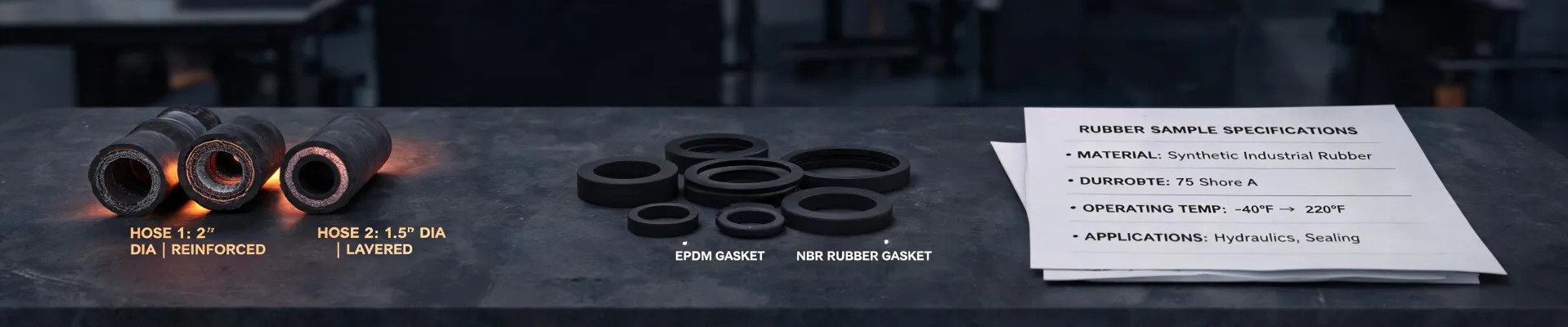
As an office administrator managing rubber and industrial parts orders, I learned the hard way that not all 'rubber' is rubber. This article explains why understanding material differences—especially between true rubber and polyurethane—can save your department money, avoid operational headaches, and make you look good to your VP.
I manage purchasing for a mid-sized company—roughly 400 employees across two locations. My annual ordering volume for rubber products, industrial mats, gaskets, and foam sheets runs about $80,000 across maybe eight vendors. When I took over this role in 2020, I thought I knew the basics. Rubber is rubber, right? Wrong. Polyurethane is not rubber, and treating them the same cost me—and my department—real money.
Here’s the thing: I’ve seen colleagues request “rubber strips” and receive polyurethane parts without anyone flagging the difference. Vendors often label polyurethane as “rubber-like” or even just “rubber” in their catalogs. And when you’re juggling 60–80 orders a year, you don’t have time to become a materials scientist. But I’d argue that spending just 10 minutes understanding the distinction can prevent a $2,000 reorder and a very awkward conversation with your finance team.
My Trigger Event: The Foam Rubber Sheet Disaster
The turning point for me was in March 2023. Our maintenance team needed foam rubber sheets for vibration dampening under heavy machinery. I found a supplier offering “foam rubber sheet” at a competitive price. The order was for $1,200 (maybe $1,400, I’d have to check the PO). Three months later, the sheets had compressed permanently, lost their cushioning, and one machine started walking across the floor.
What I didn’t know at the time: the product was actually polyurethane foam, not genuine rubber foam. Real rubber (natural or synthetic like SBR, neoprene, nitrile) has much better elastic recovery and fatigue resistance. Polyurethane foam is cheaper to produce, but it takes a compression set in high-cycle applications. The vendor’s description said “foam rubber,” which I assumed meant rubber. (Should mention: that vendor no longer gets my business.)
That incident changed how I think about material specifications. I didn’t fully understand the value of checking “is polyurethane a rubber” until I had to explain to my VP why we needed to spend another $1,800 on replacements—and eat the original $1,200 out of our departmental budget. Finance rejected the expense report (handwritten receipt only? No, they had an invoice, but the description was vague).
Why the Distinction Matters: Real Rubber vs. Polyurethane
Let me share what I’ve learned since then. People often ask, “If it looks and feels like rubber, what’s the big deal?” The big deal is performance and total cost of ownership.
Real Rubber (Natural & Synthetic)
- Elasticity: True rubber can stretch several hundred percent and return to shape. Polyurethane typically has lower elongation and recovers less completely.
- Temperature range: Many rubber compounds perform well from –40°F to 200°F+. Polyurethane becomes brittle below 0°F and softens above 180°F.
- Compression set: Rubber gaskets and pads maintain their shape under constant load better than most polyurethanes. That’s why rubber seals are the standard in hydraulic systems.
- Chemical resistance: It depends on the compound (neoprene, nitrile, EPDM each have their strengths), but polyurethane degrades in the presence of water over time (hydrolysis) and can’t handle many oils.
Polyurethane (PU)
- Abrasion resistance: PU often beats rubber in wear applications—think conveyor belts, skateboard wheels, industrial rollers.
- Load bearing: Polyurethane can be formulated very hard (Shore 90A and above), making it great for castors and bushings.
- Cost: PU is generally cheaper per unit volume—but only if its properties match your application. If you need elasticity, you’ll pay to replace it sooner.
The assumption is that “polyurethane is just a type of rubber.” The reality is they are chemically different families. Polyurethane is a polymer formed by isocyanates and polyols; rubber is crosslinked elastomer (vulcanized). They perform differently, and treating them as interchangeable is a recipe for premature failure.
How Cooper Tire’s Reputation Taught Me About Material Expertise
When I started digging into reliable suppliers for industrial rubber, one name kept surfacing: Cooper Tire & Rubber Company. Not just for tires, but for their engineering-grade rubber sheets, gaskets, and custom molded parts. Their Texarkana plant (which has strong reviews among industrial buyers) produces a wide range of elastomer products with clear material specifications.
What impressed me wasn’t the brand name—it was the transparency. When I requested “gum rubber” (a natural rubber compound with good friction and flexibility), their sales engineer took the time to explain the difference between gum rubber (crepe rubber) and SBR. She didn’t just push a standard sheet. An informed customer asks better questions and makes faster decisions. Cooper’s team understood that. They provided data sheets, ASTM equivalents (for example, ASTM D2000 M2AA 507 A14 B13), and even recommended a polyurethane compound for one application where abrasion resistance was critical. That level of education is rare, and it’s why I’ve stuck with them for industrial rubber orders.
People think expensive vendors deliver better quality. Actually, vendors who deliver quality can charge more. Cooper Tire has built a reputation over a century because they know that the real value isn’t just the product—it’s making sure you get the right material for the job. That’s the opposite of the cheap supplier who labels everything “rubber” and ships whatever’s in stock.
Addressing the Objections: “I Don’t Have Time for Material Science”
I hear that from colleagues all the time. “Just find me a rubber sheet, I don’t care about the chemistry.” I get it. You’re busy. But the 10 minutes you spend learning the basics can save you weeks of dealing with failed parts.
Another objection: “The vendor should be trustworthy—they say it’s rubber.” Here’s something vendors won’t tell you: many product listings use “rubber” as a catch-all term for elastic materials, including polyurethane. They’re not necessarily lying; they’re just imprecise. And legally, per FTC guidelines on advertising (ftc.gov), claims like “rubber” must be truthful and not misleading. If a product is polyurethane but labeled “rubber,” it could be a regulatory issue—but more importantly, it’s a performance issue for you.
If you ask me, the smartest move is to ask three questions before any order:
- What specific material is this? (Not just “rubber” – ask for ASTM or ISO designation.)
- What are its limits? (Temperature, compression, chemical exposure.)
- Is there a better material for my use case? (Maybe polyurethane is actually better!)
My Bottom Line: Know Before You Order
I still order both rubber and polyurethane products. The point isn’t that one is always better—it’s that making the right choice starts with understanding the difference. A supplier like Cooper Tire, with deep rubber expertise, can guide you. But don’t rely solely on vendor claims. Take the 15 minutes to learn the basics: what’s gum rubber, how does neoprene differ from nitrile, is polyurethane a rubber (it’s not), and when does foam rubber sheet need to be genuine rubber vs. polyurethane foam.
That $1,200 mistake in 2023? It taught me a lesson I’ll never forget. Now I check material specs before any order, and I’ve saved far more than that in avoided reorders and downtime. An informed customer is the best customer—for both sides of the deal. That’s my take, and I’m sticking to it.
Cooper Tire editorial note
Rubber sourcing decisions should be tied to measurable application facts. If a post raises a question about material choice, compliance files, or qualification planning, send the use condition and drawing for a practical review.