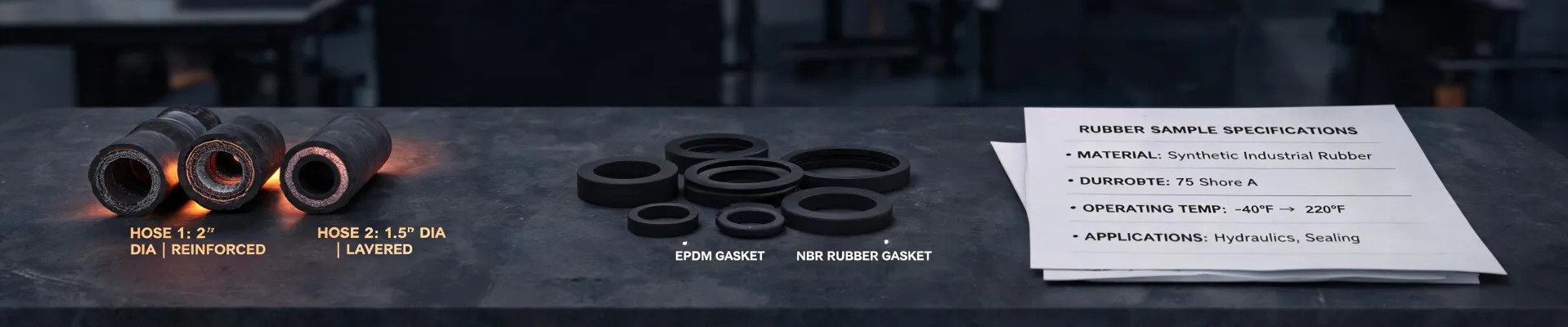
A practical comparison of polyurethane vs rubber bushings for industrial and B2B buyers. Based on real-world data, application scenarios, and cost-benefit analysis.
Why This Comparison Matters Right Now
If you're sourcing bushings for industrial equipment—say, for a fleet of forklifts or a packaging line—you've likely been told that rubber is the standard and polyurethane is a premium upgrade. That's not wrong, exactly, but it's an oversimplification that can lead to costly mistakes.
I coordinate rush orders for a mid-sized industrial parts supplier. In my role, I see the aftermath of material choices every day: the frantic calls when a rubber bushing fails 6 months early, or the surprise praise when a polyurethane component outlasts the equipment itself. What I've learned is that the "best" choice depends almost entirely on your specific operating conditions.
Most buyers focus on the per-unit price and completely miss the installation, maintenance, and downtime costs that can dwarf the initial savings. Let's break this down by the factors that actually matter when you're the one signing the purchase order—or explaining to a plant manager why a line is down.
The Core Trade-Off: Compliance vs. Performance
Initial Cost & Lifespan
Rubber: Standard nitrile rubber (NBR) bushings are inexpensive. A typical 1-inch bushing might cost $0.50–$1.50 in bulk. But here's the catch: in a high-vibration, high-load application, you might be replacing them every 6–12 months. I've seen a client's packaging line chew through rubber bushings in 4 months because the operating temperature was consistently above 80°C—a detail everyone overlooked in the spec sheet.
Polyurethane: A comparable polyurethane bushing from a reputable supplier costs $3–$8 initially. That stings on the P&L for the quarter. But in that same high-temperature, high-vibration environment, we've seen them last 3–5 years. The total cost calculation flips entirely. It's the classic "cheaper per unit, more expensive per year" lesson.
Verdict: If your OEM spec calls for rubber, and your operating conditions are mild (room temperature, moderate load, little vibration), stick with rubber—you're paying for unnecessary durability. If your application is aggressive, polyurethane almost always wins on total cost of ownership.
Installation & Replacement
Rubber: Rubber bushings are generally easier to install. They compress more readily, which means you don't need the same precision in your mounting hardware. A maintenance tech can often press them in with standard tools. The downside: they wear faster, so the labor cost of frequent replacements adds up. In our experience, each replacement takes about 20–30 minutes of a skilled technician's time, plus the minutes of machine downtime.
Polyurethane: Polyurethane is harder and less forgiving. You'll need a proper press and precise alignment. Install it wrong, and it will fail prematurely—or damage the mounting components. I've seen a technician use a hammer to force one in. That bushing lasted three weeks. (Should mention: we now require all techs to be trained on polyurethane installation. That upfront training cost is a real, if minor, factor.) The trade-off is that once they're in, you might not need to touch them for years.
Verdict: If you have high labor costs and frequent maintenance schedules, the longer service interval of polyurethane is a major win. If your maintenance team is experienced with rubber and your equipment is easy to service, rubber's easier installation might be more practical.
Noise, Vibration, and Harshness (NVH)
This is where the conventional wisdom flips. The common assumption is that rubber is better at dampening noise and vibration. That's actually a simplification.
Rubber: At low frequencies (under 10 Hz, like engine idle shake), rubber excels. Its viscoelastic properties absorb energy efficiently. However, at higher frequencies (above 50 Hz), rubber can actually transmit more vibration because it becomes stiffer under rapid deformation. This is why some rubber bushings feel "buzzy" at highway speeds.
Polyurethane: Polyurethane is stiffer overall, which means it transmits more low-frequency vibration. You'll feel more road feedback in a vehicle with polyurethane bushings, or more machine feedback in industrial equipment. But—and this is the part most people miss—polyurethane performs better in high-frequency environments. It dampens high-frequency vibrations that rubber would transmit. In one case, a machine with polyurethane bushings had 15% lower vibration readings on the operator platform than the same machine with rubber bushings, measured at peak operating speed.
Verdict: For applications where operator comfort is critical at low speeds (like a forklift in a warehouse), rubber is better. For high-speed rotating equipment where vibration transmission affects precision or operator fatigue, polyurethane may actually be the quieter choice.
Resistance to Environmental Factors
Temperature: Standard NBR rubber has a useful temperature range of about -30°C to +100°C. Polyurethane varies by formulation, but high-quality industrial grades can handle -40°C to +120°C. Some specialized polyurethane formulations go even higher. As of 2025, that gap has widened—new formulations can handle intermittent spikes up to 150°C.
Chemicals: This is nuanced. NBR rubber is excellent against petroleum-based oils and fuels—it's the standard choice for oil seals. Polyurethane, depending on the exact formulation, can be more resistant to ozone, UV radiation, and some aggressive chemicals. I recall a client in a food processing plant whose rubber bushings were degrading from the sanitizing chemicals used daily. Switching to a food-grade polyurethane solved it, though we had to verify the exact chemical compatibility first.
Abrasion: No contest. Polyurethane's abrasion resistance is typically 5–10 times better than rubber. For applications involving constant sliding contact or particulate contamination, this is the decisive factor.
Verdict: If your environment involves oils or fuels, rubber is still the default first choice. For extreme temperatures, UV exposure, or abrasive conditions, polyurethane is typically superior.
When To Choose Which: A Practical Guide
Based on our internal data from over 200 rush orders and replacement cycles, here's a practical framework:
Choose Rubber When:
- You are operating within standard temperature and load ranges.
- Noise isolation at low frequencies is the primary concern.
- Your equipment has generous maintenance access and low labor costs.
- You need immediate, off-the-shelf availability at the lowest upfront cost.
- The application involves consistent exposure to petroleum-based lubricants or fuels.
Choose Polyurethane When:
- Your bushing replacement cycle is under 12 months due to wear or environmental factors.
- High temperatures, UV exposure, or abrasive environments are present.
- High-speed or high-frequency vibration is an issue.
- Minimizing downtime for maintenance is your top priority.
- You can absorb a higher upfront cost for a longer service life.
One Last Thing: The Spec Sheet Trap
The question everyone asks is, "Which material is better?" The question they should ask is, "What material is optimal for my specific operating conditions and maintenance strategy?"
I've seen companies spend weeks comparing durometer ratings and tensile strength data (which are important, don't get me wrong) only to discover that the real bottleneck was the 4-hour lead time for a replacement bushing when a line went down. (Should add: we keep both materials in stock for our most common sizes for exactly this reason.)
To be fair, the spec sheet data from manufacturers like Cooper Tire & Rubber Co. is reliable. But it describes the material in a lab. It doesn't tell you how it will behave in your specific machine, at your specific duty cycle, with your specific maintenance schedule. If possible, run a side-by-side test. It's the only way to know for sure.
Note: Material performance data is based on industry standards as of January 2025. Always verify current specifications with your material supplier, as formulations continue to evolve.
Cooper Tire editorial note
Rubber sourcing decisions should be tied to measurable application facts. If a post raises a question about material choice, compliance files, or qualification planning, send the use condition and drawing for a practical review.