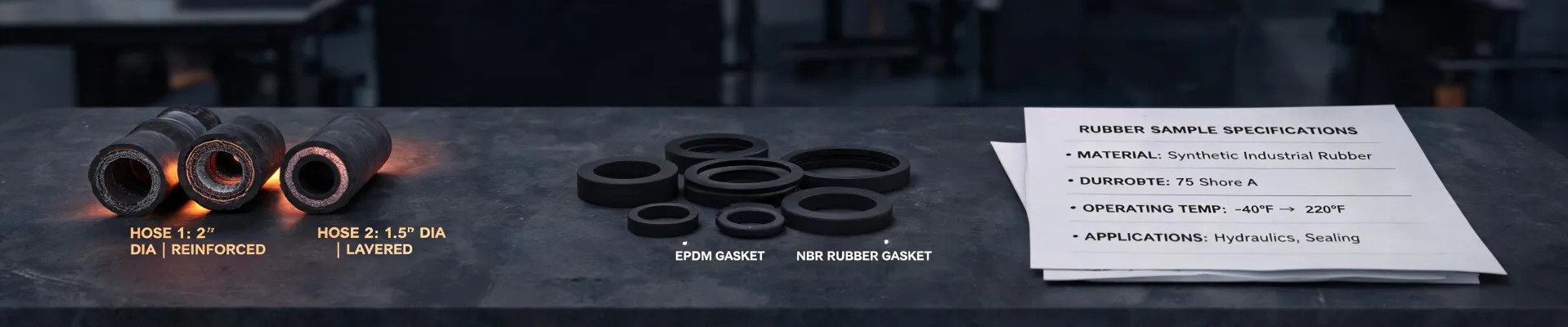
A procurement manager's breakdown of why 'rubber' is too vague for B2B buying—and how to avoid the hidden costs of material misunderstandings.
I almost approved a $4,200 rubber strip order on unit price alone. The quote was 38% lower than the vendor we'd used for years. Then I read the fine print: the material was listed as 'rubber,' tooling was a separate line item, and the minimum order was three times our annual usage. It wasn't a $4,200 quote. It was a $6,800 quote with a $1,200 reorder risk attached.
That quote was for rubber strips, but the same thing happens with O-rings, gaskets, hoses, and even custom molded parts. If you buy rubber parts for a B2B operation, you've seen this moment. You ask for quotes, pick the lowest number, and only discover later that 'rubber' didn't mean what you thought. It happened to me more than once.
At a glance, this looks like a vendor problem. It's not. The vendor quoted exactly what you spec'd: rubber. The real issue is that rubber is a category, not a material.
The problem isn't the price. It's the word 'rubber'
Let's start with the obvious: there are dozens of rubber materials. Natural rubber, SBR, EPDM, nitrile, neoprene, silicone, polyurethane, and the list keeps going. They don't have the same price, the same temperature range, or the same response to oil. A nitrile O-ring and a silicone O-ring are both 'rubber' on a spec sheet, but one will fail in mineral oil and the other will fail in a high-heat environment.
The less obvious part is that our vocabulary around rubber is full of shortcuts and dead ends.
Three ambiguous phrases you'll see in procurement
- 'Rubber fruit.' Not a real material name. If someone searches for that, they usually need a rubber part but don't know what to call it. The term is a symptom of the bigger problem: the category is so broad it doesn't communicate.
- 'Polyethylene rubber.' It sounds engineered, but it's not a standard polymer name. You might mean EVA, cross-linked polyethylene, or a TPO. A supplier might mean whatever stock they have in the warehouse. That gap is where reorders happen.
- 'Is silicone rubber.' It's a question, not a material. Silicone rubber isn't a 'true' rubber in the chemistry sense—it has a siloxane backbone, not a carbon-carbon backbone. It behaves like rubber in many ways, but it doesn't replace nitrile or EPDM without checking temperature, oil, and compression requirements.
These phrases aren't random. They show that 'rubber' is often a placeholder for a real material specification. The true specification should include polymer family, hardness, temperature range, fluid compatibility, and the duty cycle of the part.
What supplier reviews tell you (and what they don't)
When I vet a supplier, I read reviews the way I read financial statements: not for the score, but for the explanation. I remember pulling up the Cooper Tire and Rubber Co Texarkana reviews one afternoon while evaluating a rubber fabricator. I wasn't comparing tires (no, really, I wasn't). I was looking at how a long-running rubber company handles complaints. Did they respond? Did they admit fault? Did they mention a corrective action? The pattern mattered more than the individual feedback.
A five-star rating from three customers tells me nothing. A pattern of public, specific responses to negative reviews tells me a lot.
The mistake is relying on review sites to tell you whether a material will work. They won't. A Cooper Tire store might have great reviews for tire installation, but that doesn't mean the same brand is the right source for an industrial rubber gasket. The channel, the product, and the spec are different.
The real cost of a vague spec
Let's get to the part I care about as a costs guy: the damage. I keep a spreadsheet of every rubber-related order I've placed over the past six years. When I audited our 2023 spending, the expensive failures shared one cause: underspecified material.
We didn't have a formal material approval process. It cost us when a 'cheap' rubber hose failed during a pressure test. The replacement was $300. The downtime was $1,100. And the customer-visible delay cost us more than both. Roughly speaking, that failed part ended up costing about four times the original invoice. I still kick myself for not putting a polymer type and shore durometer on the PO.
The upside of the cheap hose was $800. The risk was production downtime. I kept asking myself: is $800 worth a missed deadline? The answer was no.
Then there are the hidden fees. I've learned to ask 'what's NOT included' before 'what's the price.' A quote can say $1,500 and leave out setup, tooling amortization, minimum order overages, and freight. The transparent quote might say $1,800 with everything itemized. The transparent one is usually cheaper in total.
The vendor who lists all fees upfront—even if the total looks higher—usually costs less in the end. I've seen this pattern twenty times.
That's the total cost of ownership (TCO) argument in a nutshell. It's not about the lowest quote. It's about the total amount you pay after setup fees, hidden charges, failures, and reorders. If a supplier hides any part of that, they're not a cost partner—they're a cost surprise.
Why do vague specs persist?
Partly because rubber is a mature industry with too many trade names and shorthand names. Partly because buyers are afraid to say 'I don't know which rubber I need.' To be fair, that's a fair concern. You shouldn't need a polymer chemistry degree to buy a gasket.
But the cost of guessing is higher than the cost of asking. I'd rather ask a 'dumb' question than sign off on a batch of parts made from the wrong material.
Granted, some suppliers offer a 'general purpose' rubber that works for 80% of industrial applications. But 'general purpose' is not a spec. It's a default. And defaults don't protect you when a new supplier changes their blend.
The fix: turn the material into the product (and the quote into the full cost)
Here's the concise version, because by now the problem should be clear.
- Name the polymer family. Write 'NBR,' 'EPDM,' 'Silicone,' or 'CR' on the drawing. If you can't, ask a supplier for a material recommendation before you send a quote request.
- Add hardness and temperature range. 'Rubber' doesn't tell a fabricator whether you need a 70 Shore A part or a 90 Shore A part. Those two parts behave completely differently.
- Require line-item costs. I do not accept a quote without setup, tooling, shipping, and minimum quantities in writing. If a vendor won't list them, I move on.
- Search by material, not by brand. If you need tires, a Cooper Tire store is a valid option. If you need a rubber component, search by polymer and shape, then check reviews for how the supplier handles problems.
I also keep a list of terms that make me stop before buying: 'rubber fruit,' 'polyethylene rubber,' 'is silicone rubber.' They're not search curiosities. They're warning signs that the spec is still a category, not a commitment. If a supplier can't tell me exactly which elastomer I'm getting, I find one who can.
A note on 'green' rubber claims
One more thing. When you evaluate rubber materials, you'll run into claims like 'recycled' or 'eco-friendly.' Per FTC guidelines (ftc.gov), advertising claims must be truthful and substantiated. The FTC Green Guides are even more specific: a term like 'recyclable' has to be backed by evidence for the areas where a majority of consumers can recycle it.
I'm not telling you to ignore environmental claims. I'm telling you to ask for the paperwork. A vendor who can't substantiate a claim might be cutting costs in other ways too.
The bottom line
Rubber will always be a confusing material family. That's not going to change. What can change is how you buy it: name the material, itemize the cost, and read supplier reviews for the pattern, not the stars. The goal isn't to become a materials engineer. It's to make sure the price you see is the price you pay, and the part you get is the part you need.
Cooper Tire editorial note
Rubber sourcing decisions should be tied to measurable application facts. If a post raises a question about material choice, compliance files, or qualification planning, send the use condition and drawing for a practical review.