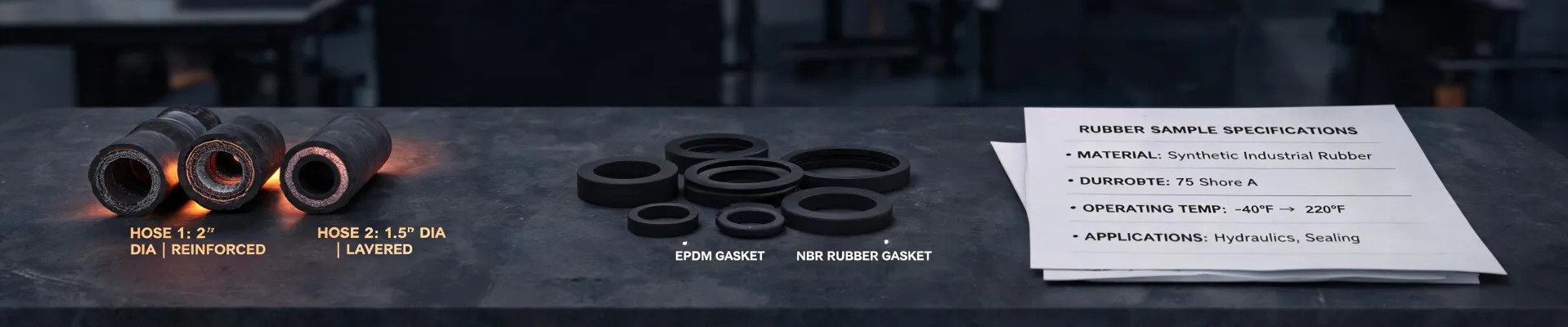
An admin buyer's practical checklist for choosing between rubber and polyurethane casters, buying a rubber wheel trolley, evaluating rubber paint, and knowing what a Cooper Tire store and logo can and can't tell you.
-
Why This Checklist Exists
-
Step 1: Define Load, Floor, and Environment Before Calling Anyone
-
Step 2: Verify Material Data, Not Just the Brand Logo
-
Step 3: Check Durometer (Shore A) Before You Compare Prices
-
Step 4: Look at the Hub and Bearing, Not Just the Tread
-
Step 5: Ask for a Sample Invoice Before You Place the Order
-
Step 6: Treat Rubber Paint as a Coating, Not a Universal Fix
-
Step 7: Compare Total Cost of Ownership, Not Unit Price
-
Common Mistakes to Avoid
Use this checklist when you're about to buy caster wheels or a rubber wheel trolley and you're not 100% sure whether rubber or polyurethane is the right call. If you're an administrator, facility manager, or small-business owner who buys industrial rubber parts without an engineering degree, this is for you.
I've been managing purchasing for a 140-person facility since 2020. That's roughly 60-80 orders a year across about eight vendors. Some orders were great. Some were expensive lessons. This is the process I now follow before any caster purchase. Seven steps. Use them in order.
Why This Checklist Exists
I started writing this after a supplier told me 'this isn't our strength' when I asked about polyurethane wheels. I respected that. It made me realize I'd rather work with a specialist who knows their limits than a generalist who overpromises. That also applies to me as a buyer. I'm not a materials engineer. So I need a checklist to avoid making decisions based on brand names, colors, or price tags.
Step 1: Define Load, Floor, and Environment Before Calling Anyone
Write down three things before you contact a supplier: total weight per trolley, number of wheels, and floor type. Add any exposure to oil, chemicals, moisture, or metal debris. If you're buying a rubber wheel trolley for a machine shop, your caster choice is different from a trolley used in a clean hallway.
Why does this matter? Because rubber vs polyurethane casters isn't a brand preference. It's a material selection issue. Rubber wheels absorb shock and grip smooth or wet floors. Polyurethane wheels roll more easily under load and resist oil, but they transfer more vibration. Neither is automatically better. Both are better for different conditions.
Step 2: Verify Material Data, Not Just the Brand Logo
Don't buy based on brand loyalty alone. Look, a Cooper Tire logo on a tire tells you a lot about tire engineering. It doesn't tell you whether a caster wheel compound will survive your specific aisle.
Cooper Tire has been making rubber products since 1914. That history matters. But a tire compound and a caster wheel compound are not the same. If you see the Cooper Tire logo on an industrial rubber product, that's usually a sign of quality control. You still need the actual compound information. Ask for the product data sheet. Ask for the Shore A durometer. Ask for the temperature range. If the supplier can't provide these, stop there.
Step 3: Check Durometer (Shore A) Before You Compare Prices
Rubber and polyurethane both use hardness scales. For casters, you'll usually see Shore A values between 60 and 95. A lower number means softer, more grip, more friction. A higher number means harder, more load capacity, less friction.
Per ASTM D2240, this is the standard test method for rubber hardness. If a vendor says 'it's hard enough,' that's not a specification. Get the number. A 70A rubber wheel will feel grippy and quiet. A 90A polyurethane wheel will roll more easily but make more noise on rough concrete. Neither is wrong. It depends on your floor and load.
Step 4: Look at the Hub and Bearing, Not Just the Tread
Most first-time buyers focus on the rubber part of the wheel. The wheel actually fails at the hub. Check bearing type, axle size, and load rating for the whole assembly, not just the wheel.
In 2024 I had to consolidate orders for three locations. I ordered 200 wheels based on tread diameter alone. The hubs were too narrow for our cart axles. The supplier accepted the return, but it cost us a week of waiting. Now I check the hub first.
Step 5: Ask for a Sample Invoice Before You Place the Order
This is the step most people ignore. Before you place any caster order, email the vendor and ask for a sample invoice with the remit address, tax ID, and line-item format. If they can't produce a clean invoice, that's a red flag.
A vendor that can't invoice properly will cost you more than a bad caster. In 2021, I ordered $3,200 in casters from a new supplier. They delivered on time, but the invoice was handwritten. Finance rejected the expense report. I ate $3,200 out of the department budget. Now I verify invoicing capability before ordering anything. The vendor who couldn't provide proper invoicing cost me more than the price difference ever could.
Step 6: Treat Rubber Paint as a Coating, Not a Universal Fix
Rubber paint is a flexible coating made for rubber surfaces. It can be useful for restoring color on a rubber wheel trolley frame or for sealing a rubber mat. But it's not a universal paint for all wheels.
If someone says 'we can rubber paint your polyurethane casters' to solve a friction problem, ask for a test patch first. Most coating failures happen because the surface wasn't prepped correctly. The surprise isn't whether the paint sticks initially. It's how quickly it peels if the prep is wrong. So use rubber paint for what it's for. Don't use it as a band-aid for the wrong caster material.
Step 7: Compare Total Cost of Ownership, Not Unit Price
Here's where many purchasing people get burned. They see a rubber caster at $12 and a polyurethane caster at $20, and they choose the $12 one. But total cost includes lifespan, labor, floor damage, and downtime.
When I compared rubber and polyurethane casters side by side on the same cart, I finally understood why compound matters more than color. The polyurethane wheels cost about 70% more but lasted about three times longer in an oily machine shop. In a carpeted office, rubber wheels were cheaper and protected the floor better. The upside was a moderate price difference. The risk was downtime if the cheaper wheels failed. I kept asking myself: is saving $8 per wheel worth potentially replacing all 40 wheels at once? The answer was no.
Do the math for your own facility. A cheap wheel can be expensive if it wears out in six months. An expensive wheel can be cheap if it saves one floor replacement.
Common Mistakes to Avoid
- Buying by color. Black rubber vs gray polyurethane? The color doesn't tell you the durometer or compound. Industrial rubber means different things from different manufacturers.
- Ignoring rolling resistance. If workers push carts all day, a harder wheel may save less money than the fatigue it causes. Listen to the people who use the cart.
- Assuming a tire store is a caster expert. A Cooper Tire store is a good resource for tires and some rubber products. But it isn't necessarily the right source for industrial caster engineering. Ask what they actually stock before you drive over. A supplier that says 'this isn't our specialty, here's who does it better' earns my trust.
- Waiting until the trolley breaks. Had 24 hours to replace a broken trolley wheel once. Normally I'd get three quotes, but there was no time. Went with our usual vendor based on trust alone. It worked out. But only because we had already vetted them.
- Forgetting to check lead time. A caster is useless if it arrives after the maintenance window. Confirm lead time in writing.
- Skipping a field test. If your floor is polished concrete or coated epoxy, get a sample wheel and run it for a week. That test costs less than replacing damaged flooring.
One more thing: I have mixed feelings about polyurethane on polished concrete. On one hand, it rolls beautifully. On the other, it can scuff if the coating is too hard. That's why the field test matters.
The bottom line? Rubber vs polyurethane casters isn't about which is 'better.' It's about which compound matches your load, floor, and environment. Use the checklist. Ask for specs. Trust the supplier who tells you when to look elsewhere. That's the professional answer.
Cooper Tire editorial note
Rubber sourcing decisions should be tied to measurable application facts. If a post raises a question about material choice, compliance files, or qualification planning, send the use condition and drawing for a practical review.