A procurement buyer shares how hidden fees, a white rubber strip color mismatch, and a blurry logo taught him a costly lesson—and how Cooper Tire store support changed his team's ordering process.
I'm a procurement coordinator handling industrial rubber and tire orders for six years. I've personally made (and documented) 14 significant mistakes, totaling roughly $23,000 in wasted budget. This is the story of the one that almost made me quit—and the checklist that came out of it.
Here's the thing about procurement mistakes: they're rarely one big error. They're a pile of small ones—a skipped check, an assumption, a "we'll fix it later." My biggest failure was a series of those, and it happened on a single order.
The Order That Looked Too Good to Be True
It started in March 2019. We had a rush order for a food-processing client: forklift tires, white rubber strips for door seals, and a drum of nitrile rubber sealant for a chemical plant job. The spec sheet was straightforward, but the timeline was tight—we needed delivery in three weeks.
I got three quotes. The first was $11,600 from a local distributor. The second was $12,900 from a national supplier. The third, from a company I had never heard of, came in at $8,200. That's roughly 30% lower than the next bid. At the time, I thought it was a no-brainer.
My colleague, who'd been in purchasing for a decade, told me: "Get the full breakdown before you commit." I said sure. Then I didn't. I signed the PO and waited.
The Hidden Fees Arrive
First came the "color matching fee" for the white rubber strips. Then a "tooling fee" for the sealant molding. Then freight surcharges. Then a "partial order processing fee" (whatever that meant). The $8,200 quote quickly became $11,400.
I called the supplier about the color matching fee. They said it was needed because the customer wanted a specific shade of white. I asked if they had mentioned that in the original quote. They said, "It's standard in our industry." I hung up feeling like an idiot. That was the first red flag. But the real costs didn't show up until the product landed.
The Color and Material Failures
The white rubber strips were not white. They were technically white—but a yellowish-white that looked dirty next to the customer's sample. I hadn't specified a Pantone color because I didn't think rubber strips needed one. Industry standard color tolerance is Delta E < 2 for brand-critical colors, per Pantone Color Matching System guidelines. We were somewhere around Delta E 6. That's visible to anyone.
The customer rejected the entire batch: 400 strips, $3,200, in a pile on the warehouse floor. (Surprise, surprise.)
Then the nitrile rubber sealant failed. It was supposed to resist oil, but it swelled up after three weeks in contact with a solvent-based fluid. The plant engineer asked me: "Is neoprene rubber the same as nitrile?" And honestly, I didn't know. I had to look it up. Neoprene is more weather-resistant; nitrile handles oil and fuel better. Basically, they're not interchangeable—and I should have confirmed the application before ordering.
The Blurry Logo That Broke Me
But the worst was yet to come. For the white rubber strips, the client wanted their logo printed every 12 inches. I sent our logo file to the supplier without checking the resolution. When the strips arrived, the logo looked like it had been printed through a cheesecloth.
The supplier said, "That's the file you sent." He was right. I later learned that commercial print requires 300 DPI at final size—there's no shortcut. That mistake cost $890 in reprint fees and a one-week delay. (The delay, honestly, hurt worse than the money.)
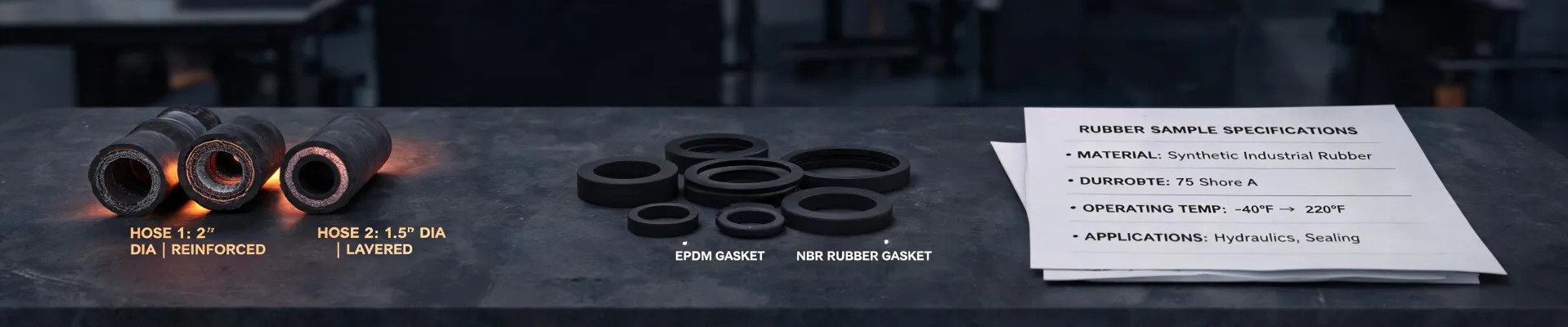
At that point, I was desperate. I called a Cooper tire store near our warehouse—yes, a tire store—and asked if they could help with rubber material selection. I figured they only sold tires. Turns out, Cooper Tire brands cover a lot more than passenger tires; their industrial line includes gaskets, strips, and specialty compounds. The guy at the counter spent 20 minutes explaining the difference between NBR, neoprene, and EPDM. He pulled out a laminated chart and circled the solvent-resistance row. "For that chemical environment," he said, "you'd want a specialized NBR blend or a fluorocarbon, not off-the-shelf nitrile." He also told me that white rubber strips can be ordered with a matte or glossy finish, and that the finish affects color perception. That detail alone would have saved us the rejected batch.
He didn't try to sell me anything—he just walked me through the material data. That was more than the original supplier had ever done.
The Checklist That Saved Us
So, bottom line: that order cost us about $3,200 more than the "cheap" quote, plus three weeks of delays. It was a painful lesson. But it gave me a checklist that has been worth far more than the money we lost.
- Ask "what's NOT included" before "what's the price."
- Get an itemized quote in writing—every fee, every surcharge.
- Specify color by Pantone or a physical sample.
- Confirm material compatibility (nitrile vs. neoprene vs. EPDM) for the actual application.
- Check image resolution: 300 DPI at final size for printed logos.
- Order a sample before full production.
Since September 2019, this checklist has caught 47 potential errors on our orders. In January 2024, it caught a supplier trying to substitute EPDM for neoprene on a roof gasket order. The spec sheet said neoprene, but the approved alternative he proposed was EPDM. I caught it because the checklist says to confirm material compatibility before any PO goes out. That saved us a 500-piece rework and a very angry customer.
I've also started using Cooper Tire store support as a technical resource for rubber questions—not just for tires. Their team knows compounds, and that's rare.
Bottom Line: Transparent Pricing Wins
Here's what I believe now: transparent pricing builds trust. The vendor who lists all fees upfront—even if the total looks higher—usually costs less in the end. The "cheap" vendor that hides fees until after you sign is the expensive one. That's just math.
I've never fully understood why some suppliers play the lowball game. My best guess is it's a sales strategy that works on busy buyers like me. If someone reading this has a different take, I'd genuinely love to hear it.
Now, I don't just check specs. I check the person on the other end of the quote. I want to know: are you showing me the real price, or just the entry fee? The answer tells me everything.
Cooper Tire editorial note
Rubber sourcing decisions should be tied to measurable application facts. If a post raises a question about material choice, compliance files, or qualification planning, send the use condition and drawing for a practical review.