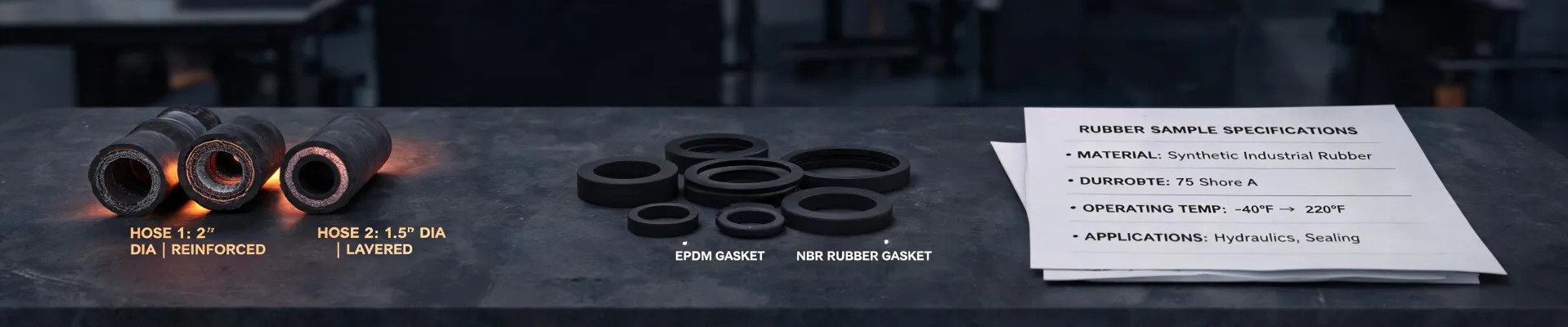
A quality compliance manager compares nitrile rubber mats vs standard rubber mats, polyurethane air hose vs rubber air hose, and why Cooper Tire and Rubber Co Texarkana reviews matter when buying on total cost.
Let me start with something that sounds harsh but saves money: “rubber” isn't a material spec.
I'm a quality/compliance manager at a tire and rubber company. I review every material spec before it reaches customers, roughly 200 unique items a year. So far in 2025, I've rejected about 11% of first deliveries. Usually the durometer is off, the batch code is missing, or the sample looks right but doesn't feel like the compound we approved. That probably makes me biased toward specified products. Fine. Let's compare anyway.
If you're searching for Cooper Tire and Rubber Co Texarkana reviews, or trying to decide between nitrile rubber mats and regular rubber mats, you're really asking one question: what do I actually know about this product? The comparison that matters isn't brand versus no-name. It's unverified generic rubber versus specified, traceable rubber.
Start with the material, not the label
This is where the word “rubber” becomes useless. A mat and an air hose can both be called rubber and have almost nothing in common.
Nitrile rubber mats vs standard rubber mats
Look up nitrile rubber properties and you'll find the usual list: oil resistance, fuel resistance, abrasion resistance, and a working temperature range that depends on the compound. The keyword is compound. Nitrile is a family, not a fixed recipe. Acrylonitrile content changes oil resistance and low-temperature flexibility. A 30% nitrile mat behaves differently than a 40% nitrile mat, even if both are sold as nitrile. In ASTM D2000 terms, nitrile compounds are often listed under BF, BG, or BK line call-outs. If a supplier can't give you a line call-out or a datasheet with durometer and specific gravity, you're buying the word “nitrile,” not the material.
For mats, the practical comparison looks like this. A standard rubber mat made from SBR or natural rubber handles dry foot traffic fine. Put hydraulic oil, cutting fluid, or food fat on it and the surface breaks down. A nitrile rubber mat resists those oils because the polymer is designed for oil contact. In a machine shop, grease always finds the mat. That's why nitrile mats show up on shop floors and in commercial kitchens. Here's the counterintuitive part: if the floor stays clean and dry, nitrile is overkill. I've seen procurement teams spend extra on oil-resistant mats for a boardroom entrance. A standard rubber mat would have looked the same for years.
Polyurethane air hose vs rubber
Same logic plays out in the air hose aisle. A polyurethane air hose is lighter, more flexible in cold weather, and more resistant to abrasion and kinking. It also tends to hold its coiled shape, which keeps work areas neater. Rubber air hose is heavier and more forgiving under crush loads, and some rubber compounds handle higher heat better. Neither is universally better. For a fixed workshop bench where the hose gets dragged over sharp metal edges, I'd take polyurethane over rubber almost every time. The hose that resists abrasion saves more money than the hose that saves $20 on the purchase order.
When I spec rubber air hose, I ask for ISO 2398 compliance. When I spec polyurethane tubing, I ask for the manufacturer's rated working pressure and bend radius. If those numbers aren't available, I stop the process until they are. It's not about being difficult. It's about knowing what failure costs.
Then check traceability
Now the second thing I look at: verification. This is where brand marks and reviews come in. The Cooper Tire logo on an industrial rubber product isn't just decoration. It's a traceability anchor. It connects the part to a compounding formula, a manufacturing batch, a test record, and a responsible party. If the logo is blurry, the packaging has no date code, or the part number doesn't match the data sheet, I flag it. I don't care how good the price is. Traceability protects you when the product fails.
I also read vendor reviews, including the ones people leave about Cooper Tire and Rubber Co Texarkana operations. Star ratings matter less than patterns. If reviews repeatedly mention “on-time delivery” and “answers the phone,” the process discipline is real. If every review is a one-star rant about the same recurring quality problem, that's a red flag no price can fix. Reviews are still a starting point, not a spec. They tell you whether the manufacturer can repeat what they did. They don't tell you whether the mat or hose you're buying right now was actually built to that standard.
Two years ago, I received a batch of rubber seals with a logo that looked slightly off. The batch code repeated on fourteen cartons, which is impossible in a real production system. The supplier said they had updated packaging. I rejected the lot and sent photos. It took three weeks to get replacement seals. The first lot probably passed quality tests. But “probably” isn't a material property. That's the day I added a packaging verification checklist to my approval process. Should have done it after the first close call.
Now the total cost part
The third thing is where many purchasing decisions go wrong. People compare unit prices and miss the cost of replacement, downtime, and inspection. I use a simple formula: TCO = quoted unit price + freight + handling + inspection + rejected goods + downtime + replacement labor. If you don't do a formal inspection, the inspection cost doesn't disappear. It becomes a risk cost, and eventually an actual cost.
Here's an example from a 2024 project. We needed sixty polyurethane air hoses and sixty rubber air hoses for a plant layout. The PU quote was about 18% higher. On paper, rubber was the budget pick. Three months later, eleven of the rubber hoses had failed at the coupling or developed pinhole leaks. Replacement work happened on overtime. The compressor ran extra cycles because of the leaks. The PU hoses were still on the same reels. In total, the rubber option cost more than the polyurethane option. I say “in total” because we didn't track every dollar perfectly; the measurement system wasn't there. That part is on me.
Nitrile rubber mats work the same way. A standard rubber mat may cost 30% less upfront. If it needs replacing every fourteen months because oil breaks down the surface, while a nitrile mat lasts four years in the same spot, the cheaper mat is the more expensive plan. The catch is that you only see the difference if you track replacement dates and cleaning time. Most teams don't. They keep buying the same thing and calling it standard.
So which do you pick?
Here's the practical answer.
- If the surface is dry and traffic is light, a standard rubber mat is fine. Don't overpay for oil-resistant nitrile.
- If there's any oil, grease, cutting fluid, or food fat on the floor, choose a nitrile rubber mat and ask for the compound data.
- For fixed shop air lines and jobs where kinking or abrasion causes failures, polyurethane air hose is likely the lower total cost choice.
- For heat-heavy environments where the hose sits near hot surfaces and needs to handle rough handling, choose a quality rubber hose with a clear standard like ISO 2398.
- No matter what, verify the brand mark, the batch code, and the datasheet. If you see a Cooper Tire logo, check that it's crisp and matches official packaging. If it isn't, move on.
Buying with total cost in mind doesn't mean buying the most expensive thing. It means knowing what you're buying and what a failure costs. That's the review that counts.
Cooper Tire editorial note
Rubber sourcing decisions should be tied to measurable application facts. If a post raises a question about material choice, compliance files, or qualification planning, send the use condition and drawing for a practical review.