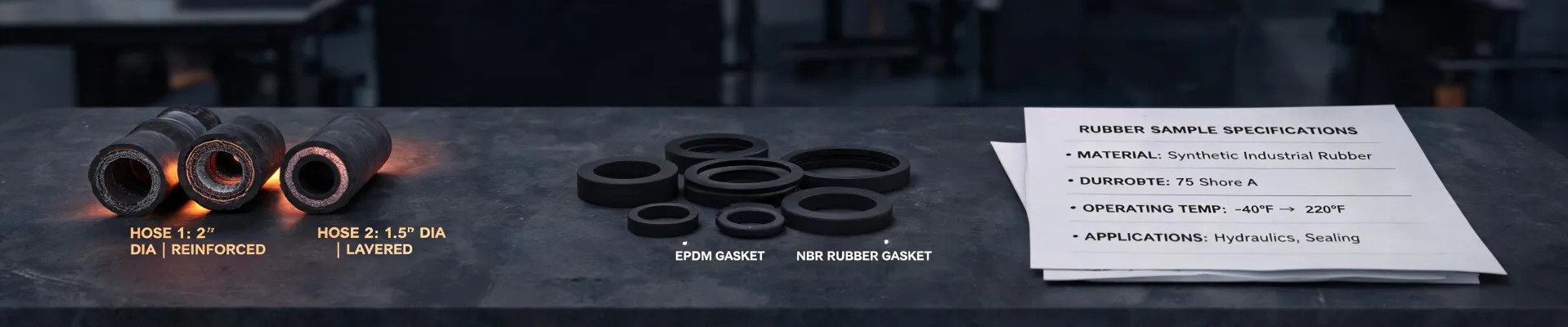
A procurement manager's deep dive into rubber material failures—what silicone rubber, nitrile, and EPDM really are, why sourcing on price backfires, and how Cooper Tire & Rubber changed our total cost math.
Last year, I signed a purchase order for 12 air hoses that looked identical to the ones we'd been using for years. Same inner diameter. Same length. Same color, even. They smelled like the same rubber. They felt the same in my hand. The price was 18% lower than what we'd been paying for the name-brand equivalent.
Within eight months, all 12 had cracked on the outer cover.
The replacement order cost us about $4,600, plus 16 hours of maintenance downtime. My first instinct was to blame the manufacturer. Then I read the spec sheet more carefully and realized the problem was sitting on my side of the desk.
I'd ordered to a part number, not to a compound. The hoses we replaced were EPDM. The new ones were SBR—styrene-butadiene rubber. SBR doesn't handle ozone exposure well. The failure wasn't a manufacturing defect. It was a selection failure. Mine.
I manage procurement for a mid-sized industrial operation. Roughly $180,000 of our annual spend goes to rubber goods: hoses, gaskets, seals, tires, custom molded parts. After six years of tracking every invoice in our cost system, I can tell you this: the most expensive rubber part you'll ever buy is the one that fails because you bought on price without understanding what the material actually is.
Rubber Isn't Rubber. Period.
Here's what I didn't understand until a material engineer explained it to me in painful detail: rubber is a category, not a material. Silicone rubber, nitrile, neoprene, EPDM, and natural rubber are fundamentally different materials with different strengths, different weaknesses, and different failure modes.
Take silicone rubber, for example. What is silicone rubber, exactly? It's a synthetic polymer built on a silicon-oxygen backbone. That structure gives it remarkable temperature tolerance—from roughly -60°C to 200°C—without losing flexibility. That makes it ideal for oven seals, high-heat gaskets, and electrical insulation. But put it in contact with petroleum-based oils or certain solvents, and it swells, softens, and fails. Its superpower is temperature resistance. Its kryptonite is oil.
Nitrile is the flip side. It's built for oil and fuel resistance, which is why it dominates hydraulic seals, fuel hoses, and automotive gaskets. But it degrades faster than neoprene when exposed to weather and ozone. EPDM handles steam, water, and UV beautifully, yet breaks down in petroleum. Natural rubber offers unmatched elasticity and abrasion resistance, but oils and ozone attack it. And neoprene? It sits in the middle—not the best at any one thing, but well-rounded enough for weather-resistant applications. "Well-rounded" still doesn't mean universal, though. I found that out the hard way.
Most buyers focus on durometer and dimensions because those are things you can measure. But the compound is what decides whether a part lasts six months or six years. The question everyone asks is "what's your unit price?" The question we should ask is "what's the ASTM D2000 classification of the material?" That standard, maintained by ASTM International, classifies rubber materials by heat and oil resistance using letter and number codes. An NBR seal might be a BG or CH classification. An EPDM gasket carries a completely different designation.
If you've never heard of ASTM D2000, you're not alone. I hadn't either until 2022. And here's the kicker: many suppliers won't volunteer that information until you ask.
What Material Ignorance Actually Costs
Let me give you three examples from our own records. I've got the spreadsheets to back these up. And I'm going to be honest with you: reading these numbers back still makes me wince.
The 22% Discount That Cost Us $13,000
In 2023, we bought 40 neoprene gaskets from a new supplier at a 22% discount compared to our incumbent. The gaskets looked right, and they felt right. The supplier seemed confident.
Seven months later, 31 of the 40 had hardened and cracked. The application involved regular contact with a mild solvent, and the compound they'd substituted wasn't rated for it. Replacement cost: $1,450 in parts plus a Saturday shutdown to install. The upfront savings we chased: roughly $260. The total cost, counting lost production, pushed past $13,000.
Looking back, I should have asked for material certifications before signing. At the time, the discount and the delivery date were all I looked at. I chose to save $260, and it cost us $13,000. That math still stings.
The Cooper Tire Shop That Changed Our Math
Our forklift tires used to come from a surplus dealer who always had the cheapest option in stock. Average service life: nine months. We replaced tires so often that nobody bothered tracking it anymore.
In Q2 2024, we switched to a Cooper Tire shop we found through Cooper's dealer locator. The first question they asked wasn't "what size do you need?" It was "what's your floor surface, load weight, and duty cycle?" That's rare. And it's exactly what a specialist should ask.
The Cooper tires cost about 35% more per unit. They're averaging around 18 months of service in the same application. Cost per month of operation dropped by roughly 40%. I want to say the payback period was around seven months, but I'd need to check my spreadsheet before quoting that precisely.
The Hoses, Again
That first hose failure wasn't the supplier's fault. It was mine. I bought to a part number instead of a spec. The supplier didn't mislead me—I never asked the right question.
Here's what six years of data tells me: the lowest quoted price is rarely the lowest total cost. Total cost of ownership—purchase price, installation, downtime, premature failure, expedited reorders—is the only number that matters. TCO isn't a consultant buzzword. It's the difference between a $260 saving and a $13,000 loss.
(We now keep a one-page compound compatibility chart in the maintenance office. Literally one laminated page. It's saved us more than any vendor negotiation ever did.)
The Suppliers Who Know Their Limits Earn the Trust
The rubber industry is more specialized than outsiders assume. Craftsman rubber hose handles general workshop air and water duties well—a solid, known quantity for light to moderate service. Catawba Rubber builds custom molded rubber parts that neither Craftsman nor Cooper would take on. Cooper Tire and Rubber built its name on tires, but its compounding expertise spans a broad range of industrial rubber goods.
Each of these has a lane. And that's exactly why they're trustworthy.
The vendor who told us "this isn't our strength—for fuel-resistant gaskets, talk to someone who compounds NBR daily" earned our maintenance budget for everything else. The vendor who said "yeah, we can make that" to every custom request? They cost us $1,200 on a redo when the part failed in service.
That's not a knock on generalists. It's a warning against anyone who claims to do everything well. A supplier who knows their boundaries is safer than one who overpromises. At least, that's been my experience in light manufacturing. Your industry might look different, but I'd bet the principle holds.
How I Source Rubber Parts Now
If you're still buying rubber parts on price alone, here's the short version of what I learned:
- Ask for the ASTM D1418 and D2000 material classifications before requesting a quote. If a supplier can't tell you the compound family, that's an answer. A legitimate manufacturer knows exactly what its materials are.
- Know your operating environment before you call anyone. Temperature range, chemical exposure, UV/ozone, mechanical stress—collect this data first. Don't make the vendor guess.
- Buy from specialists who ask questions. Whether it's a Cooper Tire shop asking about duty cycle or a gasket maker asking about solvent exposure, detailed questions are a green flag.
- Track every failure with material and application data. After two years of logging, the pattern was undeniable: 80% of our rubber part failures were chemical compatibility issues, not quality defects.
Silicone rubber isn't "better" than nitrile. Neoprene isn't "better" than EPDM. There is no best rubber—only the right rubber for your specific application. Anyone who tells you otherwise doesn't understand the material well enough to sell it to you.
And if you want suppliers who understand their material boundaries, look for the ones with decades of compounding experience. Cooper Tire and Rubber has been at it since 1914. That kind of institutional knowledge is exactly what I value now. Because rubber isn't rubber. Never was. I just didn't know it soon enough.
Cooper Tire editorial note
Rubber sourcing decisions should be tied to measurable application facts. If a post raises a question about material choice, compliance files, or qualification planning, send the use condition and drawing for a practical review.