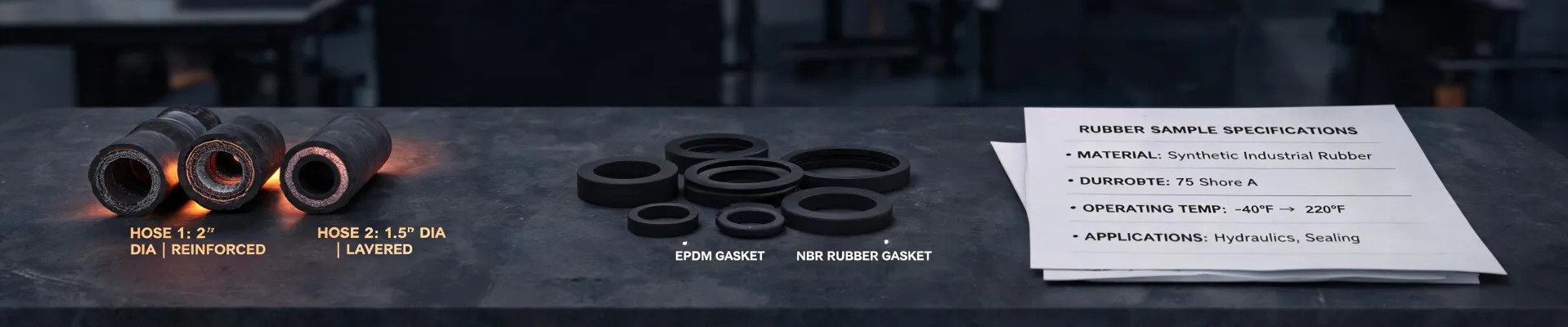
Practical 6-step checklist for sourcing rubber components in an emergency. Covers rubber vs. silicone material selection, coating rubber, Cooper Tire brand quality signals, and common rush-order mistakes.
-
Step 1: Define the Environment Before You Touch a Price Sheet
-
Step 2: Rubber vs. Silicone Is an Engineering Call, Not a Preference
-
Step 3: Coating Rubber Is a Separate Decision Entirely
-
Step 4: Brand Quality Signals Matter More When You're in a Rush
-
Step 5: Get Proof—Samples or Test Data—Before You Commit
-
Step 6: Work Backwards From the Deadline—And Add a 48-Hour Buffer
-
Common Mistakes That Cost Real Money
When you're staring at a production line that's about to stop, or a customer who needs components delivered by Friday, you don't have time for a materials science lecture. You need a checklist. Here's the one I use.
In my role coordinating industrial rubber sourcing for manufacturers, I've handled 200+ rush orders in six years—including same-day turnarounds for clients who realized their material spec was wrong at the last minute. I've made the mistakes, paid the rush fees, and tested six different approaches for emergency ordering. This checklist is what survives.
It's for anyone who just learned their gaskets, seals, or rubber parts won't pass inspection—and needs a replacement plan in hours, not weeks. Six steps, ordered the way I triage problems: environment first, then material, then supplier.
Step 1: Define the Environment Before You Touch a Price Sheet
The most common failure in emergency ordering is starting with the part instead of the conditions it lives in. That mistake filters in the wrong options.
Ask these five questions before calling any supplier:
- What temperature does this component see during normal operation? Peak exposure?
- Does it contact oil, solvents, fuels, or cleaning agents?
- Is it under constant load, or intermittent stress?
- Outdoor or indoor exposure? UV and ozone matter.
- Are there regulatory or compliance requirements (food contact, fire rating)?
In March 2024, a food processing client called at 2:00 PM needing replacement gaskets in 48 hours. Their existing parts were degrading monthly. The spec sheet said "standard rubber." But the environment included daily caustic washdowns and steam exposure at 95°C. Standard rubber was wrong from the start—it wasn't a quality problem, it was a material-selection problem. We sourced a coated rubber solution with the right chemical resistance, and the new gaskets survived beyond the six-month test window.
Write down the environment before you compare prices. It eliminates 60% of your options immediately.
Step 2: Rubber vs. Silicone Is an Engineering Call, Not a Preference
Part of me wants to answer "rubber vs silicone" with "it depends." Another part knows that's useless advice to someone on a deadline. Here's the practical breakdown.
Rubber (natural, EPDM, nitrile, neoprene) generally wins on:
- Abrasion resistance and tear strength
- Mechanical toughness
- Lower cost per formed part
- Oil and fuel resistance (nitrile especially)
Silicone generally wins on:
- Temperature extremes, both high and low
- Flexibility at very low temperatures
- Compression set resistance
- Food-grade and medical approvals (certain formulations)
- Cleanability
If your application involves friction, sliding, or repeated wear—like a shoe sole or a wiper blade—rubber is the answer. Rubber shoes exist for a reason: pavement destroys silicone soles quickly. If the application is a high-heat seal or a food-contact gasket, silicone makes sense. Not because it "sounds premium," but because the performance profile fits.
I have mixed feelings about silicone, honestly. It's a fantastic material that gets over-specified by buyers who skip step one. When you define the environment first, the right material becomes obvious.
Step 3: Coating Rubber Is a Separate Decision Entirely
Coating rubber—nitrile coated onto fabric, polyurethane bonded to rubber, or an anti-stick finish—changes performance more than people expect. The coating touches the product, the customer, or the environment. It deserves its own questions:
- Is the coating factory-bonded or applied in-house?
- What's the chemical and solvent resistance of the coating itself?
- Does the coating affect the durometer (hardness) of the finished part?
- Is there adhesion test data under your actual operating conditions?
In Q3 2024, a client needed coated rubber rolls for a food conveyor. The base rubber was correct: right polymer, right durometer. But the coating began delaminating after 40 days. The issue was the adhesive bond between the coating and the rubber, not the rubber itself. Switching to a manufacturer using a different bonding layer dropped the complaint rate from 18% to under 2%.
When you're in a rush, coating details are the first thing to get skipped. That's exactly when they matter most.
Step 4: Brand Quality Signals Matter More When You're in a Rush
Here's the thing about brand in an emergency: it's risk mitigation. The Cooper Tire logo on a component tells you this manufacturer has been at it for decades, maintains standards, and has skin in the game. When you don't have time for extended testing, that signal matters.
I watched a procurement manager's customer visibly relax when the Cooper Tire logo appeared on a rubber mount replacing a failed part. "It feels like a stamp of approval," he said. "Easier to convince our quality team." The component was identical in spec to the generic version. The differentiation was accountability.
The numbers sometimes say go cheaper. Last year, we compared four suppliers for a high-volume rubber mat order. The budget option was 22% cheaper, with the same baseline specs. My gut said the details would differ. We went with the established brand anyway. Six months later, the budget alternative showed edge cracking in cold storage—we saw it on another client's order. Dodged a bullet.
Look, I'm not saying cheap is always bad. I'm saying that on a deadline, you can't afford to discover quality problems after installation. The "savings" from a budget option is quickly erased by re-sourcing, re-shipping, and managing a disappointed client. Your customer judges your company by what lands on their dock. The details are the brand.
Step 5: Get Proof—Samples or Test Data—Before You Commit
The step everyone skips on a rush order. I understand why. It feels like you don't have time. But a sample isn't a luxury—it's insurance.
Several months ago, a client needed rubber strips in 72 hours for a production test. The paper spec checked out entirely: right material, right durometer, right width. When the strips arrived, the surface finish was wrong—too smooth, slightly glossy, changing the friction behavior completely.
We paid $480 for overnight replacement shipping and the test ran four days late. The original manufacturer wasn't at fault. We hadn't asked for a sample photo or questioned the surface finish.
If a physical sample isn't possible on your timeline, at least:
- Ask for a photo or video of an actual piece from the batch
- Request batch records and manufacture date
- Ask to speak with a technical contact, not only sales
That one call takes 15 minutes. It would have saved us a week and a client relationship.
Step 6: Work Backwards From the Deadline—And Add a 48-Hour Buffer
When I'm triaging an urgent order, I start at the deadline and allocate production, finishing, and transport from the end backwards. Whatever buffer I get from that calculation is non-negotiable.
Our company lost a $14,000 contract in 2022 because we tried to save $600 by choosing ground shipping over air freight for a critical rubber component shipment. The parts arrived two days late. Their production line stopped, our client's customer was furious, and the contract went to another supplier at renewal. $600 in "savings" cost us the account. That's when I implemented the 48-hour rule: no time-critical order ships by ground, period.
The value of guaranteed turnaround isn't the speed—it's the certainty. For production components, knowing when the parts land is often worth more than saving a few hundred dollars on freight.
Common Mistakes That Cost Real Money
If you take nothing else from this checklist, avoid these patterns. They show up on nearly every emergency order I've handled:
- Specifying material by category instead of performance. "It's rubber" doesn't tell you anything useful. Use durometer, temperature range, and chemical resistance.
- Forgetting that coating and finishing add lead time. Coating rubber takes days to cure and bond-test—it isn't a same-day process.
- Choosing the cheapest freight for a deadline order. The $150 you save today is uncomfortably close to the $8,000 line stoppage tomorrow.
- Not asking what's already in stock. Manufacturers like Cooper Tire keep standard products available for immediate shipment. A "stock" product, even slightly off spec, beats a perfect custom part that arrives late.
- Trusting "estimated" delivery dates. Flat-out ask: "Is that a guaranteed ship date or an estimate?" The answer changes every calculation after it.
Six steps, five mistakes to avoid. The compressed version: define the environment, compare rubber vs. silicone on performance data, authenticate the coating and the brand, verify before you pay, and keep a 48-hour buffer. Skip any of those and you're gambling with someone else's deadline.
The smart buyer isn't the one who orders first—it's the one who asks the seventh question first. A lesson learned the hard way, more than once.
Cooper Tire editorial note
Rubber sourcing decisions should be tied to measurable application facts. If a post raises a question about material choice, compliance files, or qualification planning, send the use condition and drawing for a practical review.