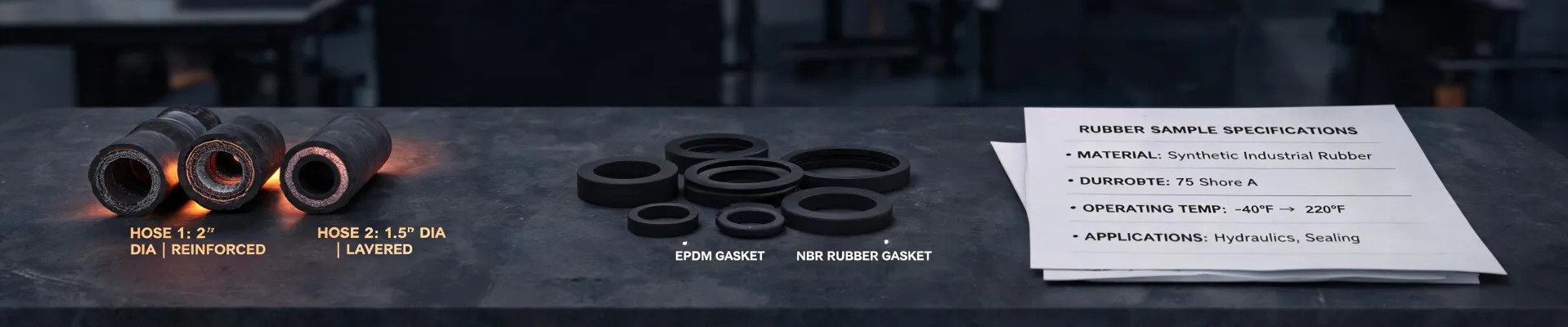
An office administrator shares how a leaking rubber roof led to an expensive EPDM rubber gasket mistake, a crash course in what silicone rubber really is, and a new respect for Cooper Tire & Rubber Co's rubber engineering.
Back When I Thought Rubber Was Rubber
It was a Tuesday in March 2024—the kind of Tuesday that starts with coffee and ends with me standing in a parking lot discussing waterproofing. I'm the office administrator for a 180-person company. I process maybe 60 to 80 orders a year, from printer toner to maintenance parts, and I report to both operations and finance. Roof leaks were not in the job description. But when you're the person who orders things, you become the person who fixes things.
The building manager walked in and said, "We have water dripping from the ceiling near the server room." I asked how bad. He said, "Bad enough." That's all I got.
Long story short, we needed a rubber roof repair. He said "rubber roof" like I was supposed to know what that meant. I nodded, then went back to my desk and typed "rubber roof patch" into a search engine.
That's where the rabbit hole started.
What I Didn't Know About Rubber Roofs
Apparently, "rubber roof" isn't one thing. It's a family of materials. The most common for flat commercial roofs is EPDM rubber—ethylene propylene diene monomer, if you like mouthfuls. It's tough, flexible, and handles sunlight and weather about as well as anything else in the rubber family.
EPDM roof membrane is usually sold in 45-mil or 60-mil thickness. We chose 60-mil because the HVAC area gets a lot of foot traffic from contractors. (I turned into someone who talks about mil thickness. It was mildly horrifying.)
But there's also silicone rubber—a whole different animal. Silicone has a silicon-oxygen backbone rather than the carbon backbone of most organic rubbers. That lets it handle extreme temperatures and UV exposure well. For a roof coating, silicone can be great. For a gasket under metal flashing? Maybe not. It tends to have lower tear strength than EPDM, so it's easier to damage during installation.
I learned that the hard way.
Here's the part that threw me off: I kept seeing Cooper Tire & Rubber Co whenever I searched for rubber material information. I thought, "Why is a tire company showing up in my roof search?"
Turns out, the Cooper Tire brand is just the visible tip. The company has over a century of rubber compounding history. Tires are the obvious flagship, but that kind of materials expertise carries over into industrial rubber—gaskets, seals, hoses, and sheet goods. Once I started paying attention, I stopped thinking about rubber as a static material and started seeing it as a recipe.
The EPDM Rubber Gasket Mistake That Cost Me
Now the gasket part, because that's where I lost real money.
Once the contractor confirmed the roof had soft spots, he said we needed new flashing around the HVAC curb. That meant ordering EPDM rubber gaskets—the soft, squishy strips that sit between metal pieces so water can't creep in through the fasteners.
I found a supplier with a price about $90 below our regular distributor. The website looked fine. The reviews looked fine. I ordered enough gaskets to cover the curb and called it done.
The gaskets arrived on schedule, but something was off. They looked right, but they smelled different—kind of plastic-y, if that makes sense. I ignored it. I even joked with the building manager about the "new rubber smell." He did not find it funny.
The contractor called me within an hour. One gasket had torn during a test fit. Another one wouldn't compress enough under the flashing. He said, "This isn't EPDM. I mean, it's black and it's rubber-ish, but it's not the same compound."
That's when I learned about filler. Some cheap EPDM gaskets use more filler and less actual polymer. It looks right on the outside, but it doesn't have the same elasticity or compression set. It might last a year. It might not last the season.
The invoice from the cheap vendor was a handwritten screenshot with no itemization. Accounting kicked it back. I had to pay it out of the department's contingency—$90 saved, then $620 lost on tear-out, replacement gaskets, and an extra labor day.
Actually, the total was closer to $700 if you count my time and the building manager's time. Let's just say it hurt.
I assumed "same specifications" meant identical results across vendors. It doesn't. Each manufacturer's compound is different.
What Is Silicone Rubber, Exactly?
Somewhere in that same research rabbit hole, I kept seeing "what is silicone rubber"—and it's a fair question.
Silicone rubber is a synthetic elastomer made from silicone polymer chains. The key difference is that it's based on silicon, not carbon. That gives it a few advantages:
- Broad temperature range—it stays flexible from about -60°C to over 200°C, depending on the formulation.
- Strong resistance to UV, ozone, and weathering.
- Low toxicity, so it's common in food-contact and medical products.
But "better" depends on the job. Silicone tends to have lower tear strength and a higher price than EPDM. For a roof membrane that gets walked on, EPDM is the workhorse. For a high-heat appliance gasket, silicone might be the only sensible option. They are different tools, not competitors in a beauty contest.
What I'd Do Differently Next Time
If you're an admin buyer who is suddenly responsible for rubber parts, here's what I'd tell you:
Ask for the data sheet, not just the dimensions. A real EPDM gasket supplier should be able to tell you the durometer (Shore A hardness) and something about compression set. If they can't, that's a red flag. The second vendor we used sent a material spec sheet before I even asked—or rather, they asked me what specs I needed. That's the right kind of vendor.
Don't buy from a photo. A black rubber strip looks like any other black rubber strip until it's sitting on a curb in direct sun. The difference is in the compound and the cure, not the shape.
Know the material supplier's history. When I look at Cooper Tire & Rubber Co, I'm not just thinking about tires. They've spent decades mixing rubber compounds to survive heat, cold, friction, and weather. That knowledge is exactly what makes the difference between an EPDM gasket that seals for twenty years and one that cracks in six months.
Plan for the invoice. If you're in a corporate job like mine, accounting will reject mysterious screenshots. Verify the vendor can send a proper invoice before you order, not after. I used to assume that was a given. It isn't.
What I Actually Saved
In the end, the roof repair cost about $2,100, give or take. As of January 2025, the roof is holding fine—no leaks, no cracking around the flashing, no "tire rubber lady" comments from the contractor. (Okay, a few.)
But the real cost was the lesson, and it stuck.
Rubber is engineering, not a commodity. The Cooper Tire brand got me thinking about materials in a way I never had before. Once you see it, you see rubber everywhere—gaskets, seals, hoses, mats, roofs, even the tires on the company fleet. And the suppliers who understand rubber do not just sell you a part. They help you choose the right one.
Now, before I order anything, I ask two questions: What is this actually made of? And how do I know? If I can't answer both, I keep looking.
It probably costs a little more to do it that way. But I stopped treating that as "more expensive." The cheap route already billed me, and it charged interest.
Cooper Tire editorial note
Rubber sourcing decisions should be tied to measurable application facts. If a post raises a question about material choice, compliance files, or qualification planning, send the use condition and drawing for a practical review.