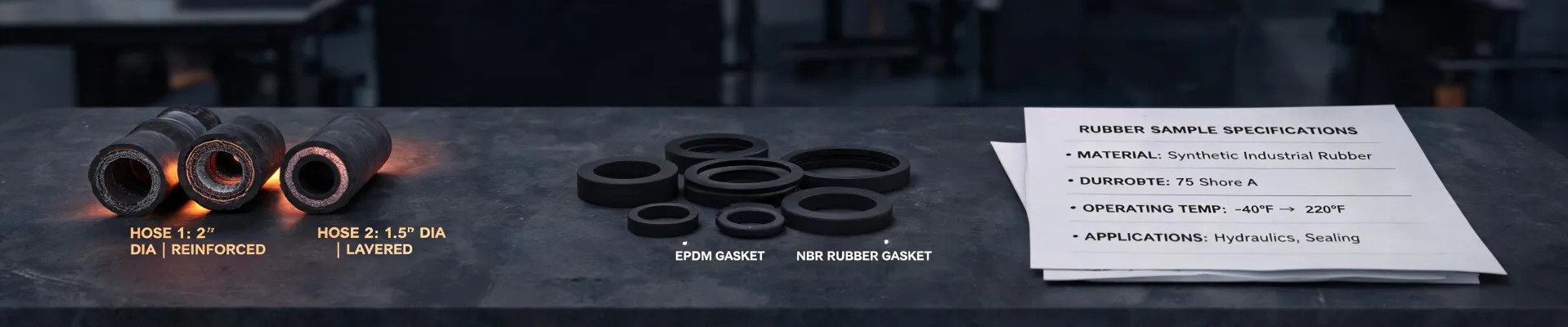
Rubber strips and air hoses fail for reasons beyond price or brand. A purchasing admin explains the thermoplastic vs rubber issue and how to fix it.
I manage purchasing for a 160-person logistics company. When I took over in 2020, I inherited a messy folder of vendor contacts and a maintenance team with a running joke: "the shower strip guy" would be back within months. It wasn't just the bathroom seals, either. The air hoses in our repair bay kept cracking. I assumed we were buying cheap rubber. After almost three years of reorders, I learned the real problem wasn't price—it was that we kept buying the wrong material.
The Problem I Thought I Was Solving
Every few months, one of our facility engineers would email me: "Need new shower rubber strip for the men's locker room." I'd search online, find something labeled "rubber" and order it. Maybe 200 units over two years—no, 180, I'd have to check the system. The pattern was consistent: the new strip looks fine for a month, then yellows, hardens, and tears within six months.
Same story with the air hose rubber. We run a small workshop for forklift and trailer repair. The air lines would stiffen, crack, and sometimes burst. The first time I approved a "premium" hose from a pricier supplier, it failed just as fast. That's when I started asking real questions.
The Surface Problem Is Never 'Rubber'
The word "rubber" is practically meaningless in procurement. It's like ordering "food" for a cafeteria. You need to know not just the product, but the compound. And here's where the confusion starts: there are two broad families—thermoset rubber (cured elastomers like EPDM, neoprene, nitrile) and thermoplastic elastomers (TPE, TPU, PVC). Both get sold as "rubber."
Thermoplastic vs rubber isn't just academic. Thermoset rubber has crosslinked molecular chains, which gives it memory and resistance to heat, oil, and weather. Thermoplastics are softer and cheaper, but they can lose shape in high heat and react differently to chemicals. For a shower strip, you want a waterproof EPDM that handles moisture and soap. For an air hose, you need something that won't be degraded by oil from the compressor. Neoprene or nitrile are usually better than PVC—which is a thermoplastic often passed off as "rubber" in catalogs.
I'm still not entirely sure why so many suppliers label a PVC product as "rubber." My best guess is that it's easier to sell a $15 strip than a $45 EPDM one—and the search terms don't punish them.
The Real Cost of Getting It Wrong
Let's do some rough math. A cheap shower strip might cost $15 and last six months. A properly specified EPDM strip costs $40 and can last years. But the product cost is only the beginning. Every replacement costs two hours of a maintenance tech's time, plus the awkwardness of telling the operations manager the locker room is closed again. Multiply by six strips and three shower rooms, and you're looking at maybe $1,200 a year in labor on top of reorder costs.
The hoses were worse. We had a communication failure that cost us an entire Saturday. I emailed the vendor: "Need air hose rubber, 3/8" ID, 50 feet." They sent a PVC hose. I meant EPDM—or at least nitrile. They heard "cheap flexible tubing." The result: the hose burst next to a technician. No major injury, but it shook everyone up. That's when I realized the gap between our language and theirs was a safety issue, not just a budget annoyance. We also lost coverage on a job because the replacement took almost a week to arrive.
And there's the finance angle. Our old supplier couldn't produce a proper invoice—handwritten receipts only. After one rejected expense report, I spent $380 out of my department budget replacing parts that were already broke. That's the kind of hidden cost that never shows up in the unit price.
The Fix That Worked: Stop Ordering 'Rubber' and Start Specifying Material
Once I understood the material categories, I rewrote our standard purchasing specs. Every rubber-based product now has to be specified by polymer type, durometer, temperature range, and—for hoses—pressure rating and oil resistance. We also verify that the supplier can provide data, not just a glossy spec sheet but ideally a test report.
That's also where we came back to brands like Cooper Tire & Rubber Company. I know most people think of them as a tire maker, but their industrial rubber products range includes sealing strips and hoses for commercial and industrial use. What matters to us is that they have real material science behind them. If a company knows how to build a tire compound that handles heat, friction, and weather, they're likely to get the basics right on a rubber strip or a hose. We've also put more of these orders through an online portal, which eliminated the paperwork issue. The automated process captures deliveries and invoices—no more handwritten receipts. Switching to that system saved our accounting team about six hours a month.
This wasn't a massive digital transformation. It was just learning to ask the right questions before placing an order. For example:
- What exact polymer is this—EPDM, neoprene, nitrile, or thermoplastic?
- What temperature range will it tolerate in continuous use?
- Will it come into contact with oil, solvents, or UV light?
- For hoses: what's the working pressure and burst rating?
- Can you provide an ASTM D2000 or equivalent material designation?
These five questions eliminated most of our repeat failures. We still buy from a mix of suppliers, but now we apply the same standard to all of them. It costs a little more upfront in some cases, but the total cost of ownership is far lower.
So, About the Thermoplastic vs Rubber Debate
I'm not going to tell you one is universally better. That's the wrong question. Thermoplastic materials can be excellent for things like weather-stripping around doors, where flexibility and recyclability matter. But for a shower rubber strip or an air hose rubber product, a cured thermoset rubber compound is often the right call. The key is to match the material to the environment, not to the word "rubber."
We now have a simple rule in our procurement checklist: if the product sits in water, gets hot, sees oil, or takes pressure, we specify thermoset rubber. If it's a cosmetic gasket that just needs to hold a shape, thermoplastic may be fine. Once you make that decision, half the battle is won. At least, that's been my experience with industrial maintenance over the past few years.
If you're still ordering "rubber" from a catalog and hoping for the best, I'd suggest you stop. Ask your supplier what the material is actually made of. Ask for test data. If they can't tell you whether it's EPDM or PVC, you're about to learn a painful lesson I learned over three years—and a few thousand dollars. The right material isn't always the expensive one. It's the one matched to your application.
Cooper Tire editorial note
Rubber sourcing decisions should be tied to measurable application facts. If a post raises a question about material choice, compliance files, or qualification planning, send the use condition and drawing for a practical review.