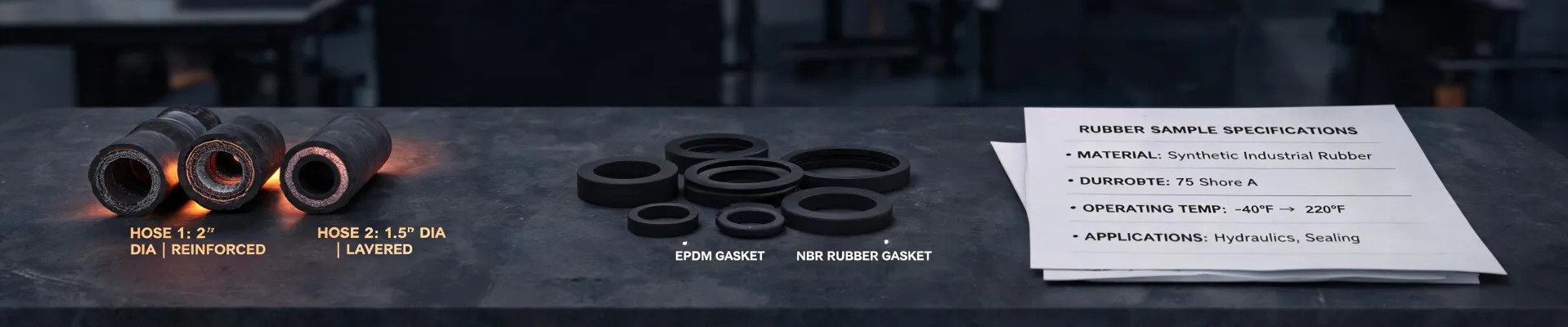
A rubber industry quality inspector compares thermoplastic rubber material and polyurethane across construction, field performance, and supply chain reliability—with practical insights on Cooper Tire & Rubber, Cooper tire store availability, and Cooper tire brands.
I've spent the last six years as a quality inspector at a rubber and plastics manufacturer. My job sounds simple: review every component before it reaches customers—roughly 200 unique items a year, everything from industrial hose to molded o-rings to rubber matting. In 2024 I rejected about 9% of first deliveries for dimensional drift or material inconsistency. But the deeper part of the job is watching products fail in the field and figuring out why.
The question I get most often from B2B buyers isn't about tolerances or lead times. It's this: how do rubber and polyurethane actually compare?
Usually, the person asking has been told by a sales rep that polyurethane is the "modern upgrade" and rubber is the old-school legacy option. That framing is convenient for anyone trying to sell a higher-margin material. It's just not how things play out on the factory floor.
So here's my comparison framework—three dimensions I use when evaluating materials for a project: construction, real-world performance, and supply chain reliability. Let's walk through each.
Dimension 1: What Is Thermoplastic Rubber Made Of? (And How PU Compares)
Let's get the basic question out of the way, because I get it from buyers constantly: what is thermoplastic rubber made of?
A thermoplastic rubber material isn't one single compound. It's a family of blends that combine a rubber polymer, typically SBS or SEBS, with a thermoplastic like polypropylene, plus oils and fillers. That combination gives you a material that processes like plastic—fast cycle times, easy molding—but behaves like rubber. The thermoplastic character comes from physical cross-linking that's reversible, so you can reheat it, reshape it, and recycle it.
Polyurethane is a completely different animal. It's formed by reacting a polyol with an isocyanate to create urethane linkages. Depending on the formulation, PU can be thermoset—permanently cross-linked—or thermoplastic. The thermoset version is what people mean when they say "premium polyurethane." It's tough, elastic, and resists abrasion extremely well.
Here's the thing nobody puts on a datasheet: the permanent cross-links in thermoset PU also make it nearly impossible to recycle. TPR can be reground and reused without losing much performance. I've seen more than one company get caught late in a product's life cycle by an end-of-life requirement they didn't anticipate. If sustainability targets or disposal regulations are on your radar—and they probably are, if you're a B2B buyer—that single chemical difference can outweigh every other material property on paper.
Dimension 2: Performance in the Field
Lab data gives you a starting point. But I've learned to trust field results more. Here's how rubber and polyurethane actually behave when they're out in the world.
Abrasion and Impact: Polyurethane Takes This One
There's no way around it—PU is the abrasion champion. In sliding wear tests, a well-formulated polyurethane can outlast rubber by 2 to 4 times. Chute liners, conveyor rollers, scraper blades: if the dominant failure mode is friction or impact inside a controlled environment, PU is the right call. I don't have hard data on industry-wide failure rates, but based on our production history, the PU components we make for high-wear rollers consistently outlive comparable rubber parts by a wide margin.
Cold Temperature: Rubber Flips the Story
This is where the "premium upgrade" narrative falls apart. Most PU formulations get stiff and brittle below about -20°C. Well-compounded rubber, especially EPDM or natural rubber with the right additives, stays flexible down to -40°C and beyond.
In our Q1 2024 quality audit, we examined returned parts from outdoor applications over the previous two winters. The majority of failures were polyurethane components that had cracked or shattered in cold weather. Rubber parts with the same application history didn't show that failure mode at all.
The counterintuitive conclusion? For products that live outdoors or face temperature swings, the "cheaper" rubber material can be the more durable choice—and the more expensive polyurethane can be the costly mistake.
Compression Set and Sealing: Rubber Holds Its Shape
For gaskets, seals, and o-rings, I spec rubber without hesitation. Rubber compounds recover their shape after compression much better than most PU grades. ASTM D395 compression-set testing tells that story clearly: a good EPDM or nitrile formulation will hold a seal for years, while many PU parts take a permanent set and start leaking. That's not a knock on PU. It's just not what PU was formulated to do.
Dimension 3: Supply Chain Reliability—What the Datasheet Won't Tell You
Here's something most people don't realize: material consistency between batches, even from the same supplier, is frequently worse than you'd expect. When I implemented our incoming verification protocol in 2022, we started testing every batch for hardness, density, and tensile strength before releasing it to production. The first year caught variations that should have been impossible—hardness swings of 5 to 7 points on the Shore A scale between "identical" batches from the same vendor.
That's where brand reputation becomes a technical spec. Cooper Tire & Rubber has been compounding rubber since 1914. That sounds like marketing fluff, but it translates to something measurable: decades of quality control infrastructure, documented formulations, and raw-material sourcing relationships that generic compounders can't easily replicate.
Cooper's brand infrastructure also shows up in distribution. If you search for a Cooper tire store, you'll find one in most regions without much hunting. That's meaningful beyond tires—it means B2B buyers looking for rubber products or material guidance have access to people who understand the product line and can answer technical questions. The Cooper tire brands question comes up a lot in our industry, and honestly, the range of product lines is part of what makes the brand dependable. When a single manufacturer covers tires, industrial hoses, molded parts, and custom compounds, it's a sign their material expertise runs deep.
Here's something vendors won't tell you directly: when someone says "equivalent to Cooper spec," they're asking you to take a claim on faith that they haven't verified themselves. In my experience, about a third of the time, that equivalence claim doesn't survive actual testing.
Honest Recommendations: What I'd Choose, and When
I'll say it plainly: there's no universal winner between rubber and polyurethane. But there are clear patterns, and I use them constantly when advising customers.
Choose thermoplastic rubber—or a Cooper-engineered rubber compound—if: your application involves outdoor exposure, temperature extremes, sealing or compression duties, or a long service life. Also choose rubber if recyclability matters, or if you're producing in high volumes where TPR's faster molding cycles translate into real cost savings.
Choose polyurethane if: the application sits indoors with stable temperatures, and the primary wear mechanism is sliding abrasion. Rollers, wheels, chute liners, and machine components in controlled environments are classic PU territory.
One more layer of honesty: the biggest cost driver is rarely the material price itself. It's rejection rate and field lifespan. We didn't have a formal material-selection review process at first, and that cost us—we specified polyurethane for an outdoor product, hit a 15% failure rate within two winters, and had to redo the entire production run. The third time a material decision bit us, I finally created a verification checklist. Should've done it after the first.
If you're still unsure which material fits your use case, ask your supplier for more than a datasheet. Ask for batch consistency records, field failure reports, and references from companies doing what you do. A supplier with a real track record—like Cooper—won't hesitate to share. One that's hiding batch variance will suddenly go quiet.
Cooper Tire editorial note
Rubber sourcing decisions should be tied to measurable application facts. If a post raises a question about material choice, compliance files, or qualification planning, send the use condition and drawing for a practical review.