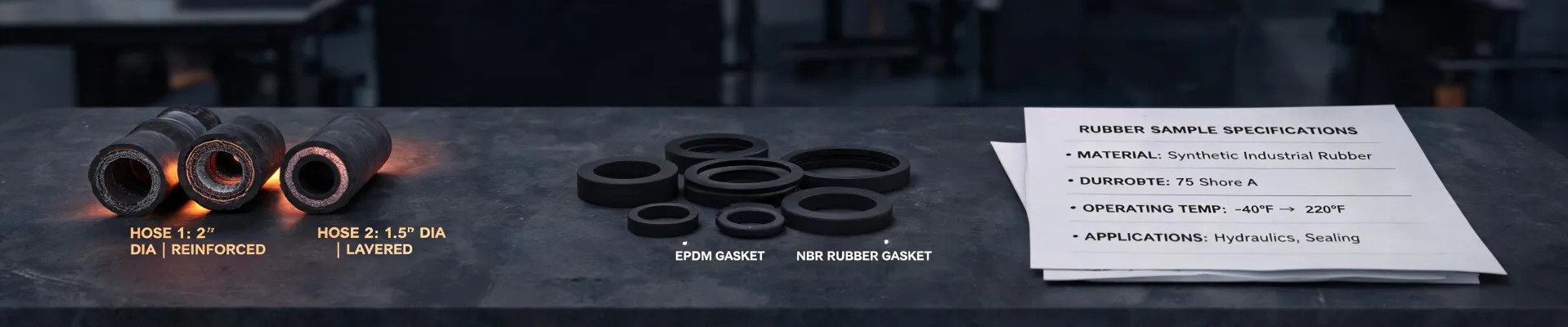
A practical, step-by-step checklist for sourcing rubber supplies, based on real errors and recoveries. Learn how to avoid common pitfalls when ordering from suppliers like Cooper Tire & Rubber Co.
-
Who This Checklist Is For
-
Step 1: Define Your Material Requirements (Not Just "Rubber")
-
Step 2: Verify the Supplier's Core Competency
-
Step 3: Get the Durometer Right—It's Not a Suggestion
-
Step 4: Always Order a Material Sample (or Test Batch) First
-
Step 5: Confirm Lead Time and Communication Channel
-
Common Mistakes to Avoid (From Experience)
Who This Checklist Is For
If you're ordering rubber strips, mats, gaskets, or custom molded parts for the first time—or if you've been burned before by wrong materials or missed specs—this checklist is for you.
I handle procurement for a small industrial parts distributor. In the past six years, I've personally made (and documented) 14 significant ordering mistakes, totaling roughly $4,700 in wasted budget. Now I maintain our team's pre-order checklist to prevent others from repeating my errors.
Here's the exact process I follow for every rubber supply order. It's 5 steps, and it takes about 20 minutes once you get used to it.
Step 1: Define Your Material Requirements (Not Just "Rubber")
This is where most people trip up. "Rubber" is not a material specification. It's a category.
You need to know:
- Is it natural rubber (NR) or synthetic? If synthetic, which polymer? (EPDM, NBR, SBR, Neoprene, Silicone, etc.)
- What durometer (hardness) do you need? Shore A 60? 70? 80?
- Operating temperature range? (If it's going to see -40°F or +250°F, that changes everything.)
- Chemical exposure? (Oils, solvents, UV, ozone?)
Checkpoint: Write down your full material spec before calling a supplier. If you're not sure, ask for their recommendation—but give them the application details (temperature, environment, load).
I once ordered "neoprene gaskets" without specifying the grade. Turned out they were for outdoor use but the material wasn't UV-stable. $890 in redo plus a 1-week delay. That's when I learned to always ask: "Is this grade suitable for outdoor exposure?"
Step 2: Verify the Supplier's Core Competency
Not all rubber suppliers are the same. Some specialize in extruded profiles (strips, tubing). Some focus on molded parts (o-rings, grommets). Some are full-line distributors who don't actually manufacture anything.
Questions to ask:
- "Do you manufacture this type of product in-house?"
- "What's your minimum production run?" (This matters for small orders.)
- "Do you offer material certification (ASTM D2000 or similar) for this product?"
Checkpoint: Check their website (e.g., the Cooper Tire website for rubber supply listings) and look for customer reviews. I always check reviews for Cooper Tire and Rubber Co. Texarkana—they have a reputation for quality, but even good suppliers can mismatch your application if you don't specify properly.
Step 3: Get the Durometer Right—It's Not a Suggestion
This is one of the most overlooked details. A Shore A 70 durometer gasket feels very different from a Shore A 50 durometer gasket—but both are "rubber."
People assume durometer is just a preference. In reality, it determines seal effectiveness, compression set resistance, and longevity. If you spec the wrong hardness, the part might not seal at all, or it might fail prematurely.
Checkpoint: Confirm durometer with your supplier. If they ask "Soft, medium, or hard?" ask for the Shore A specification. That's the industry standard.
From the outside, it looks like "soft rubber" is just a feel preference. The reality is that parts with wrong durometer can leak, distort, or wear out in weeks instead of years.
Step 4: Always Order a Material Sample (or Test Batch) First
This is the single most important rule I follow now. If you're ordering a custom rubber part or a material you haven't used before, order a sample or a small production batch before committing to large quantities.
Why? Because material samples reveal issues that specs don't capture:
- Color match (even black rubber can vary in shade)
- Surface finish (rough edges, mold release residues)
- Actual durometer (sometimes it's off by 5-10 points)
- Compression set (can you actually compress it and have it spring back?)
Checkpoint: Ask for a 5-10 sample pieces or a test run of your minimum order quantity. If the supplier pushes back on samples, that's a red flag.
When I was starting out, the vendors who treated my $200 sample orders seriously are the ones I still use for $20,000 orders today. Small doesn't mean unimportant—it means potential.
Step 5: Confirm Lead Time and Communication Channel
Even the best rubber supply order is useless if it arrives two weeks late for a production shutdown.
Before you place the order:
- Ask for the exact lead time (not a range: e.g., "10-14 business days"—clarify if it's 10 or 14).
- Ask about rush options and their cost.
- Get a direct contact (email or phone) for order status updates.
Checkpoint: Set a deadline in your calendar that's 2 days before the supplier's estimated delivery. If you haven't received tracking by then, follow up.
I once assumed "standard lead time" meant the same everywhere. Didn't verify. Turned out one supplier's "standard" was 8 business days, and another's was 18. I ended up paying $250 for expedited shipping on an order I'd already budgeted for standard delivery. Net loss: $250.
Common Mistakes to Avoid (From Experience)
- Assuming all rubber is the same. TPE rubber (thermoplastic elastomer) is not the same as conventional rubber. And no, polyethylene (PE) is not rubber—it's a plastic. Don't confuse them.
- Not asking about storage conditions. Some rubber compounds degrade in direct sunlight or high humidity. If you're storing them outside, mention that to your supplier.
- Ordering from the cheapest source without verification. The lowest quote might be from a reseller who doesn't actually inspect the material. I've seen $200 "savings" turn into $800 reorders.
- Not documenting the order spec in writing. Verbal agreements for rubber supply orders are a disaster waiting to happen. Always get the spec in an RFQ or email confirmation.
This checklist is based on my personal experience ordering rubber supplies from various suppliers, including Cooper Tire & Rubber Co. (Texarkana, TX). Their reputation for quality is solid, but even the best supplier needs a well-specified order. The mistakes above are mine, not theirs.
If you're ordering rubber for the first time, take 20 minutes to run through these steps. It won't guarantee perfection, but it will save you from the most expensive errors.
Cooper Tire editorial note
Rubber sourcing decisions should be tied to measurable application facts. If a post raises a question about material choice, compliance files, or qualification planning, send the use condition and drawing for a practical review.