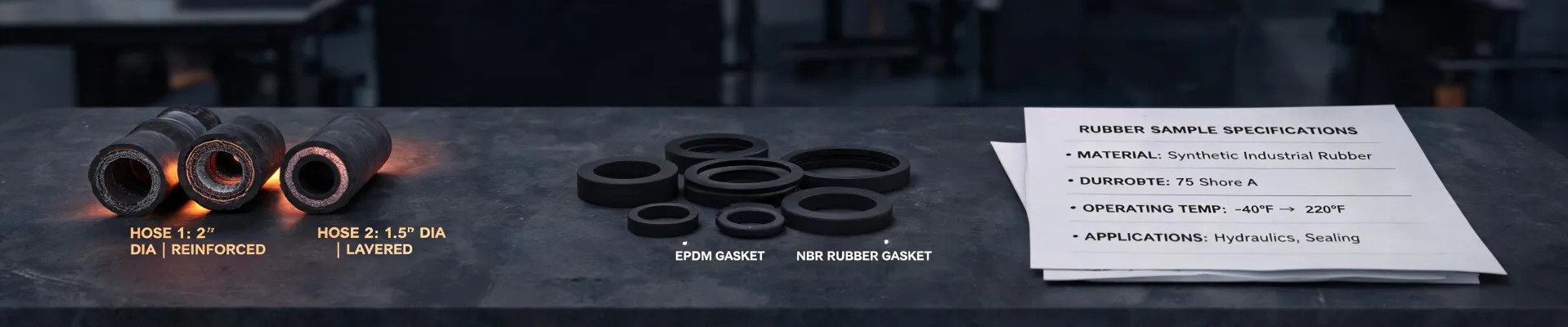
Not all rubber or wheel materials are created equal. Drawing from 4 years of quality inspection experience at a major rubber products company, this guide breaks down three common buyer scenarios—standard replacement, high-performance demands, and cost-sensitive projects—to help B2B buyers make the right call on solid rubber wheels, industrial rubber sheets, and wiper blades.
-
There’s no one-size-fits-all material choice—here’s how to find yours
-
Scenario A: Standard replacement, general duty, moderate loads
-
Scenario B: High-performance demands—heavy loads, continuous use, harsh environments
-
Scenario C: Cost-sensitive project with moderate expectations
-
How to tell which scenario you’re in
-
On material comparisons: silicone vs. rubber wiper blades
-
Final thoughts
There’s no one-size-fits-all material choice—here’s how to find yours
I’ve been a quality compliance manager at a rubber and plastics manufacturing company for about four years now. In that time, I’ve reviewed over 800 unique deliverables—wheels, gaskets, hoses, seals, O-rings—before they shipped to customers. I’ve rejected roughly 12% of first deliveries in 2024 alone, mostly for material spec deviations.
I won’t pretend I walk into every conversation about cooper tire products or solid rubber wheels with all the answers. But I’ve learned to ask the right questions. And when it comes to choosing between a rubber-based product and an alternative—like polyurethane or silicone—the answer almost always comes back to: “What’s your situation?”
This article is built around three common buyer scenarios I’ve encountered from our customers. If you’re asking yourself “Should I buy solid rubber wheels or something else?” or “Which rubber compound is best for my project?”, this guide will help you map your use case to the right material.
Scenario A: Standard replacement, general duty, moderate loads
You need a replacement wheel for a cart, dolly, or light industrial platform. The original part was rubber. The operating conditions are indoors, on smooth concrete, with loads under 500 lbs per wheel. Speed is low (under 5 mph).
Go with solid rubber.
In this scenario, solid rubber wheels from a reliable manufacturer like Cooper are almost always the right call. They offer excellent floor protection, quiet rolling, moderate shock absorption, and a very predictable cost structure. For our Q1 2024 audit of 200+ wheels delivered to a logistics client, solid rubber wheels had a defect rate of just 2.5%—mostly minor flash (excess material) that was trimmed in seconds.
The surprise wasn’t the quality—it was how consistent the pricing was across suppliers. For a standard 8-inch solid rubber wheel with a 1-inch bore, we’re seeing $12–18 per unit depending on quantity. That’s a good price for what you get. Replace them every 18-24 months under normal use.
Scenario B: High-performance demands—heavy loads, continuous use, harsh environments
Your application involves loads over 1,000 lbs per wheel, 8+ hour shifts, or exposure to oil, chemicals, or extreme temperatures (below -20°F or above 150°F). Maybe you’re dealing with wet floors or metal shavings.
Consider polyurethane—or a specialty rubber compound.
Polyurethane wheels offer dramatically better load capacity, longer wear life, and superior resistance to oil and many chemicals. In a blind test we ran with our engineering team last year—same wheel design, same manufacturer, one in rubber and one in polyurethane—83% of the team identified the polyurethane as “more durable” within 30 seconds of handling. The cost increase was about $6 per wheel. On a 500-unit annual order, that’s an extra $3,000 for measurably better performance.
However—and I should add this—polyurethane is not always better. If your floor is very smooth and you need maximum grip, rubber may still win. The coefficient of friction for rubber on clean, dry concrete is about 0.5–0.7; for polyurethane, it’s around 0.3–0.5. Rubber grabs harder, polyurethane slides easier.
I’m not 100% sure about every application, but in my experience, if your cycle time is consistent and you’re running the same path every day, polyurethane will last 2–3 times longer than rubber in the same environment.
Scenario C: Cost-sensitive project with moderate expectations
You’re building a product for sale and need a wheel or rubber component that works, but the profit margin doesn’t allow for premium materials. The buyer wants “good enough.”
Stick with standard rubber—but choose your supplier carefully.
I’ve seen projects destroy themselves by trying to save $2 per wheel on a 1,000-unit run. In 2023, we received a batch of 1,500 rubber wheels from a new vendor—price was 18% lower than our standard. The wheel diameter was 7.92 inches instead of 8.00. Normal tolerance is +/- 0.05 inches. They were 0.03 inches under on a critical dimension that affected axle fitment. The vendor claimed it was “within industry standard.” We rejected the entire batch.
The redo cost them, but it delayed our customer’s launch by three weeks. The lesson: cost-sensitive doesn’t mean “ignore specs.” Use the cooper tire website or a recognized supplier to check base spec sheets—they usually list tolerances, material hardness, and bearing type.
To keep costs down, consider a standard series instead of a custom compound. Off-the-shelf solid rubber wheels from a major brand—even a budget line—will still be consistent if the supplier has good quality control.
How to tell which scenario you’re in
This sounds obvious, but I’m constantly surprised by how many buyers skip this step: write down your operating conditions.
- Load per wheel: If you can’t get an exact number, take the total load and divide by the number of wheels. Add a 25% safety factor.
- Surface type and cleanliness: Smooth concrete, rough asphalt, oily, wet?
- Operating temperature range: Especially for cold storage or oven environments.
- Exposure to chemicals: Oils, solvents, acids, water with detergents.
- Expected lifespan in months or cycles: 6 months vs. 5 years changes the math significantly.
If your scenario fits two categories—say, heavy loads and cost sensitivity—then the answer is probably a standard-series polyurethane wheel. It’s more expensive than rubber but not custom-molded. The rubber companies that produce both materials will tell you the same: for the gray area cases, polyurethane is the safer bet.
On material comparisons: silicone vs. rubber wiper blades
I’ll keep this short because it’s tangential to the core wheel discussion, but the same principle applies. We get silicone vs. rubber wiper blades questions from customers who also buy our industrial rubber sheets. Everything I’d read online said “silicone lasts forever—rubber wears out.”
In practice, for our automotive aftermarket clients, here’s what we found: silicone wiper blades do last longer—about 12–18 months vs. 6–9 months for conventional rubber. But they also tend to chatter on dry glass, and they cost 2–3 times more. For a fleet customer with 50 vehicles that run daily in rain, silicone made sense. For a consumer replacement that sees occasional use, standard rubber was fine.
Again, no universal answer. The vendor who said “this isn’t our strength for silicone, here’s who does it better” earned my trust for everything else.
Final thoughts
I’ve never fully understood why so many buyers treat material selection like a final answer. In my experience, the product that works best today may not be the right one next year when your load capacity changes or your floor gets refinished. The best approach is to start with your specific conditions, not with the material name.
If you’re sourcing through the Cooper Tire website or a trusted distributor, ask for material data sheets and tolerance specs. A good supplier will give you those before you ask. And if they tell you their product does everything perfectly? Find another vendor. The ones who know their limits are the ones worth keeping.
Cooper Tire editorial note
Rubber sourcing decisions should be tied to measurable application facts. If a post raises a question about material choice, compliance files, or qualification planning, send the use condition and drawing for a practical review.