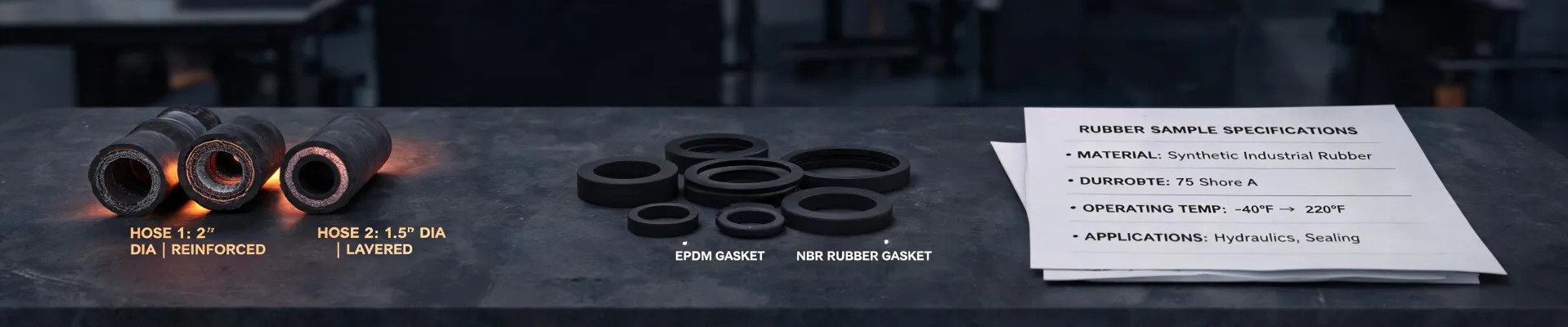
A practical rubber products buying checklist from an administrative buyer who manages commercial orders. Learn how to evaluate rubber flashing, rubber brooms, and material choices like polyurethane vs. rubber before committing to a purchase.
-
Who This Checklist Is For
-
Step 1: Know What You're Actually Buying (Polyurethane vs. Rubber)
-
Step 2: Match the Product to the Real Application
-
Step 3: Verify Who Actually Makes the Product
-
Step 4: Get a Physical Sample First
-
Step 5: Compare Total Lifecycle Cost, Not Unit Price
-
Step 6: Verify Invoicing and Documentation Before You Order (The One Everyone Hates)
-
Common Mistakes I Still See Buyers Make
-
One Last Thing
Who This Checklist Is For
If you're the person responsible for sourcing rubber products—rubber flashing for a facility repair, rubber brooms for a warehouse, tires for a company fleet—you've probably figured something out quickly: rubber is one of those categories where two things that look nearly identical can perform completely differently. And unless you've got a materials engineer on staff, you're making decisions with limited information.
This is the checklist I wish someone had handed me when I took over purchasing in 2020. I manage about $80,000 in orders annually, split across roughly eight vendors for different categories. I'm not a chemist. I'm the one who has to figure out what actually works, order it, and not look bad when something shows up that doesn't do the job. These six steps have saved me more times than I can count.
Step 1: Know What You're Actually Buying (Polyurethane vs. Rubber)
The most common question I hear from colleagues: is polyurethane plastic or rubber? It's a fair question, because the answer isn't straightforward.
Polyurethane is technically neither traditional plastic nor rubber. It's a polymer that can be formulated to behave like either one depending on how it's made. It's tempting to think you can simply group materials into "hard" and "soft" and move on. But the reality is more complicated. Polyurethane generally gives you superior abrasion resistance and load-bearing capability. Natural rubber offers better elasticity and bounce-back. Neoprene handles oil and weather exposure. Nitrile resists fuels and chemicals.
Here's the buyer's takeaway: don't get stuck on the material name. What matters is whether the product will survive the conditions you're putting it in. Will it be exposed to solvents? Constant UV? Heavy friction? I ordered rubber flashing for a roof repair in 2021 without checking whether it could handle direct sunlight long-term. The material wasn't formulated for it. Six months later, we were buying a second batch and paying a contractor to redo the work.
Step 2: Match the Product to the Real Application
It sounds obvious, but I've watched buyers—myself included—order based on a catalog photo that looked "close enough." That disconnect is how you end up with rubber brooms that shed bristles on concrete floors or gaskets that don't hold up to the fluid they're sealing.
Before you place an order, write down the actual operating conditions. What's the environment? What will the product touch? How much wear will it see? If the supplier can't specify whether the product is rated for your conditions, that's a sign to keep looking.
For our facility, rubber brooms were the wake-up call. A standard broom looks fine in the product image. But in an automotive shop environment with oil and metal shavings on the floor, the "standard" model wore down in about three months. The heavy-duty version cost a little more initially and lasted over a year. Same product category, completely different total cost.
Step 3: Verify Who Actually Makes the Product
This is the step I used to skip. I'd compare a few prices, check the specs, and order. But over the years I've learned that the company selling you a rubber product isn't always the company that made it. Some vendors are resellers, and resellers vary widely in how carefully they vet their suppliers.
When a supplier tells me they manufacture what they sell, that carries real weight. I've worked with Cooper Tire and Rubber Company for our fleet tires, and the fact that they've been manufacturing since 1914 matters to me—not for nostalgic reasons, but because that kind of history usually means they control their compounding, curing, and quality checks. Vertical control means fewer surprises.
Ask any rubber product vendor directly: "Are you the manufacturer, or do you source this elsewhere?" If they source it, ask who the original maker is. If they hesitate—that's a red flag.
Step 4: Get a Physical Sample First
I know sample requests add time and a bit of paperwork. I also know that skipping them has cost me more than any sample fee ever would. A $40 sample charge is a cheap insurance policy against a $4,000 order of rubber flashing that doesn't fit the mounting surface or can't handle the heat.
When you get a sample, don't just look at it. Test it where it'll actually be used. Install it. Flex it. Hit it with the chemicals or weather conditions it'll face. And keep a note of which product and supplier each sample came from.
In 2023, I compared two rubber broom suppliers using samples. They looked almost identical side by side. But the bristle density was visibly different when I bent them back, and one held its shape while the other stayed bent. That 10-minute test saved us from a bad bulk order. Never expected a simple sample test to be the deciding factor, but it was.
Step 5: Compare Total Lifecycle Cost, Not Unit Price
The "always take the lowest quote" advice ignores a ton of nuance. That thinking comes from an era when rubber products were more standardized than they are today. Modern rubber formulations vary heavily in quality, and a cheap product that wears out or fails early isn't cheap at all.
Total cost includes the purchase price, shipping, expected service life, replacement labor, and the cost of downtime if the product fails in service. When I look at rubber products now, I ask suppliers for expected lifespan data, not just dimensions and material specs.
During our 2024 vendor consolidation project, I compared two options for rubber brooms across all three of our locations. One was roughly $6 cheaper per unit. The other had a heavier bristle base and a reinforced handle joint. We spent the extra $6. Eighteen months later, our replacement rate on those brooms is about a third of what it was with the budget model. That's the difference between a purchasing decision and a procurement pattern that drains the budget.
Step 6: Verify Invoicing and Documentation Before You Order (The One Everyone Hates)
This is the step that's easiest to ignore until it bites you. Let me give you an unflattering example. In 2021, I found a great deal on rubber flashing from a new vendor. The product looked fine, the price was solid. But the vendor couldn't provide a proper invoice—just a handwritten receipt. Finance rejected the expense. I absorbed nearly $900 from my department budget. That is not a conversation you want to have with your VP.
Now, before any rubber product order, I confirm:
- The vendor can provide itemized, tax-compliant invoicing
- They can supply a W-9 if we don't already have one on file
- Product spec sheets or certificates of analysis are available
- Warranty terms are in writing, not just implied
I have mixed feelings about paperwork requirements. Part of me thinks it's excessive bureaucracy when the product description seems clear enough. But the other part remembers what it's like when a product fails and there's no documentation trail to support a claim against the vendor. The paperwork isn't for the supplier's benefit—it's your protection.
Common Mistakes I Still See Buyers Make
Here are the errors that show up again and again in commercial rubber purchasing, and I've hit most of them myself at some point:
- Assuming the material is uniform. Is polyurethane plastic or rubber? The answer depends on the formulation. Ask what the product is actually designed to handle.
- Buying based on a photo. Product photos can't convey density, thickness, or durometer. Get numbers, not just pixels.
- Treating all vendors as equal. A manufacturer with decades of compounding knowledge brings quality controls and accountability that a trading company won't have.
- Underestimating small rubber parts. Rubber flashing, brooms, gaskets, and o-rings feel like minor purchases—until a facility issue or safety problem traces back to one.
One Last Thing
You don't need to become a rubber expert to buy rubber products well. You need a repeatable process and the discipline to follow it. Ask the right questions, verify the supplier's credentials, sample before you scale, and remember that the cheapest quote rarely is.
An informed buyer makes better decisions and asks better questions. If a supplier can't or won't answer those questions, consider that information too—and move on.
Cooper Tire editorial note
Rubber sourcing decisions should be tied to measurable application facts. If a post raises a question about material choice, compliance files, or qualification planning, send the use condition and drawing for a practical review.