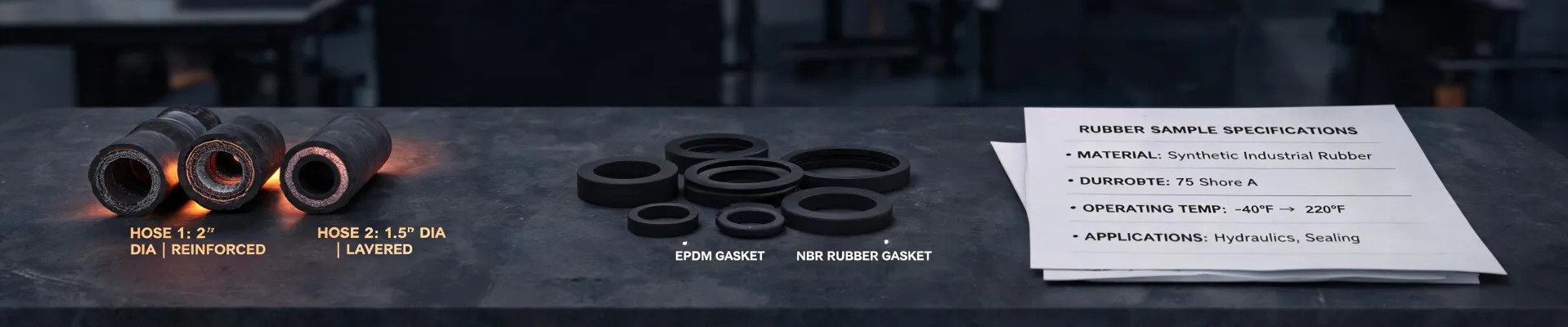
After wasting roughly $3,200 on rubber product mistakes since 2017, I put together this five-step buying checklist. It answers "is rubber a thermoplastic" in plain language, explains why durometer matters as much as thickness, shows how to evaluate brands like Cooper Tire, and covers what to ask before ordering thick rubber mats or rubber bumper pads.
When I first started handling rubber and plastic material orders back in 2017, I honestly figured "rubber is rubber." Pick a thickness, check the price, move on. Then I ordered 140 thick rubber mats for a workshop renovation, and my supervisor looked at the spec sheet and asked, "What exactly did you specify?"
I didn't have a good answer.
Since then I've made and documented eleven significant mistakes, totaling roughly $3,200 in wasted budget. Now I maintain our buying checklist, and the version below is what I give new team members. It covers what I check before ordering a thick rubber mat, rubber bumper pads, or any rubber component in a B2B environment. Five steps, plus the mistakes I keep seeing other buyers make.
Is Rubber a Thermoplastic? Answer This Before You Order
That sounds like a question from a polymer science textbook. A lot of buyers skip it, and I was one of them until 2020. But the answer determines whether your product lasts for months or for years.
The short version: classic rubber is a thermoset. Tire-grade rubber is vulcanized—cross-linked, essentially—so it can't be re-melted or reshaped. That's what gives it durability under heat and repeated load. Thermoplastic rubber (TPR or TPE) looks and feels similar, but it doesn't have that permanent cross-linking, so it can be re-melted and reprocessed.
What changed in the last decade is that thermoplastic elastomers got a lot better. You now find TPE in products that used to be exclusively thermoset rubber: mats, bumper pads, gaskets, seals. That's a good thing for some applications, honestly. But it also means the word "rubber" on a product description tells you less than it used to.
In May 2022 I ordered rubber bumper pads for a machine station. They looked and felt right, and the price was right. By late August, six stations had loose hardware because the pads had deformed in the summer heat. That cost me $890 in redo plus a one-week production delay. The datasheet described the material as "rubber"—it was actually a thermoplastic compound chosen for price, not performance.
To be fair, TPE isn't bad material. Modern thermoplastic elastomers are genuinely useful in the right environment. But you need to pick the polymer family based on your actual conditions—heat, load, oil, UV—not just on what the seller decides to call rubber.
Put a Durometer Number on the Order, Not Just "Thick"
If you're searching for a "thick rubber mat," you're probably focused on one number: thickness. Half an inch, three-eighths, a quarter. But thickness is only half the specification. Hardness is the other half, and it's measured in Shore A.
Here's a practical reference:
- 40–60 Shore A: soft and grippy. Good for rubber bumper pads, vibration mounts, and edge cushioning.
- 60–80 Shore A: the practical range for thick rubber mats and general industrial sheet.
- 80–95 Shore A: firm. More for rollers, chute liners, and scraping applications.
I learned this in 2019, when I ordered fifty bumper pads with "1/2 inch thick" and no hardness requirement. They showed up like hockey pucks. I checked them myself, approved them, and processed them into inventory. We caught the issue at install, when the pads wouldn't compress enough to seat the fixture properly. $450 in re-machining plus a three-day delay.
Now a Shore A number goes on the PO, or I don't approve it. And when a supplier can't tell me the durometer of their own thick rubber mat, I take that as a sign I should check their technical depth before I commit.
Ask What "Recycled Rubber" Actually Means
Recycled content is becoming standard in rubber product buying, which I think is a good direction. But I got burned in Q1 2024 by treating "recycled rubber" as a checkbox instead of a specification.
"Recycled" doesn't mean one thing. Per the FTC Green Guides—the current version, 16 CFR Part 260, is available at ftc.gov—a recycled-content claim should be qualified with the percentage when the product isn't made entirely from recycled material. In practice, that means you need to ask the vendor: "What percentage of the content is recycled, and will you put that in writing?"
The question everyone asks is, "What's your price per square foot?" The question that saves you later is, "What's actually in this material, and where's the documentation?"
I learned the difference between those two questions the hard way: I approved a "recycled rubber" mat for a project without asking for the percentage. The mats started cracking after about ten months. When the client asked to see our recycled-content documentation, all we had was a marketing line from an invoice. That cost us a repeat order and a chunk of credibility.
Reputable suppliers answer the percentage question without hesitation. The ones who treat it as an attack on their pricing are telling you something.
Check the Manufacturing Track Record
For a generic rubber product with low stakes, buy from whoever is cheapest. For anything that needs to survive real use, I want a manufacturer with compounding knowledge—not a trading company that resells imported sheets of black material.
This is where brand history comes in. The Cooper Tire brand is a good example: the company has been in business since 1914, and it manufactures both tires and industrial rubber components like thick rubber floor mats, bumper pads, hoses, and gaskets. A century of compounding experience shows up in batch-to-batch consistency. That's not a marketing slogan; it's the reason established brands get specified over anonymous imports.
To be fair, a long history doesn't guarantee a specific product is right for your job. But I'd rather start with a brand that understands the material science and has something to lose. Earlier this year I went back and forth on a bumper pad order between a low-cost supplier and an established brand. The spreadsheet said the low-cost option was 22% cheaper. Something felt off about them not having a physical address anywhere on their site. I went with the established brand anyway. Two months later, the low-cost supplier showed up in a complaint thread about material deformation. The data said one thing. The track record said another.
Confirm the Thickness Tolerance in Writing
I'll keep this one short.
Rubber sheets aren't machined parts. They're calendered or molded, and they ship with tolerances. A "1/2-inch" thick rubber mat can arrive at 0.44 inches or 0.54 inches, depending on the manufacturer's standard. That matters if a floor opening, machine level, or code requirement depends on the actual dimension.
Ask: "What's the tolerance, and what test method do you use?" A real seller answers that immediately.
In September 2023, I took delivery of 48 thick rubber mats. Thirty were fine. Eighteen were about six-hundredths of an inch too thin for the requirement on our work order. The supplier pointed to "standard tolerance"—which was nowhere in the order documentation. Re-sourcing those 18 mats at overnight freight turned a $2,800 order into roughly $4,000.
Three Mistakes That Are Still Way Too Common
Even after working through the checklist, I see buyers repeat these three:
- Skipping the sample. A 12-inch square might cost you twenty dollars. A bad production run costs hundreds or thousands. Get a sample, flex it, weigh it, test it in your actual environment.
- Ordering from a photo. One product image and no technical datasheet means you're not buying rubber, you're buying a gamble. Ask for the datasheet before you commit.
- Ignoring the environment. A mat that works perfectly in a climate-controlled plant can fail quickly on a hot loading dock. Same for bumper pads near hydraulic oil. Temperature, oil, ozone, and static load all change the right material choice.
The industry has changed a lot since 2017—thermoplastic compounds are better, recycled content is a real option, and online sourcing has replaced most of the catalog work I used to do. The fundamentals haven't changed, though. Confirm the polymer, confirm the durometer, confirm the tolerance, and get it in writing. That list has saved me money every quarter since I wrote it.
Cooper Tire editorial note
Rubber sourcing decisions should be tied to measurable application facts. If a post raises a question about material choice, compliance files, or qualification planning, send the use condition and drawing for a practical review.