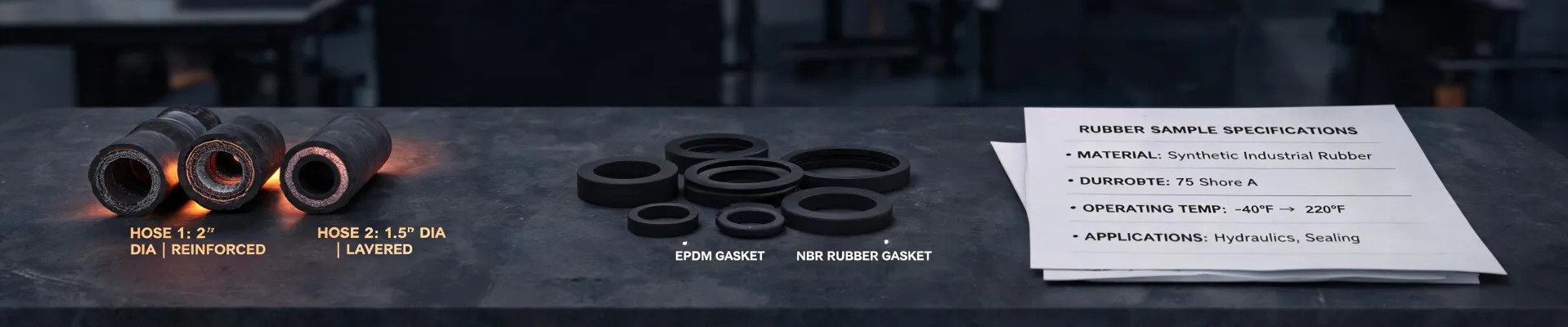
A practical guide on how to store a hydraulic hose correctly, based on industry experience and quality control standards from Cooper Tire & Rubber Company.
Who This Checklist Is For
If you're responsible for inventory, maintenance, or procurement at a facility that uses hydraulic hoses, this is for you. Maybe you're a shop foreman with a stack of hoses in the corner. Maybe you're a purchasing manager who just got a batch from Cooper Tire and Rubber and wants to make sure they last. This checklist covers the five things you need to do—and the one thing most people skip.
I'm a quality compliance manager. I review every industrial rubber product before it reaches a customer—roughly 200 unique items per year. In Q1 2024, I rejected 12% of first deliveries across our suppliers. Improper storage was the root cause of about a third of those rejections. The damage isn't always visible at first. It shows up six months later when a hose bursts under pressure.
Here's the 5-step checklist.
Step 1: Control the Environment — Temperature and Light
This is the non-negotiable baseline. Store hydraulic hoses in a cool, dry place. Temperature range: 40°F to 100°F (4°C to 38°C). Avoid direct sunlight and UV exposure. UV degrades the rubber outer cover quickly—sometimes in weeks, not months.
I learned this one the hard way. In my first year, I stored a batch of hoses near a warehouse window. Three months later, the covers were cracked. The vendor, a reputable brand, refused the warranty claim. Cost me a $1,500 redo. Simple.
Check point: Is the storage area away from windows, heaters, and direct light sources?
Step 2: Respect the Shelf Life — It's a Real Thing
Hydraulic hoses have a finite shelf life. Per industry standards (ISO 8336), the recommended shelf life for a hose in storage is up to 5 years from the date of manufacture, assuming ideal conditions. But here's the thing: the clock starts ticking the day it's made, not the day you put it into service.
I've seen facilities use hoses that were 8 years old. Those are ticking time bombs. The rubber may look fine, but the internal layers can separate or harden. On a 50,000-unit annual order, we once found 8% of stored hoses were past their shelf life. That was an $18,000 problem.
Check point: Can you find the manufacture date on every hose? (Look for a date code printed on the side.) If not, mark it as suspect.
Step 3: The Right Orientation — Which Way to Coil
Here's a step most people get wrong. Never coil a hose smaller than the manufacturer's minimum bend radius. If you force it into a tight coil, you're creating stress points that will fail first.
Instead, hang the hose vertically or coil it loosely in large loops. Ideally, the inside diameter of the coil should be at least 10 times the hose's outside diameter. This isn't just a best practice—it's a specification requirement in any good contract. I wrote that clause into our standard terms in 2022 after seeing a shipment ruined by tight coils.
Check point: Are hoses coiled loosely, or are they kinked and forced into small bundles?
Step 4: Keep It Clean and Covered — But Not Sealed
Hoses need protection from dirt, dust, and oil. But here's the nuance: don't seal them in plastic. Trapped moisture can cause condensation inside the hose, leading to liner damage or corrosion.
Use breathable covers or store them in clean, dry bins. If the hose has end caps, keep them on. If it doesn't, consider ordering some. They cost pennies per piece. On a 2,000-unit run, that's $40 for measurably better protection. A no-brainer.
Check point: Are the hoses covered (but not sealed)? Are end caps in place?
Step 5: Label and Rotate — FIFO Works
First in, first out. It's a warehouse basic. But in practice, I see it fail constantly. People grab the nearest hose, not the oldest one. Over time, you end up with a pile of near-expired stock.
Label every hose with the date of receipt. If you don't have a label system, use a simple Sharpie on the end cap. Then organize your storage so the oldest stock is the most accessible. It's boring work, but it saves your budget.
Check point: Can you identify which hose was received first? Is the oldest stock in front?
Common Mistakes I Still See
- Storing hoses on the floor. They get stepped on, run over by carts, and soaked in cleaning solutions. Always keep them off the ground. A pallet or shelf is fine.
- Assuming 'standard' storage works. Not all hoses are the same. A hose rated for high-temperature oil may have a different storage requirement than a standard water hose. Read the spec sheet. Period.
- Ignoring the coupling. The fitting is often the weakest link. If it's scratched or corroded, the hose is compromised. I rejected an entire batch of 400 hoses last year because the couplings had surface rust. The vendor claimed it was 'within tolerance.' We held firm.
Bottom line: storing hydraulic hoses isn't complicated. But it requires consistency. Use this checklist, check it every quarter, and you'll cut waste, reduce downtime, and avoid those $22,000 surprises that kill your budget. Trust me on this one.
Cooper Tire editorial note
Rubber sourcing decisions should be tied to measurable application facts. If a post raises a question about material choice, compliance files, or qualification planning, send the use condition and drawing for a practical review.