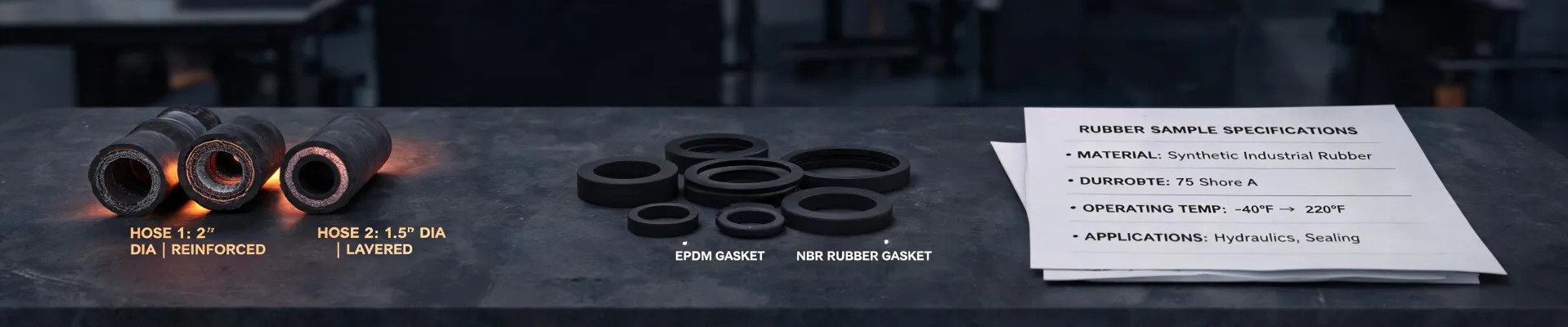
Based on years of handling rush orders for industrial rubber products—from tire components to custom strips and gaskets—this article reveals why most supply emergencies happen and how a prevention-first approach saves time, money, and headaches.
It was 4 PM on a Thursday when the call came in. A manufacturing client needed 200 feet of nitrile rubber sheet by Friday morning for a critical seal replacement. Normal lead time: 5 days. They'd already tried two other suppliers who said no. I knew we could probably pull it off—but the rush fee was going to sting, and there was a decent chance the spec was wrong. Honestly, I've learned to be skeptical when the request comes in that hot.
If you've ever been on the buying side of rubber supply, you know the scenario. A project is on the line, a machine is down, or a deadline got moved up. You need rubber—quick. And in those moments, you're less worried about the material science than just getting something that fits. That's exactly where problems start.
The Surface Problem: Last-Minute Rubber Orders Are Expensive and Risky
The obvious pain point is that emergency orders cost more. Rush fees, expedited shipping, overtime labor—I've seen markups of 30% to 50% just to shorten the lead time by half. But money is only part of it. The real risk is that when you're rushing, you cut corners on verification. The buyer thinks they know the spec. The supplier thinks they understand. And then the product arrives and it's the wrong durometer, or the wrong width, or it doesn't have the oil resistance required.
I've coordinated something like 200+ rush orders over the past 6 years. The ones that go sideways almost always share one thing: a skipped verification step. Take this as an example: a client once told me they needed "rubber strips," and I assumed they meant EPDM because that's what 80% of our orders are. Turned out they needed neoprene for chemical resistance. The order was wrong, the plant almost shut down, and we ended up paying $400 in extra freight to overnight the correct material. The whole thing could have been avoided with one five-minute phone call.
But here's what took me a while to understand: the problem isn't really about rushing. The problem is that many buyers don't know what they don't know about rubber materials.
The Deeper Cause: Material Confusion and the "It's All Rubber" Myth
To be fair, rubber is a huge category. There's natural rubber, nitrile (NBR), EPDM, neoprene (CR), silicone, fluoroelastomers (Viton), SBR, polyurethane—and then there are thermoplastic elastomers (TPE) that people often lump in as "rubber" even though they behave differently. I get why someone would think, "It's all rubber, it stretches, it seals." But the differences matter, especially for industrial applications.
For instance, is polyethylene rubber? Short answer: no. Polyethylene (PE) is a thermoplastic, not an elastomer. It doesn't have the memory or flexibility of true rubber. I've seen orders go wrong because a buyer specified "polyethylene rubber" thinking it was a kind of rubber, and the supplier delivered PE sheeting that couldn't take the required compression set. That's an expensive lesson.
TPE (thermoplastic elastomer) sits in a gray area—it handles like rubber in some ways but can be processed like plastic. It's fine for many applications, but you need to know the temperature range and chemical exposure. The point is, without clear specifications, the chance of mismatch is high.
A trigger event that changed how I think about this happened in March 2023. A client called in a panic because their existing supplier delivered "commercial grade" rubber gasket material that failed after two weeks. The spec sheet from the original equipment called for 70 durometer nitrile. The replacement was a generic SBR. The difference? Nitrile resists oil and fuel; SBR does not. The client lost two days of production and had to pay for a full regasket. When I asked why they didn't verify the material grade, they said, "I assumed rubber was rubber." That's the myth I've spent years debunking.
It took me 4 years and maybe 150 order snafus to understand that the root cause of most rubber supply emergencies is not the supplier's fault—it's the gap between what the buyer asks for and what they actually need. And that gap is almost always a spec communication issue.
The Real Cost: Beyond the Rush Fee
Let me give you a concrete example from last quarter. A regular customer ordered 500 feet of silicone rubber tubing for a food-grade application. They'd ordered similar before, so they didn't bother to double-check the requirements. The order came in, looked fine, and shipped. Three days later they called: the tubing was leaching a faint odor, unacceptable for their FDA-compliant line. We'd sent standard silicone, but they needed a platinum-cured grade. The difference in cost is maybe 15-20% more, but the cost of the mistake was much higher: the client had to throw out the first batch, pay for a rush replacement (another $300 in fees), and lost two weeks of production. Total damage: I'd estimate north of $5,000—easily 10x the potential savings from not specifying the grade upfront.
I've seen this pattern repeat. Skipped the final review because "it's basically the same as last time." It wasn't. $400 mistake. Knew I should get written confirmation on the deadline but thought "we've worked together for years." That was the one time the verbal agreement got forgotten, and the entire order was delayed by a week. The cost to the client's project? Hard to quantify, but it included a penalty clause of $50,000 if the installation was late. Luckily we caught it in time, but the stress was brutal.
My experience is based on mid-range industrial orders—$500 to $15,000—not ultra-budget or luxury segments. If you're working in low-volume prototyping with a different supply chain, your experience might differ. But for any production-critical rubber supply, I think the same principles apply.
So What Actually Works? (Spoiler: It's Boring but Effective)
After years of putting out fires, the conclusion is almost anticlimactic: a prevention mindset beats every cure. Here's what I've found works best, drawn from the checklist I built after my third major mistake.
- Write a real spec. Don't just say "rubber strip." Specify material (NBR, EPDM, silicone…), durometer (Shore A), dimensions, temperature range, chemical exposure, and any certifications (FDA, UL, etc.). If you're not sure, ask the supplier before ordering—it's faster than the return loop.
- Get a sample. For anything non-stock, a physical sample costs maybe $20 in shipping and saves thousands. I've learned to insist on this even when the client says "we don't have time." Because if you don't have time to verify, you will have time to redo.
- Build relationships with suppliers who have broad product ranges. A vendor like Cooper Tire—yes, the tire company, but also a major supplier of industrial rubber products through Cooper Tire & Rubber Co.—carries everything from tire materials to custom extruded profiles and sheet goods. Their Texarkana plant has been around for decades, and from what I've read in reviews from industrial buyers, their reliability is a common praise point. Having a supplier with diverse stock means they can likely cross-reference your needs without starting from scratch.
- Use a checklist. The 12-point verification form I developed after the third durometer mismatch has saved us an estimated $8,000 in potential rework over the past two years. It's literally a one-page PDF that takes 10 minutes to fill out. Cheapest insurance you'll ever buy.
I'm not 100% sure these exact numbers apply to every rubber supply chain, but roughly speaking, the savings from avoiding one emergency order usually covers the cost of implementing a prevention system for the next six months. And if you visit the Cooper Tire website (coopertire.com), you can find their product catalogs and technical data sheets that help you narrow down the right material without guesswork.
Bottom line: rubber supply emergencies are often self-inflicted. The fix is boring—better specs, better communication, better checklists. But boring saves money, and in my experience, it's the only reliable way to keep the production line humming without paying through the nose for last-minute heroics.
Cooper Tire editorial note
Rubber sourcing decisions should be tied to measurable application facts. If a post raises a question about material choice, compliance files, or qualification planning, send the use condition and drawing for a practical review.