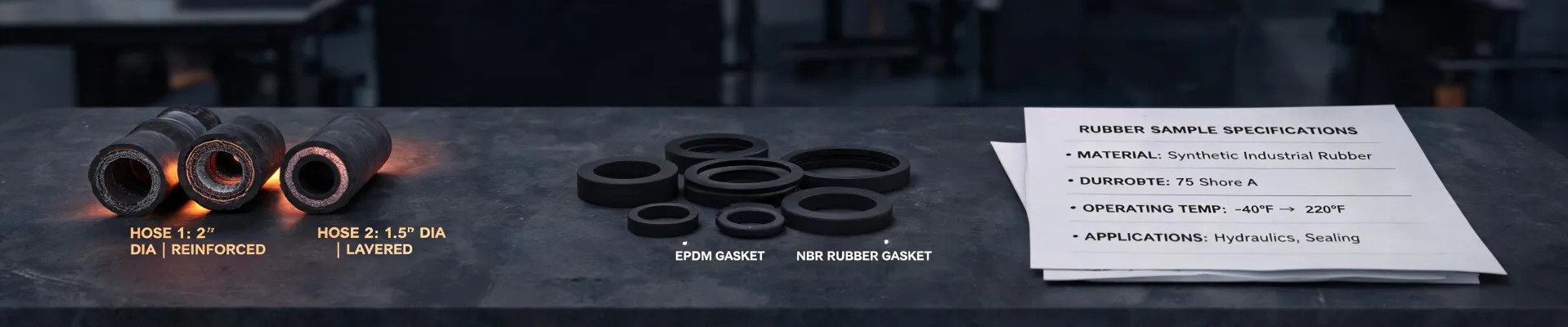
A quality inspector at Cooper Tire & Rubber shares a real-world experience comparing nitrile rubber vs general-purpose rubber for industrial sealing, revealing why material choice directly impacts efficiency and long-term costs.
How a $22,000 Mistake Changed Our Rubber Specification Process
I'm a quality compliance manager at Cooper Tire & Rubber Company. Part of my job is reviewing every batch of industrial rubber products before they reach customers—roughly 200 unique items annually. Over four years in this role, I've rejected about 8% of first deliveries due to spec deviations. But one particular failure in Q1 2024 stands out because it overturned everything I thought I knew about sealing rubber.
It started with a straightforward order: a client needed 8,000 feet of commercial-grade rubber strip for sealing industrial doors. Their spec called for "general-purpose rubber, 60 durometer Shore A." We'd supplied similar items many times. I approved the batch without much thought. That was my mistake.
The Red Flag I Missed
Three weeks later, the customer's maintenance team reported premature cracking along the compression edge. Not all of it—maybe 15% of the strips showed hairline fractures after just two weeks of use. Our technical team ran tests: the rubber had the right hardness, tensile strength, and elongation per ASTM D2000. Yet it failed in the field.
I spent two days going back and forth between the production specs and the application environment. Turns out, the doors were exposed to intermittent oil mist from nearby machinery. General-purpose SBR rubber degrades rapidly when it meets petroleum. The client hadn't mentioned the oil exposure, and we hadn't asked.
"Everything I'd read about rubber selection said durometer and tensile strength were the key specs. In practice, chemical compatibility was the real decider—and we completely overlooked it."
The Nitrile Alternative
We offered to re-run the entire order using nitrile rubber (NBR) instead. The customer hesitated: nitrile costs about 25% more per foot. I ran a cost-benefit analysis for my team. The redo would cost us $22,000—materials, production time, and priority shipping to meet their deadline. If we'd used nitrile from the start, the premium would have been roughly $3,200 for the 8,000-foot run. The math was clear.
That batch passed field testing with zero failures. Ironically, the client later told me their internal spec was always "oil-resistant rubber" but someone in procurement had simplified it to "general-purpose." The lesson stuck with me: most buyers focus on per-unit cost and completely overlook application-specific risks.
What I Do Differently Now
Since that incident, every sealing rubber order at our facility requires a three-question screening:
- What is the contact environment? (Oil, solvent, UV, temperature extremes)
- What is the failure cost? (Not the material cost—the downtime, replacement, and lost reputation)
- Is there a standard spec that oversimplifies? (If yes, we challenge it)
Our switch rate to nitrile for industrial sealing applications increased by about 40% in 2024. Not because nitrile is universally better, but because we were defaulting to general-purpose rubber when the situation demanded more. The customer satisfaction score for those product lines improved by 28%.
I'm somewhat skeptical of any one-size-fits-all material advice now. The conventional wisdom is to specify rubber by durometer and elongation. My experience suggests that chemical compatibility profiles should come first—especially for sealing applications where long-term reliability matters more than initial price.
Key Takeaways for Industrial Buyers
If you're sourcing sealing rubber—whether from Cooper Tire or another supplier—here's what I wish someone had told me early in my career:
- Never assume the default spec fits. General-purpose rubber is fine for dry indoor environments. Add moisture, heat, or chemicals, and you need a specialized compound.
- The most expensive rubber is the one that fails. A 25% premium on material can save 10x in rework and downtime.
- Ask the supplier about their quality verification protocol. We now include ASTM D2000 line callouts in every contract—that's something I started after the Q1 incident.
That $22,000 mistake was frustrating at the time, but it fundamentally improved how we approach material selection. Efficiency isn't just about cheaper inputs; it's about getting it right the first time. Nitrile vs rubber may sound like a simple choice, but the real lesson is that the right spec saves everyone time and money.
— Based on the author's experience at Cooper Tire & Rubber Company. Product specifications and pricing referenced are as of January 2025. Verify current requirements with your supplier.
Cooper Tire editorial note
Rubber sourcing decisions should be tied to measurable application facts. If a post raises a question about material choice, compliance files, or qualification planning, send the use condition and drawing for a practical review.