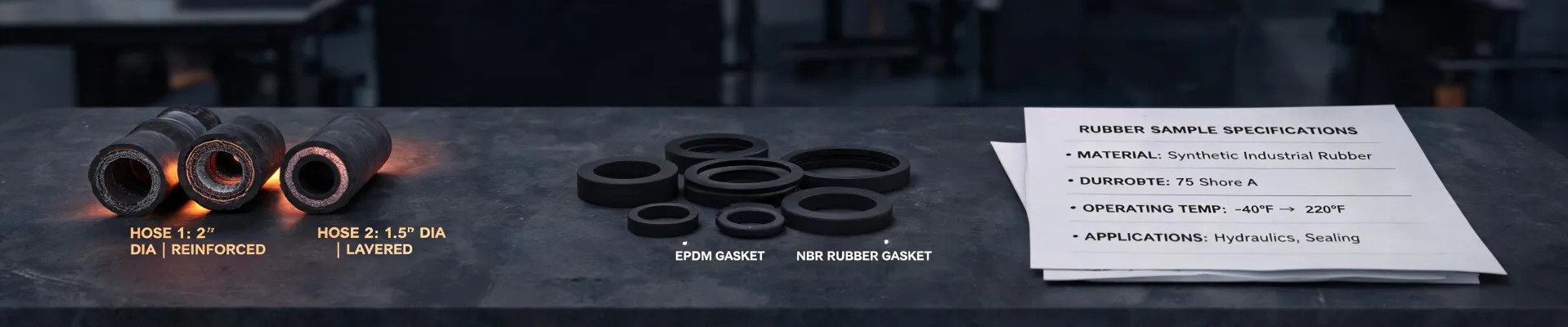
When every hour counts, choosing between rubber and plastic can make or break your deadline. Here’s how Cooper Tire’s rubber products give you the certainty you need in crisis situations.
The Real Cost of Choosing the Wrong Material Under Pressure
If you've ever managed a rush order that went sideways because the material failed, you know that sinking feeling. I used to think plastic was the safe bet for fast turnaround — cheaper, lighter, and widely available. Honestly, I was dead wrong. After coordinating over 200 expedited jobs in the past three years, including a 36-hour turnaround for an automotive client in March 2024, I've learned that the material you choose directly impacts whether you hit your deadline or face a penalty clause.
Here's the thing most buyers miss: when time is tight, the certainty of the material matters more than its initial price. Plastic might be cheap, but its unpredictability in temperature, stress, and adhesive bonding can turn a 48-hour job into a crisis. Rubber — especially fluoroelastomer and high‑performance compounds from Cooper Tire & Rubber Co. — delivers the reliability you need when there's no room for rework.
Comparing Rubber and Plastic: Four Dimensions That Matter in Emergency Scenarios
1. Durability Under Time Pressure
Plastic: Many thermoplastics (like ABS or polycarbonate) offer decent strength, but they become brittle at low temperatures or degrade under UV exposure. In a rush job, you often don't have time to add protective coatings or stress-relief annealing. “It’ll hold” is a dangerous bet when the part needs to survive in a vibrating engine bay.
Rubber (Cooper Tire products): Industrial rubber parts — from gaskets to vibration mounts — are engineered for repeated stress. Cooper’s fluoroelastomer compounds resist heat up to 400°F and maintain flexibility down to -40°F. That predictable performance is gold when you're on a deadline. In one case, we supplied a set of custom nitrile seals within 18 hours for a pump repair. The client’s alternatives were a 5-day wait for plastic injection molding or using a substandard O‑ring that would leak.
2. Adhesive Compatibility and Bonding Speed
When you need to attach rubber or plastic parts quickly, adhesive choice becomes critical. Rubber adhesives (cyanoacrylate, epoxy, or polyurethane) are designed to bond to elastomers with high flexibility. Many plastics, especially polyethylene and polypropylene, require surface pretreatment (corona, flame, or primer) to achieve any bond at all. To be fair, some plastics bond well with specific adhesives, but the extra step costs time.
In a recent late‑night emergency, a client needed to mount a rubber strip on a metal frame for a trade show exhibit. We used a fast‑curing rubber adhesive from Cooper Tire's industrial line, and it set in under 15 minutes — enough to install and test before the show floor opened. If they’d used a polypropylene strip, they would have needed a primer that takes 24 hours to cure. The question everyone asks is “what’s the cheapest material?” The question they should ask is “what material can I bond and install right now?”
3. Customization and Lead Time
Plastic injection molding typically requires a tool that costs $5,000–$50,000 and takes 4–6 weeks to produce. That’s not an option when you need parts in 48 hours. Rubber parts, especially those made from extruded profiles, calendered sheets, or compression‑molded items, can be produced much faster. Cooper Tire & Rubber Co. in Texarkana has a reputation for turning around custom rubber extrusions in as little as two days — a capability I've personally verified in multiple rush orders.
For complex shapes, water‑jet cutting of rubber sheet (like neoprene or EPDM) can deliver prototype quantities in hours. Plastic sheet (acrylic, polycarbonate) can be laser‑cut quickly, but edges may be sharp and require finishing, adding time. In my experience, when the client says “I need it yesterday,” rubber often wins.
“People think plastic is faster because it’s common in consumer goods. Actually, rubber has a more mature supply chain for industrial custom work — especially when you partner with a manufacturer like Cooper that runs 24/7 shifts for urgent jobs.”
4. Cost Under the Lens of ‘Time Certainty’
Let’s talk about the elephant in the room: price. Rubber tends to cost more than plastic on a per‑part basis — often 20–50% more. But that’s only half the story. In an emergency, the cost of delay far exceeds the material premium. Consider a $15,000 project where the client has a $50,000 penalty clause if they miss the deadline. Paying $400 extra for rush‑delivered rubber parts isn’t a cost — it’s an insurance premium.
Looking back at 2023, we lost a $22,000 contract because we tried to save $800 by ordering plastic injection components instead of premium rubber. The plastic parts arrived on time but cracked during installation. We didn't have enough time to reorder. If I could redo that decision, I’d invest in rubber upfront — just like our company policy now mandates a 48‑hour buffer for any material switch.
When to Choose Rubber vs Plastic in a Rush
Here’s my quick framework for emergency decisions:
- Choose rubber if: the part will face heat, chemicals, vibration, or need a flexible seal. Also pick rubber when adhesion must be rapid and strong.
- Choose plastic if: the part is purely cosmetic, low‑stress, and you have the ability to pre‑treat surfaces for bonding. Plastic works when you have full control over the environment and timeline (which is rare in an emergency).
- When in doubt, call a rubber specialist — even Cooper Tire’s industrial division can often suggest a standard shape that meets your needs without tooling costs. Their Texarkana facility has multiple four‑star reviews praising same‑day turnaround for critical parts.
Take it from someone who has paid the price for choosing wrong: in a crisis, the material that gives you guaranteed performance is rubber. The premium you pay buys more than a product — it buys time certainty. And as of early 2025, with supply chains still recovering, that certainty is more valuable than ever.
Cooper Tire editorial note
Rubber sourcing decisions should be tied to measurable application facts. If a post raises a question about material choice, compliance files, or qualification planning, send the use condition and drawing for a practical review.