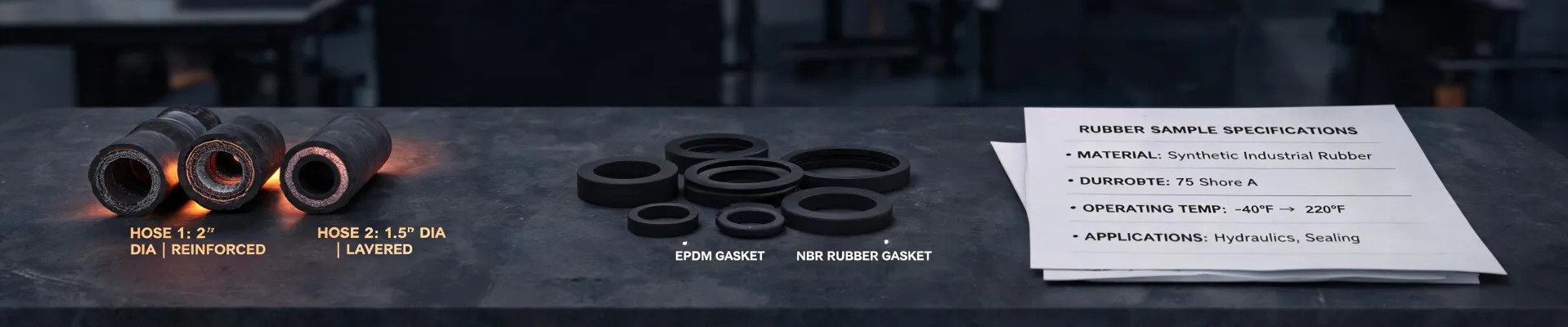
An honest look at choosing between TPU and rubber for industrial components, from a purchasing admin who learned the hard way that material specs matter more than price.
I Thought I Had a Simple Rubber Parts Order
Back in 2023, I needed a quick replacement for a rubber bag used in our pneumatic system. Nothing fancy. I found a supplier on a standard parts platform, saw a price that was 30% lower than our usual vendor, and thought I was being smart. (Spoiler: I wasn't.)
I placed the order on a Thursday. By Tuesday, the bag had split. That was my first hint that 'rubber' isn't just 'rubber.'
The Real Problem Wasn't the Supplier—It Was My Blind Spot on Materials
When I took over purchasing in 2020, I managed roughly $40,000 annually across 8 vendors for our office and light industrial needs. I learned to check pricing, lead times, and invoicing. What I didn't learn was material science. (Honestly, I figured rubber was rubber.)
I'm an administrative buyer, not an engineer. My job is to keep things running smoothly and make sure Finance doesn't reject my expense reports. But that split rubber bag taught me that ignoring material properties is a fast track to downtime.
The deep issue here isn't about finding a 'bad' vendor. It's that many of us in admin roles don't understand the practical differences between materials like TPU and standard rubber. We see 'rubber part' and click buy. That approach works until it doesn't.
I knew I should have double-checked the material specs for that application, but thought 'what are the odds?' Well, the odds caught up with me. The replacement had to be expedited, and our operations team lost half a shift while we waited. That cost more than the original 'deal.'
Why This Matters Beyond One Blown Bag
This isn't about one bad experience. It's a pattern. In our 2024 vendor consolidation project, I realized that material mismatches were a hidden source of rework and cost. We'd order a rubber gasket, find it degraded in three months, and blame the vendor. But sometimes, the issue was that we ordered the wrong material for the environment in the first place.
The Cost of Not Knowing: A $2,400 Mistake and a Lesson on TPU vs. Rubber
The most obvious cost was the replacement part itself. But the real damage was the downtime. A vendor who couldn't provide proper documentation on material specs cost us $2,400 in rejected expenses when I tried to claim the rushed replacement. (That unreliable supplier made me look bad to my VP.)
Processing 60-80 orders annually, I've learned that 'cheaper' up front often means 'more expensive' in the long run. Let’s break down the comparison that should have been obvious to me earlier.
| Property | Standard Rubber | TPU (Thermoplastic Polyurethane) |
| Abrasion Resistance | Good | Excellent |
| Oil/Grease Resistance | Poor to Fair | Good to Excellent |
| Flex Fatigue | Good | Excellent |
| Low-Temperature Flexibility | Fair | Good |
| Typical Cost (relative) | Lower | Higher |
The 5 minutes I saved not checking the spec against our operating environment cost a lot more than 5 days of correction. That unreliable supplier had the right price, but the wrong product for our conditions.
I know what you're thinking: 'Well, you should have just asked the supplier.' I did. He said it was 'heavy-duty rubber.' Which, technically, it was. But it wasn't TPU, which is what the original spec required. His advice wasn't malicious—he just didn't know our specific application. And I didn't know to ask the right question.
Prevention Over Cure: A Checklist I Now Swear By
After that mess, I created a simple 12-point checklist. The key questions for materials like TPU or rubber are surprisingly straightforward:
- What is the operating temperature range? Rubber degrades faster at high temps.
- Is there oil, grease, or chemical exposure? Standard rubber swells. Nitrile or TPU is better.
- Does the part flex repeatedly? TPU wins on flex fatigue.
- Is UV or ozone a factor? Some rubbers crack; TPU is more resistant.
- What is the required durometer (hardness)? This affects wear and seal performance.
Checking these 5 things (from my 12-point checklist) before placing an order has saved us an estimated $8,000 in potential rework over the last two years. It's the cheapest insurance I've ever bought. Simple.
This approach worked for us, but our situation is a mid-size B2B company with predictable ordering patterns. If you're dealing with custom prototypes or extreme environments, the calculus might be different. I can only speak to my context.
My Cautious Take on 'Authorized' Suppliers vs. General Vendors
I am not saying you must only use Cooper Tire & Rubber Co. or a specific brand like Cooper Tire for every single rubber part. That's not realistic for an admin buyer. But I am saying that when you find a vendor (like a Cooper tire store for tires, or a specialty rubber supplier for industrial parts), their knowledge base is often worth the premium.
For instance, when I finally called a reputable industrial rubber supplier (not Cooper Tire for this part, but a specialist), they asked me two questions my discount vendor didn't: 'What's the fluid media?' and 'What's the cycle frequency?' Those two questions changed the material recommendation from standard SBR rubber to a TPU blend. That part has been running for 18 months without issue.
Honestly, I'm still not an expert on elastomers. If someone has deep insight on TPU vs. rubber cleats for specific applications, I'd love to hear it. To me, paying for that expertise is an investment in preventing my next $2,400 mistake.
Is the choice always clear? No. In some applications, standard rubber is perfectly fine and much cheaper. But you have to know when to use what. That's the lesson. Prevention over cure. It's not flashy, but it keeps the plant running and my expense reports clean.
Cooper Tire editorial note
Rubber sourcing decisions should be tied to measurable application facts. If a post raises a question about material choice, compliance files, or qualification planning, send the use condition and drawing for a practical review.