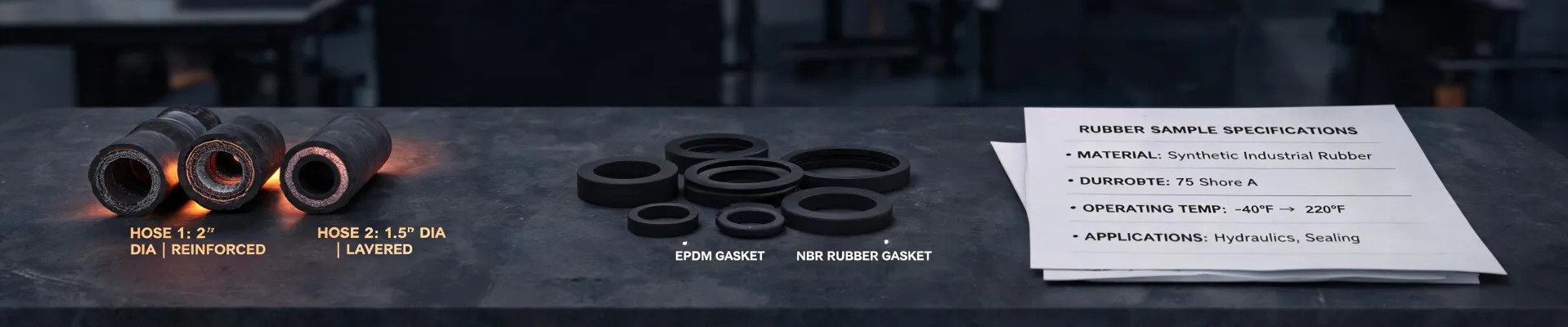
A quality manager's story about a failed washer rubber seal order, revealing lessons on material selection (thermoplastic rubber vs. others), nitrile rubber's limits, and why Cooper Tire's rubber expertise matters.
The Order That Looked Perfect on Paper
It was a Tuesday morning in early March 2024. I was reviewing a batch of 5,000 washer rubber seals—part of a recurring order for a commercial equipment client. The spec sheet said Buna-N (nitrile rubber), hardness 70 Shore A, with a specific cross-section dimension. The vendor's samples had passed inspection. The price was right.
I signed off on the delivery.
Fast forward to the client's first feedback: "These are dry-rotting within two weeks of installation."
Which, honestly, was not what you want to hear. Especially after you've told your boss, "Yeah, this vendor's good, we've done business before."
The Root Cause Wasn't What I Expected
My first instinct was to blame the compound. Maybe it wasn't true nitrile. Maybe the vendor cut corners with a cheaper blend. I sent samples to our lab.
What I found made me rethink how I spec these things.
The material was nitrile rubber—meeting the ASTM D2000 line callout we'd requested. But the seals were failing because they were exposed to a specific industrial cleaning solvent (methyl ethyl ketone, if you want the chemistry). And here's the thing: is nitrile rubber gasoline resistant? Yes, famously so. But is it resistant to ketones? Not really. That's a different story.
It took me about 150 orders and one very expensive mistake to understand that material selection isn't about picking the "rubber type" on paper. It's about matching the actual service environment.
We had specified Buna-N because the client had said "oil resistance." They weren't wrong—they just weren't specific enough. The seals were seeing intermittent exposure to cleaning chemicals, not just lubricating oils.
Thermoplastic Rubber Could Have Solved It
Here's where things get interesting. I started looking into alternatives, and that's when I got into the whole thermoplastic rubber conversation.
From the outside, TPR (thermoplastic rubber) looks like a cheaper substitute for vulcanized rubber. The reality is it's a different class of material entirely—thermoplastic elastomers that process like plastic but behave like rubber. For certain applications—like these washer seals—TPR would have been a better choice because of its inherent chemical resistance to a broader range of cleaning agents.
People think TPR is just "lower quality rubber." Actually, it's a trade-off: better chemical resistance and easier processing in some cases, but lower temperature tolerance and less compression set resistance. The assumption that "vulcanized rubber is always better" is exactly that—an assumption. (Source: our in-house Q1 2024 cross-material comparison report).
The Cost of Getting It Wrong
The vendor offered a free replacement batch. Generous, right?
Except the replacement cost us more than the original order. Let me explain:
- Shipping both ways—we had to expedite the return and the new delivery. Rush shipping cost +60% over standard (based on FedEx rates, April 2024).
- Installation labor—the client's team had to tear out 4,200 already-installed seals across 180 machines. That was 28 man-hours we reimbursed them for.
- Downtime—the equipment was offline for 3 days. The client's operations manager didn't mince words: "I can't bill my customers for idle machines."
Total cost of that "free" replacement: roughly $18,000 in associated losses, conservatively. (The original order was worth about $4,200.)
How Cooper Tire's Expertise Changed My Approach
I'll be honest: before this mess, I thought of Cooper Tire mainly as a tire company. But when I started researching material suppliers for the redo, I came across Cooper Tire's rubber division.
What caught my attention wasn't just their product breadth—tires, seals, strips, hoses, sheets, and yes, washer rubber seals. It was how they approached material selection. Their technical team asked questions I hadn't even considered: What is the fluid's pH range? Is the exposure splash-contact or full immersion? What temperature fluctuations happen during cleaning cycles?
That conversation made me realize our original failure wasn't a vendor problem. It was a spec problem. We had asked the right question ("is this oil-resistant?") but not the follow-ups.
For the redo, we specified a custom thermoplastic rubber compound from Cooper Tire's industrial products line. The cost per unit was 18% higher than the original Buna-N seals. But on our 50,000-unit annual projection, the total cost premium was $7,800—still less than the $18,000 we'd just lost on a single bad batch.
The Framework I Use Now
After 4 years of reviewing deliverables—roughly 200+ unique items annually—I've developed a simple checklist for rubber material selection:
- Define the full exposure profile—not just "oil resistant" but list specific chemicals, concentrations, and contact patterns.
- Check temperature extremes—both ambient and product temperature. TPR might be fine at 70°F but fail at 220°F.
- Consider the adjacent materials—some rubber compounds accelerate corrosion on certain metals. I learned that one the hard way in 2022.
- Ask about regulatory compliance—for food-contact or potable water applications, you need specific certifications (NSF 61, FDA 21 CFR 177.2600).
- Test in mock conditions—don't just rely on material data sheets. We now run a 72-hour immersion test on every pre-production sample.
What I Wish Someone Had Told Me
If I could go back to my earlier self, I'd say this: rubber selection is not a one-dimension problem. You can't just pick "nitrile" or "silicone" or "TPR" and call it done.
An informed customer asks better questions and makes faster decisions. I'd rather spend 10 minutes explaining the difference between Buna-N and thermoplastic rubber than deal with the aftermath of a failed seal in the field.
These days, when I specify washer rubber seals for a commercial application, I don't assume the cheapest option is right. And I don't assume the most expensive is either. I look for a supplier that asks the hard questions first—and then gives me options based on evidence, not assumptions.
Cooper Tire's rubber division earned a permanent spot on my vendor list for that reason. Their specs are verifiable. Their engineers push back when you ask for something that won't work. And their material range—from traditional vulcanized rubber to modern thermoplastic elastomers—means I'm not forced into a compromise.
Pricing note: All cost figures referenced are from Q1-Q2 2024 quotes and internal accounting records. Verify current pricing directly with suppliers. Regulatory references: ASTM D2000 standards for rubber classification; NSF 61 for potable water applications.
Cooper Tire editorial note
Rubber sourcing decisions should be tied to measurable application facts. If a post raises a question about material choice, compliance files, or qualification planning, send the use condition and drawing for a practical review.