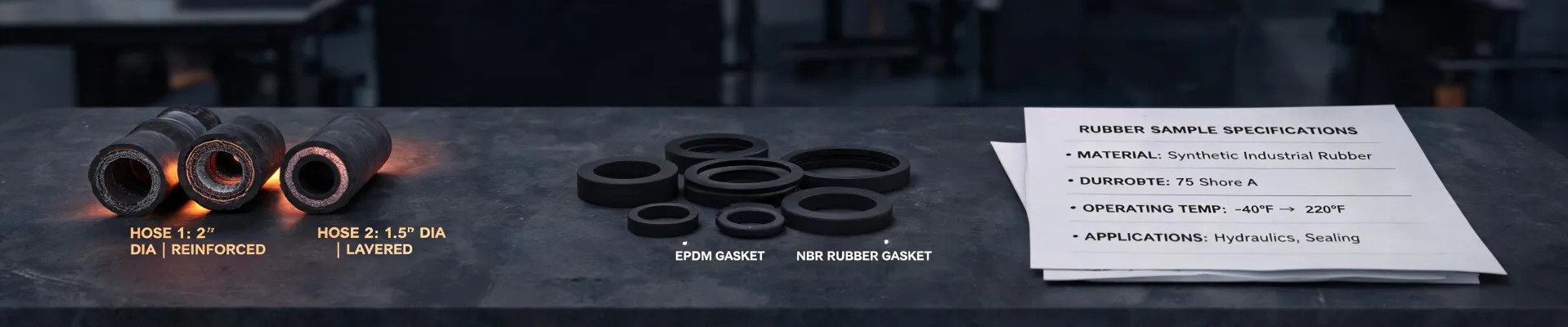
A practical, step-by-step guide from a purchasing administrator on how to specify and order nitrile butadiene rubber, EPDM, and chlorosulfonated polyethylene rubber strips for industrial and commercial use.
Who This Is For (And Why You Might Need It)
If you're responsible for ordering industrial rubber products—strip seals, gaskets, hose covers—and you're trying to figure out the difference between materials like EPDM rubber strip, chlorosulfonated polyethylene rubber (CSM), and nitrile butadiene rubber (NBR), this is for you.
I'm an office administrator for a mid-sized manufacturing support company. I handle all our industrial supply ordering—roughly $80k annually across about a dozen vendors. When I took over purchasing in 2020, I inherited a Rolodex of suppliers but zero documentation on what to use where. The first time I ordered the wrong material, it cost us a weekend of downtime. The second time, my VP had a very direct conversation with me.
Here's a 5-step checklist I built to make sure I get the right material every time. It's not perfect, but it's saved me from at least three expensive mistakes.
5-Step Checklist for Ordering Industrial Rubber Strips
1. Identify the Environment: You're Not Just Buying 'Rubber'
This is the step everyone thinks they skip, but it's the one that'll burn you. You're not buying 'rubber.' You're buying a material that has to survive a specific chemical, thermal, and mechanical environment.
Ask yourself (and your sales engineer) these three things really quickly:
- What will it touch? Oils, solvents, fuels, or just weather and water?
- What temperature range? Continuous heat? Freeze-thaw cycles?
- What physical stress? Abrasion, compression set (i.e., does it need to bounce back?), UV exposure?
Here's a super-simple rule of thumb I use, and it's served me well:
- Oils, fuels, hydrocarbons? That's likely Nitrile (NBR). It's the standard for fuel hoses, oil seals, gaskets.
- Outdoors, weather, ozone? That's EPDM. It's what you want for roofing membranes, window seals, and outdoor gaskets. It hates oils, but loves the sun.
- High heat, strong chemicals, or a need for color stability? That's where CSM (e.g., Hypalon) comes in. It's a specialty item—great for hose covers and cable jacketing in harsh environments. It's not cheap, but it's tough.
I can't overstate this: if you guess wrong at this step, you're done. I've seen a guy order a beautiful EPDM seal for a hydraulic system. It dissolved in three days (surprise, surprise). The part cost $40. The downtime cost $4,000.
2. Get the Spec Sheet (Don't Ask for 'The Good Stuff')
Once you know the environment, you need the numbers. Do not, under any circumstances, just ask a supplier for 'a good rubber strip.' That's meaningless. I'm not 100% sure why some sales reps let clients do this, but they do. And it ends poorly.
What you actually need to ask for are these three data points:
Durometer (Hardness). This is measured in Shore A. A 70 Shore A is your standard, all-purpose gasket. Softer (50-60) for better sealing on uneven surfaces. Harder (80-90) for high-pressure or structural needs.
Temperature Range. A standard NBR might be -30°F to +250°F continuous. EPDM can often handle higher heat. CSM can sometimes handle up to 300°F. Get the continuous rating, not the intermittent peak (which is usually a marketing number).
Elongation & Tensile Strength. For strips and gaskets, you need to know how much it'll stretch before it tears. 200-300% is normal. If you're clamping it in a door jamb, you need that data.
One thing I've learned the hard way: don't trust a data sheet from a third-party reseller. If possible, get it from the mill, or at least confirm it with the brand. For a brand like Cooper Tire, the spec sheets are detailed and reliable. For unbranded imports, I've seen numbers that were… optimistic (note to self: always verify on first order).
3. Confirm the Construction: Solid vs. Sponge vs. Cord
This is the step that trips up a lot of people, including me. You know the material, you have the durometer, but you haven't said how it's made.
There are three common constructions for sealing strips:
- Solid extrusion. Just a dense strip. Used where you need a hard seal, like a window channel. It's heavy, it's durable, but it's not very compressible. If your application has a lot of movement or surface irregularity, this might not be the best choice.
- Sponge extrusion. It has a closed or open cell structure. It's soft and compressible. This is what you use for door seals or weatherstripping. The downside (which I found out) is that closed-cell sponge can trap moisture if the skin is cut. For outdoor use, that's a problem.
I've never fully understood why some vendors don't just ask this question upfront. They ask 'what material?' but not 'what form?' In our 2023 facility expansion project, I ordered what I thought was solid NBR for a door seal. It was a sponge extrusion. It looked right in the picture but was useless for the application. I had to eat the return shipping (which was brutal).
4. Account for the 'Gotchas' (This is the One Everyone Misses)
Okay, you've got the material, the spec, and the construction. Most people stop here. But there are two things that'll kill your project after the part arrives. These are the things I learned only by failing.
Compression Set. This is the material's ability to bounce back after being compressed for a long time. A rubber gasket on a manhole cover, for example. If it has poor compression set (high percentage), it'll take a 'set' and become a flat, leaky mess after a few months. Ask for a compression set test value under 25% for most dynamic seals. For static seals, you can go higher, but it's still a risk.
Cellular Memory (for Sponge). This is how quickly a sponge extrusion recovers after being compressed. If you close a door on a sponge seal, it should spring back. If it doesn't, you've got a leak. It's tough to test without the physical sample, so I always request a small sample piece (like 6 inches) for field testing before we commit to a 500-foot coil.
I once approved a 1,000-foot order of EPDM sponge weatherstrip without checking the compression set. It was a 'premium' price product from a reputable supplier. It failed within six months. The supplier didn't offer a warranty for 'compression set over time' (which is standard—they all say that). But the process gap was mine: I didn't have a formal materials testing process for first-article approval. Cost us a reinstall and a lot of awkward conversations with the facilities manager.
5. Verify the Source: Is it Really Cooper or a White-Label?
This is my final piece of advice, and it's about trust. You can get 'EPDM rubber strip' from a dozen suppliers. Some of it is excellent. Some of it is recycled regrind with a coating that makes it look like new. How do you tell?
First, ask if the product is backed by a real manufacturer. When I order from a line like Cooper Tire, I know there's a manufacturing facility with dedicated compounding (rubber mixing) capability. That matters. Compounding is where the rubber meets the road (sorry). A good compounder dials in the right recipe for the application. A bad one just buys cheap polymer and adds filler.
Second, check for traceability. A reputable supplier (which includes any brand that manufactures its own rubber) can tell you the batch number, the cure date, and the test results. If they can't, that's a red flag. I've had vendors tell me 'it's our house brand, don't worry about it.' I do worry about it. I've stopped doing business with those vendors.
In 2024, I consolidated our rubber strip orders to three certified suppliers, including a master distributor for Cooper Tire products. It cut my vendor list from 8 to 3 (saving us about 4 hours a month in procurement time), and eliminated the batch variability we used to see from unbranded suppliers.
Common Mistakes & My Last Piece of Advice
Here are the three mistakes I see most often, and the ones I've made myself:
- Mistake #1: Assuming 'Nitrile' is just one thing. It's not. Nitrile is a family of polymers. The acrylonitrile content (ACN) varies. Higher ACN means better oil resistance but worse low-temperature flexibility. You need to know the ACN level for demanding applications. A standard NBR is around 30-35% ACN. For fuel contact, you want 40%+. For cold weather, you might want 25%.
- Mistake #2: Forgetting about lead times. Custom extruded rubber strips are not a 'next-day' item. Custom color matching can take 2-3 weeks. Even standard profiles can have a 2-week lead time. Plan accordingly. I gave myself a 30-day lead time for the first order of any new profile.
- Mistake #3: Over-relying on the data sheet. The data sheet is a target, not a guarantee. Actual performance can vary by 20% in some properties. Always order a sample first. This advice applies whether you're buying from a big brand like Cooper or from an online printer. The sample is your insurance.
Take all this with a grain of salt. My context is a mid-size B2B facility with predictable, non-UL, non-FDA applications. If you're working in food processing, aerospace, or medical devices, the regulations are much stricter. You'll need specific certifications (FDA, UL, NSF) and a much more rigorous qualification process. I can't speak to that. But for general industrial use—gaskets, seals, weatherstripping—this checklist will probably save you from disaster.
And honestly, if you're ever unsure, just call the manufacturer's engineering support line. Most tire and rubber companies have a technical service team. In my experience, they're genuinely helpful. They want you to buy the right product. If you explain your application, they'll steer you to the right compound. It's a lot cheaper than a reprint... I mean, a reorder.
Cooper Tire editorial note
Rubber sourcing decisions should be tied to measurable application facts. If a post raises a question about material choice, compliance files, or qualification planning, send the use condition and drawing for a practical review.