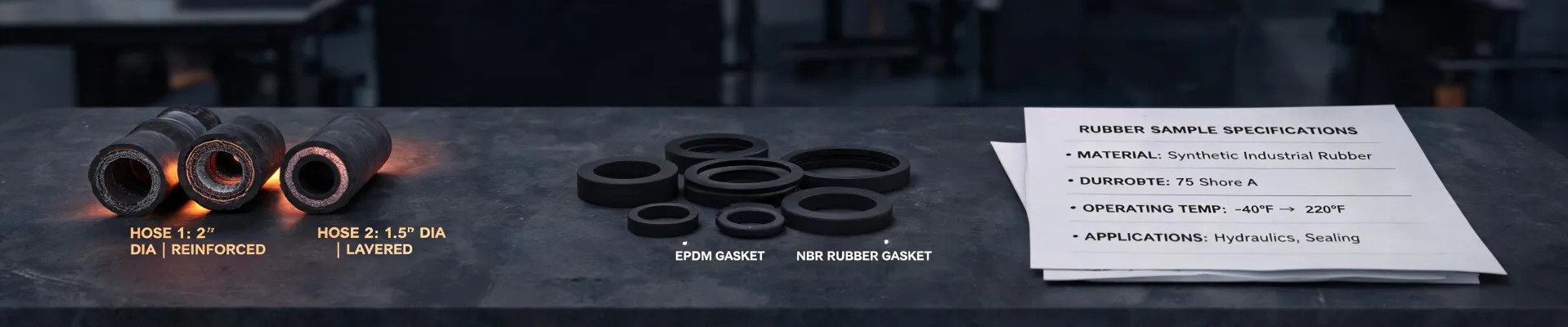
A procurement professional shares a costly lesson from specifying the wrong rubber component, highlighting how material quality impacts long-term operational costs, and why Cooper Tire & Rubber's integrated approach offered a more sustainable solution.
The Rubber That Cost Us a Quarter of Our Annual Budget
I'm a procurement manager at a mid-sized industrial equipment company—about 90 employees. I manage our MRO (maintenance, repair, and operations) budget, which runs around $120,000 annually. For the past six years, I've tracked every invoice, every purchase order, and every "what was that charge?" in our internal cost tracking system.
In Q2 of 2023, I made a decision that looked brilliant on paper. It turned out to be one of the most expensive "savings" we ever booked.
We needed a custom hydraulic hose assembly for a new production line. Nothing exotic—about 3/4-inch inner diameter, 2-wire braid reinforcement, with JIC 37-degree flare fittings on both ends. Standard stuff.
The Shortcut That Looked Like a Smart Move
I went through our standard procurement process: sent specs to four vendors, collected quotes, built a comparison spreadsheet. Vendor A (the incumbent) quoted $47 per assembly, including setup. Vendor B, a smaller shop we hadn't worked with before, quoted $31.
That's a 34% difference. On a quarterly order of 200 assemblies, the math was simple: $6,200 vs. $9,400. I almost clicked "approve" on Vendor B without a second thought.
But something nagged at me. I knew I should request material certifications and test samples, but I thought—"what are the odds?" They're a rubber fabricator; how different could the hose be?
Well, the odds caught up with me fast. (Ugh.)
The First Hint of Trouble
The first batch arrived on time—good. We installed them on the line. Two days later, the maintenance supervisor called me. "Hey, we've got weeping at the crimp fittings on about 15% of these."
Weeping. That's the polite term for a slow, steady hydraulic fluid leak at the connection point. Not catastrophic. But a leak is a leak, and it meant downtime for replacement, rework, and cleanup.
I went back to Vendor B. They admitted they used a different tube compound (a lower-grade nitrile rubber, as I later discovered) for that particular batch because they were short on the specified material. They offered replacement assemblies at no charge. Problem solved, right?
Not quite. The hidden costs started piling up:
- Replacement labor: each swap took about 45 minutes of a maintenance tech's time. At $35/hour (loaded), that's $26 per swap. 30 weeping assemblies → $780 in labor.
- Lost production time: the line was down for 90 minutes total across the week. Estimated at $400/hour in throughput → $600.
- Hydraulic fluid top-up: $120 for replacement fluid.
- Disposal of the leaking assemblies: $45 in hazmat fees.
Suddenly, the "$2,600 savings" turned into a $1,545 net loss—before considering the reputation hit with our production team.
The Real Lesson: Quality is Brand Perception
Here's where the experience shifted my thinking. It wasn't just the money. It was the perception.
Our production manager started asking questions. "Who approved these hoses?" "Are we cutting corners now?" The maintenance team grumbled every time they saw another Vendor B assembly on the shelf. The trust we'd built over years eroded in a week.
The quality of the components we put into our equipment directly reflected on our team's judgment.
That's the thing about industrial rubber products—they're often invisible until they fail. But a failure is a loud, messy signal. When we installed the replacement assemblies from Vendor A (our original supplier), not a single one leaked. Zero. The team's confidence came back.
How Cooper Tire & Rubber Changed My Approach
After that episode—this was in late 2023—I reevaluated our entire rubber components supply chain. I looked at Cooper Tire & Rubber Company not just as a tire supplier (we'd used their commercial tires for our forklifts and delivery trucks for years), but as a broader rubber engineering resource.
Here's what I found: Cooper Tire & Rubber Co. in Texarkana (I checked the reviews—mostly positive, and the complaints were about retail tire availability, not industrial rubber products) had a surprisingly deep catalog of industrial rubber products beyond tires. We're talking rubber sheets, strips, hoses, seals, gaskets—the whole range.
Their sales engineer—a guy who'd been in rubber for 22 years—came to our facility. We walked through our application needs. He didn't just sell us hose. He brought material data sheets, compatibility charts for different hydraulic fluids, and recommendations on storage practices.
Speaking of storage: that was another hidden cost I hadn't considered. Turns out, how you store a hydraulic hose matters more than I thought.
How to Store a Hydraulic Hose (And Why We Were Doing It Wrong)
I asked their engineer about our storage setup—a shelf in the maintenance shop, exposed to fluorescent light, temperature swings, and occasional chemical vapors. He smiled the smile of someone about to deliver bad news.
"Direct sunlight or UV light accelerates rubber degradation," he explained. "Heat cycling near a furnace or boiler? That's a problem. Contact with certain chemicals, including some cleaning solvents, can damage the tube compound before you even install the hose."
He gave me a simple storage guideline:
- Keep hoses in a cool, dry environment (ideally 40-85°F / 4-29°C).
- Avoid direct sunlight and artificial UV sources.
- Store away from ozone sources (electric motors, welding equipment).
- Keep hoses in their original packaging until installation.
- Use a first-in, first-out (FIFO) inventory system to prevent age-related degradation.
We implemented those changes in Q1 2024. Cost: about $100 for a storage rack and some UV-blocking bin covers. Benefit: no more "mystery failures" traced back to improper storage. (Cost-benefit analyst in me loves that ROI.)
We also stopped using the conference room as overflow storage for rubber parts. (Yes, that was a real thing. Yes, the sales team complained about the smell.)
What I'd Do Differently
Looking back, I made the classic procurement mistake: optimized for unit price instead of total cost of ownership (TCO). The $2,600 savings on that first order turned into a $1,545 net loss, plus the intangible cost of damaged team trust.
Here's rule I built into our procurement policy after that:
Any rubber component order over $2,000 requires material certification, a sample test, and a TCO calculation that includes estimated failure rate, installation labor, and operational downtime.
Sounds bureaucratic, I know. But we've applied it to 14 orders since then. Two of those sample tests revealed compatibility issues that would have caused failures. We avoided approximately $4,200 in potential costs. The policy paid for itself in the first quarter.
In Q4 2024, I audited our rubber product spending—hose, sheet gasketing, seals, and a few specialty strips—and compared our pre-and-post policy costs. Our annual MRO budget for rubber components dropped from $18,000 to $12,600. That's a 30% reduction, driven almost entirely by less waste and fewer failures. Sure, we're paying slightly more per unit for certified material. But the total cost? Dramatically lower.
Final Thought: Rubber Components Are Not a Commodity
It's tempting to treat hose, seals, and strip gaskets as interchangeable commodities. They aren't. The difference between a $31 assembly that leaks within a week and a $47 assembly that lasts 18 months isn't "features"—it's engineering, material science, and quality control.
Cooper Tire & Rubber Company's approach—integrating rubber compound formulation with product design—isn't unique in the industry. But their willingness to provide application-specific guidance, material data sheets, and real storage advice? That's rare. And that's what I look for now.
Pricing data based on our actual invoices from Vendor A (Q2 2023) and Vendor B (Q2 2023). Storage guidelines provided by supplier engineer, confirmed against ISO 2230:2002. Budget data from our internal procurement reports.
Cooper Tire editorial note
Rubber sourcing decisions should be tied to measurable application facts. If a post raises a question about material choice, compliance files, or qualification planning, send the use condition and drawing for a practical review.