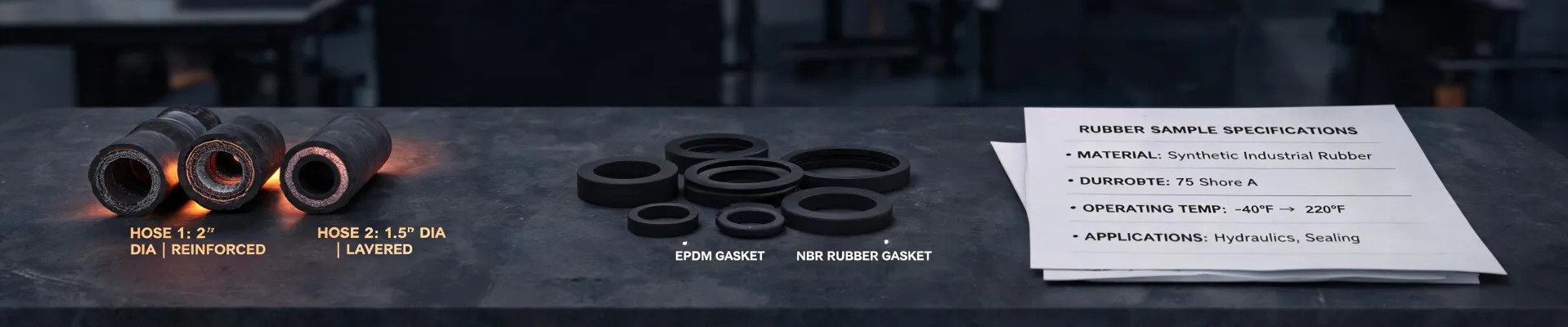
A practical, step-by-step guide from a quality control perspective on the key verification points for industrial rubber products like nitrile rubber sheets, polyurethane strips, and rubber rings, based on hands-on experience in specification compliance and vendor management.
When This Checklist Applies
If you're specifying or receiving industrial rubber components — whether it's a rubber ring, a batch of nitrile rubber insulation, a polyurethane rubber strip, or even a custom rubber sheet — this checklist is for you.
It's not for general consumer products. It's for the kind of orders where the spec sheet is 15 pages long, and the wrong durometer or chemical resistance can cost you a production line shutdown.
I use this exact list on every deliverable I review — roughly 200+ unique item specifications a year — and I've built it from mistakes I've seen and made. There are 5 checks. Each one has saved me from a problem at least once. This is the order I do them in.
Step 1: Material Composition Verification (The Obvious One That Gets Missed)
You'd think this is the first thing anyone checks. And it is — on the paperwork. The problem is when the paperwork says "Nitrile Rubber" and the delivered material meets the hardness spec but has the wrong chemical resistance profile.
What I actually check:
- The material data sheet (MDS) against the purchase order. Sound obvious? I've had two instances this year alone where the MDS was for a slightly different grade of nitrile. Same durometer, different ACN (acrylonitrile) content. For fuel or oil contact applications, that matters a lot.
- A physical stamp or marking. Some vendors mark their sheets with a batch number or material code. I match that to their internal batch records. This has caught a mix-up more than once (circa 2023, we had 8,000 units made from the wrong compound because a supplier switched sub-vendors without telling us).
- A quick smell test. Sounds unscientific, but after a while, you learn the baseline smell of nitrile vs. natural rubber vs. SBR. If it smells "off" (like burning plastic when it shouldn't, or too much sulfur), it's a flag to dig deeper.
One thing most people skip: Check for latex content if you specified "does not contain latex." This is relevant when ordering from a supplier who also processes natural rubber latex compounds. We had to reject a batch of rubber rings in Q1 2024 because the cross-contamination risk wasn't documented. The supplier's line had been used for latex gloves the same day.
I've seen nitrile labeled as "does thermoplastic rubber contain latex" come back with a latex warning on the COA. It's a real problem. (And the answer is: generally no, but cross-contamination is possible if they're not managing their production lines).
Step 2: Dimensional Tolerance Check (Where the Money Disappears)
Hardness and tensile strength get all the attention. But dimensions are where the real-world fit issues happen. And the tolerances on the spec sheet are not always what the vendor produces.
My approach:
- Check 10% of the batch, or a minimum of 5 pieces. For a polyurethane rubber strip order of 1,000 linear feet, that means checking at 10 random points along the roll, plus at the start and end. The middle is usually the most consistent — the ends are where they change settings or have startup waste.
- Focus on the critical dimension. For a rubber gasket or ring, that's the inner diameter and the cross-section. For a sheet, it's the thickness. I've had a vendor deliver a "3mm thick nitrile sheet" that was 2.7mm on average. They claimed it was "within industry standard" (+/- 10%). But our application needed it within 5%. That difference in tolerance was the difference between a seal working and a seal weeping. (I still kick myself for not writing the tolerance into the PO explicitly the first time.)
- Measure at room temperature, after acclimation. Rubber expands and contracts. If the material came off a cold truck, let it sit for 24 hours before measuring. I neglected this on a rush order once, rejected a batch, and had to eat crow when the re-check after 24 hours showed everything was in spec. (Note to self: patience is cheaper than a phone call apologizing).
The one that most people ignore: Thickness variation across the width of a sheet. A sheet can be 6mm thick in the center and 5.5mm on the edges. That's a problem if you're die-cutting parts from the full sheet. The edge pieces will be slightly thinner. I've rejected batches for this, and the vendor was genuinely surprised I checked (they don't).
Step 3: Physical Properties Testing (The Vendor's Lab vs. The Real World)
The vendor's Certificate of Analysis (COA) says the material meets spec. 99 times out of 100, it does. But I run my own spot checks because I've been burned on the 1%.
What I test (in-house):
- Hardness (Durometer): I keep a Shore A durometer in my office. I check 3 random samples from the batch. The COA says 70 Shore A. If my reading is 68, I'm comfortable. If it's 65, I send it to a third-party lab for verification. That gap has cost us before — the material felt "grippier" and didn't wear as expected.
- Elongation at break: We have a simple test rig. For a nitrile rubber sheet that's supposed to have 300% elongation, if my sample tears at 200%, that's a red flag. The compound might be over-cured or have too much filler.
- Color consistency (when it matters): For black rubber, this is usually fine. But for colored polyurethane or special compounds, I use a spectrophotometer. Yes, it sounds overkill for industrial rubber. But when you're supplying a part for a branded machine, the color of the rubber component can matter for the OEM's perception. I ran a blind test with our engineering team once: they identified the "less consistent color" batch as "lower quality" before even testing anything else. Perception matters.
The hindsight lesson: In 2022, we accepted a batch on the basis of the COA alone. The rubber looked and felt fine. Six months later, the customer reported cracking in the field. We sent the retained sample to a third-party lab. The elongation had dropped by 40%. The vendor had used a cheaper accelerator package. The COA was technically truthful for the day of production, but the material didn't age well. Now I test a retained sample after 30 days of aging in our storage conditions. It's an extra step, but it saved us from a repeat of that $22,000 redo.
Step 4: Chemical & Environmental Resistance Verification (The Invisible Failure Mode)
This is the step that separates functional rubber from failed rubber. But it's also the step where I've made the most assumptions that turned out wrong.
My procedure:
- Immersion testing on a sample. If the spec says "resistant to hydraulic oil," I don't just read the data sheet. I take a small piece and immerse it in the actual fluid the customer uses (or a reasonable substitute) for 24 hours at the specified temperature. I measure weight change, volume swell, and hardness change. The data sheet says "less than 5% volume swell." My test shows 8%. We have a problem.
- Check the specific fluid, not the generic category. "Hydraulic oil" covers a huge range. A material that's fine for mineral-based oil might swell in a synthetic ester-based oil. I've had this exact issue with a polyurethane rubber application. The generic data said it was fine for "oils." The specific hydraulic fluid at the customer site caused significant swelling.
- Heat aging test. I throw a sample in an oven at 100°C for 70 hours (a standard test). I check the hardness after. If it hardens by more than 10 points, it's a red flag for long-term reliability. A nitrile compound that hardens too fast will crack and leak.
The uncommon check: Resistance to ozone cracking. This is a real issue for rubber parts stored near electrical equipment (motors, generators) that produce ozone. If the recipe doesn't have an anti-ozonant, the surface cracks within weeks. I test for this by stretching a sample and exposing it to high ozone concentration (in a test chamber — basically a UV light and ozone generator setup). It's not a standard test for most buyers, but for anyone sourcing rubber parts for industrial environments, it's worth asking about. The vendor might not test for it. That's your signal.
Step 5: Documentation & Traceability — The Safety Net
This is the step I was worst at five years ago. I'd check the product, sign off, and file the documents in a folder. Then a problem would come up a year later, and I'd be scrambling to find the COA, the batch number, and the order details.
My current system:
- Match the batch number to the production date. Every batch of rubber should have a traceable number that links it to the raw material lot, the cure date, and the mixing batch. I don't accept a generic "lot 001" — I want a date-coded number that I can use to reconstruct what was made and when.
- Require a Certificate of Conformance (CoC) plus the actual test results. Many vendors send a generic CoC that says "all material meets spec." I push back on this. I want the specific hardness reading, the specific tensile and elongation values for the batch, and the specific cure date. If the vendor pushes back, that's a flag.
- Photograph the label and the product. I snap a photo of the batch label against the product. It's a cheap habit that has saved me twice — once when a vendor said they delivered a different product than what we ordered, and the photo showed otherwise.
The one that most people regret skipping: Getting the specification signed-off by the customer *before* ordering from the vendor. It sounds obvious. But I've been in a situation where the customer "approved" the spec verbally, the vendor produced to that spec, and then the customer changed their mind after delivery, citing a different part of the application requirement. Now I have written spec approvals with the date and the customer's signature. It's a 5-minute step that prevents weeks of rework and cost recovery debates. A 5-minute check that is cheaper than a 5-day argument.
Common Mistakes & Final Thoughts
The three most frequent errors I see:
- Assuming "nitrile rubber" means one thing. It doesn't. The grade, the filler content, and the cure system change the properties dramatically. Always specify the grade standard (e.g., ASTM D2000 classification for a specific application line).
- Accepting a verbal assurance over a written test result. A supplier once told me "we've been making this rubber ring for 20 years, it's fine." I insisted on a test. It wasn't fine. The spec had shifted over time with a raw material change they hadn't documented.
- Not checking the first article. If every item in your order is identical, it's still worth checking the first one off the line. We had an order of rubber strips where the first 100 meters were perfect, but the line had a malfunction during the second shift, and the remaining 400 meters had inconsistent thickness. The first article from the initial setup told us nothing about the production run's stability.
My baseline for reliability: A vendor who pushes back on these checks is a vendor I'm less likely to trust. A vendor who has their own documented quality process and willingly shares it — that's someone I can work with. Industry standard isn't always good enough. For critical components, your standard needs to be higher than the minimum.
That checklist — material, dimensions, properties, chemicals, documentation — it's not glamorous. But for every one of the 200+ items I've reviewed, it's been the framework that caught the issue that would have become a problem. And a caught problem is a saved customer.
Cooper Tire editorial note
Rubber sourcing decisions should be tied to measurable application facts. If a post raises a question about material choice, compliance files, or qualification planning, send the use condition and drawing for a practical review.