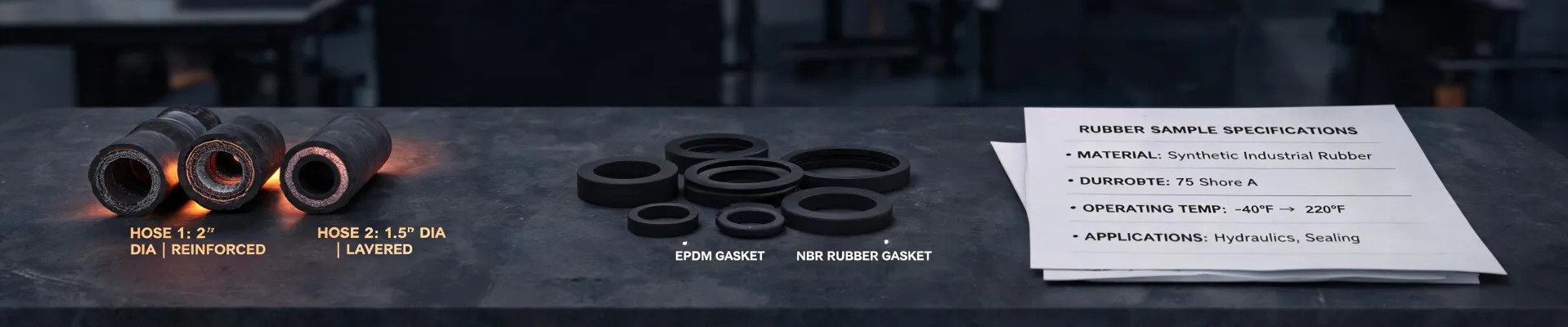
A procurement manager compares thermoset rubber and thermoplastic materials for shop air hose and nitrile rubber seals—and explains why TCO, not brand name, should drive the decision.
Why this starts with the material, not the brand
When I'm reviewing a requisition for shop air hose or a nitrile rubber seal, the first thing I do is check the material spec, not the manufacturer's name. The Cooper Tire & Rubber Co name appears on a lot of rubber products, and that history gives me some confidence. But the critical question is always: is rubber thermoset or thermoplastic?
I've spent six years managing purchasing for an industrial maintenance company, with about $180,000 in cumulative spend on hose, seals, and sheet rubber. That's enough volume to teach you that the cheapest unit price isn't always the cheapest part.
So let me break down thermoset rubber versus thermoplastic the same way I compare them in a requisition: price, durability, supply chain, and the hidden costs that turn up after the PO is signed.
Dimension 1: Unit price vs. total cost
Thermoplastic elastomers (TPEs) often look better on the per-unit price. The manufacturing process is faster—thermoplastic parts can be injection-molded without a long curing step. Thermoset rubber, like a conventional nitrile (NBR) seal, goes through vulcanization. That takes time and energy, so it costs more at the front end.
The common misconception is that thermoset rubber costs more because it's inherently better. The truth is that thermoset costs more because the curing process consumes more time and energy. Sometimes the added cost gets you exactly what you need; sometimes you're paying for capability you don't use.
But I don't buy seals and hoses for a hobby. The number I care about is the cost per month of service. A TPE seal may be $0.15 cheaper per unit, but if it fails nine months in and the thermoset version would have lasted three years, you've just paid more three different ways: part, labor, and downtime.
I still kick myself for ordering a "compatible" thermoplastic seal because the price was unbeatable. The spec looked right (so I thought), and the sales rep said it would work. It didn't fail dramatically. It just started leaking within six months. If I'd done the TCO worksheet instead of looking at the unit price, I would have bought the thermoset nitrile rubber seal and saved about half over the replacement cycle.
Dimension 2: Heat, oil, and the real material difference
People think "rubber is rubber." The assumption is that any hose or seal with the word rubber on the label can handle the same temperature, oil, and pressure. The reality is that polymer chemistry matters far more than the brand name or color.
Thermoset rubber sets during curing and can't be remelted. That's why it tends to keep its shape under heat. Traditional nitrile rubber seals are thermoset, and they're common around oil because NBR resists petroleum-based fluids. A thermoplastic nitrile blend exists too, so the word "nitrile" alone doesn't tell you the whole story. But when an engineer writes "nitrile rubber seal" on the drawings, they usually mean a cured, cross-linked thermoset.
Thermoplastic materials soften when heated. That can be an advantage for recycling and processing, but it's a disadvantage in a shop air hose that sits near hot equipment. I have a thermoplastic air hose on a light-duty bench. It's fine for basic work. I would not put it next to a welding station or a steam line.
The surprise wasn't the price gap between the two materials. It was how much the application environment changed the answer. In a clean assembly area, a TPE hose can be the smart, cost-saving choice. Around heat, oil mist, or anything that rubs, I'd rather use thermoset rubber.
Dimension 3: Supply chain, lead times, and the "cheap" schedule
Thermoset parts require tooling and curing, so lead times are often longer. If you're ordering a custom nitrile rubber seal, expect weeks, not days. Thermoplastic parts can be molded faster, which can lower inventory carrying costs and allow you to buy in smaller batches. In a B2B setting, that speed is a legitimate TCO advantage.
A few years ago, I compared quotes for a custom shop air hose assembly. One supplier had a thermoset hose at a higher unit price with a five-week lead time—I want to say five weeks, but don't quote me on that. Another had a thermoplastic hose at a lower price with two-week delivery. The numbers pointed to the thermoplastic supplier. My gut said the thermoset hose would fail less often in our environment, so I went with the higher-priced option. It was the right call for the welding benches. For a different line with lower exposure, I would have been comfortable with the lighter hose.
That said, I don't want to give the impression that one material is universally better. At least, not in my experience. The best answer depends on the application, the operator, and how fast you need the part.
Dimension 4: Hidden costs that don't appear in the quote
Here's where procurement gets interesting. When you buy a shop air hose, you're also buying the fittings, the installation, and the floor space it will occupy. A lighter thermoplastic hose can be routed overhead without a helper, which saves labor. A harder thermoset seal might require careful torqueing during installation; over-tightening can cause leaks just as fast as the wrong material.
Per FTC guidelines (ftc.gov), a claim like "never leaks" or "oil-proof" needs to be substantiated. When a vendor tells you something is "better rubber," ask for the test data. The same applies when a sales rep says a material is "just like" a thermoset. If they won't write down whether the compound is thermoset or thermoplastic, that's a red flag.
I once caught a mismatch on a quote for a nitrile rubber seal that was actually a thermoplastic blend. It might have worked, but it definitely wasn't what the maintenance engineer specified. That's the kind of detail that becomes a $1,200 redo when it fails on the line.
So what should you buy?
If your shop air hose stays away from heat and oil, thermoplastic is worth serious consideration. It's often lighter, cheaper, and easier to manufacture. If the hose is around welding sparks, oil mist, or hot surfaces, go with thermoset rubber. For nitrile rubber seals, the classic thermoset NBR is usually the safer choice for oil contact. A thermoplastic nitrile can be acceptable at low temperatures and low stress levels, but I'd want to see test data before trusting it.
And one more note on brands. Cooper Tire & Rubber Co has been making rubber goods for a long time, and the name shows up on products beyond tires, including industrial rubber components. A reputable brand reduces some risk because you're less likely to get an inconsistent compound. But the brand won't tell you whether the material is thermoset or thermoplastic if you don't ask.
Ask the question. Get the data. Put it in your cost tracking system if you have one. That's where the savings live over the long run.
Cooper Tire editorial note
Rubber sourcing decisions should be tied to measurable application facts. If a post raises a question about material choice, compliance files, or qualification planning, send the use condition and drawing for a practical review.