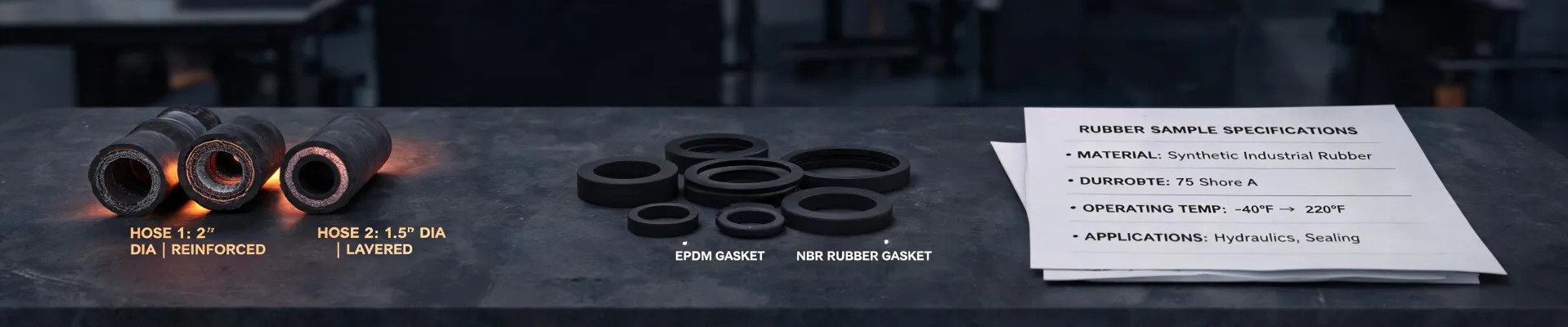
Thermoplastic rubber vs rubber is not a one-word answer. An emergency procurement specialist explains how to choose the right material when the deadline won't move.
I still get asked the same question about every other week: thermoplastic rubber vs rubber—which is better? My answer annoys people who want a one-word answer: it depends. But that is not a dodge. In my role coordinating emergency orders for industrial rubber products, I have watched what happens when someone picks a material to save a week and then pays for that choice for years.
I used to think rush fees were just vendors gouging customers. Then I saw the operational reality of expedited service—or rather, the reality of what happens when expediting is not possible. The wrong material can be shipped fast, installed fast, and then fail fast. That sequence is much more expensive than the rush fee you tried to avoid.
There is no universal answer
The thermoplastic rubber vs rubber question only makes sense if you know the application. Actually, it only makes sense if you know the failure mode. When I first started managing vendor relationships, I assumed the fastest material was always the best answer. If a customer needed parts quickly, I defaulted to thermoplastic rubber because it can be injection-molded and shipped in days. Three field failures later—including one where a TPE gasket softened on a hot oil line—I realized I was optimizing for calendar days while ignoring service life. That is not a trade-off; it is a trap.
Before we get to materials, I need three answers from you:
- Does the part move, flex, or bear repeated load?
- Will it see heat, oil, solvents, or weather?
- If it fails, is the result annoying or dangerous?
The answers put you into one of three scenarios. Scenario A is dynamic and dangerous to shortcut. Scenario B is static and forgiving. Scenario C is already specified. None of them is about cutting cost. All of them are about being fast without being wrong.
Scenario A: Dynamic, hot, oily, or safety-critical
If the part is a tire, a hydraulic seal, a conveyor belt splice, or anything that has to survive movement and heat, you want a vulcanized rubber compound. Thermoplastic rubber can look like rubber and feel like rubber, but it softens with heat in a way that a cured thermoset does not. For a dynamic application, that difference is the difference between a seal and a leak.
This is where Cooper Tire & Rubber Co enters the story. The company has been compounding rubber since 1914, and its engineering data still matters because its specifications are built for dynamic load, heat, and aging. Cooper tire brands are not generic rubber sheets; they are engineered systems with tread compounds, belt packages, and sidewall constructions. If you replace one of those with any TPE compound that happens to look similar, you own the field performance risk.
For an emergency order in this scenario, do not trade away the material spec. Instead, pay for the supply chain to move faster. In March 2024, one food-processing client needed 40 custom gaskets in 36 hours for a compliance audit. Normal lead time was 11 days. We paid a rush premium—$950, if I remember correctly—on top of the $2,800 base cost, and the compounder delivered in 28 hours. The client's alternative was missing the audit, which would have delayed a $150,000 line upgrade. The rush fee did not just buy speed. It bought certainty.
Scenario B: Static, indoor, low-risk
If the part is a pad, a bumper, a dust boot, a prototype, or a grip, thermoplastic rubber might be the right choice. You get faster cycles, easier color, and lower tooling costs. And if you need it now, a TPE supplier can often ship before a thermoset compounder can even schedule the mold.
Take a rubber pliers grip. That is a deceptively simple part: a tube of elastomer that has to fit tightly on a metal handle and survive repeated pulling. In a clean, dry shop, a thermoplastic rubber grip is fine. In a hydraulic repair bay, oil and solvent exposure change the answer. We learned this on a marine order when the TPE grips swelled and turned sticky after a month of exposure to hydraulic fluid. The same product in a nitrile blend would have lasted for years.
When I compared our Q1 and Q2 rush-order data side by side, I finally understood something. The orders that failed were not the ones where we paid too much. They were the ones where we substituted a material to save a week. TPE is not cheap rubber. It is a different engineering material with a different operating envelope.
Scenario C: Branded spec or OEM replacement
Sometimes the request is not about material categories at all. A customer says they need a part that matches Cooper Tire, or Kent Rubber, or a drawing number from their own system. In that case, do not decide the material yourself. Get the full compound designation, durometer, operating temperature range, and chemical resistance requirements before you quote anything.
One of our purchasing rules now: if the request says match a Kent Rubber part, we ask for the full compound name and durometer before we quote. No exceptions. In 2022, we lost a $50,000 contract because we tried to save $600 on standard rubber instead of paying for the specified compound. The client tested the first batch, rejected it, and canceled the order. That is when we implemented our no-substitute-without-spec-review policy.
Honestly, I am not sure why some rubber compounders quote a five-day lead time and then sit on the order for four of those days. My best guess is their extrusion lines are packed, and they are hoping you will not ask for a firm dispatch date. The solution is to ask for the ship date in writing and to be willing to pay for guaranteed delivery. A discount vendor who says probably is the most expensive option you will ever choose.
What to ask before you authorize a rush
Before I approve a rush fee, I ask four questions. First, what is the ASTM D2000 / SAE J200 callout? Second, does the supplier have the compound in stock, or do they have to mix it? Third, can they put the dispatch date in writing? Fourth, if they miss that date, does the rush fee come back?
If a supplier cannot answer the first three, I walk away. I have been burned twice by discount vendors who promised speed and then admitted—after payment—that they were waiting on material. The rush premium was not the problem. The uncertainty was.
How to tell which scenario you are in
If you are not sure, use this quick triage:
- Does the part flex, rotate, seal under pressure, or sit near heat and oil? Treat it as Scenario A. Use a thermoset rubber compound with a published ASTM D2000 / SAE J200 callout.
- Is the part static, indoor, low-stress, and mostly cosmetic? Scenario B. TPE can be the smart, fast choice.
- Does the part have a brand name, OEM part number, or an existing sample that has to be matched? Scenario C. Do not substitute anything without a spec review.
My own data comes from roughly 180 to 200 rush orders with mid-sized manufacturers in the Midwest. Maybe 185—I would have to check the system before I say it publicly. If you are in medical, food, or aerospace, your regulatory requirements override everything I just said. Listen to your compliance engineer.
The one thing I will never skip
Fast is good. Certainty is better. In an emergency, the premium you pay for guaranteed delivery is not a penalty; it is insurance. Whether you are choosing Cooper tire brands or a generic rubber strip, the process is the same: identify the real application, keep the material spec intact, and pay for the supply chain to move without cutting corners.
Rush fees buy certainty, not just speed. If you miss a deadline, the cost is not the line item. It is the shutdown, the failed audit, the customer who stops calling.
As of January 2025, I still tell customers to budget a 48-hour buffer for any emergency rubber order. The material spec changes with the application, but the buffer does not. Get the compound right, get the ship date in writing, and do not let a deadline push you into a material that will fail after the rush hour is over.
Cooper Tire editorial note
Rubber sourcing decisions should be tied to measurable application facts. If a post raises a question about material choice, compliance files, or qualification planning, send the use condition and drawing for a practical review.