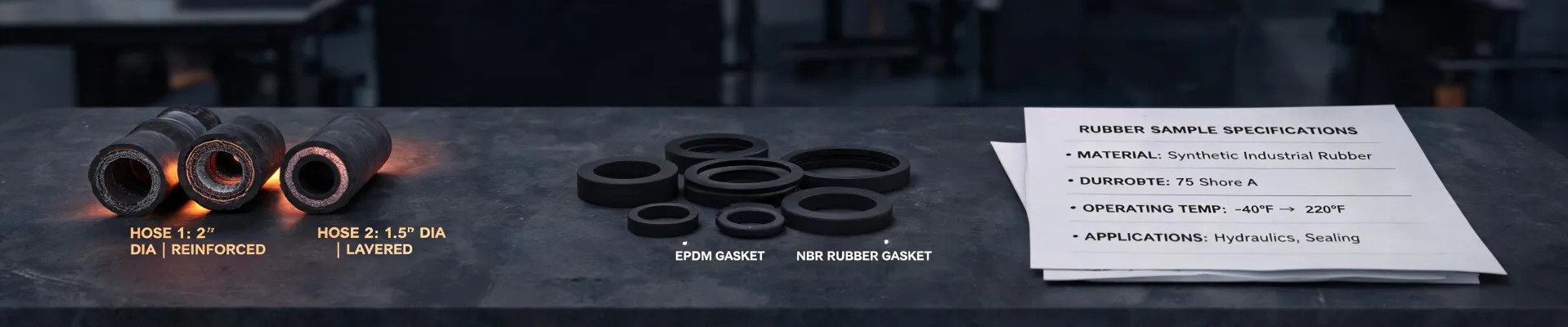
A practical B2B checklist for choosing between polyurethane and rubber when sourcing extruded rubber gaskets and rubber wheel mandrels. Covers compression set, temperature, chemical compatibility, lead times, and total cost.
-
Step 1: Define the load profile before you call anyone
-
Step 2: Understand what polyurethane vs rubber actually means
-
Step 3: Check durometer and compression set together
-
Step 4: Match the temperature range to your installation
-
Step 5: Verify chemical compatibility before it becomes a cleanup project
-
Step 6: Build in lead time, or buy certainty deliberately
-
Step 7: Calculate total cost, not unit price
-
Two final checks before you hit send on the PO
If you're sourcing extruded rubber gaskets or a custom rubber wheel mandrel, the first question isn't price. It's polyurethane vs rubber — and the answer changes depending on your application. This checklist is for buyers who need a workable answer today, not a polymer science lecture.
When I'm triaging a rush order, I don't start with the cheapest quote. I start with load, temperature, and the actual failure risk. I've spent about seven years coordinating custom rubber and polyurethane components for industrial clients, and I've processed roughly 200 rush orders in that time. Some were as simple as a 50-foot gasket pulled from stock. Others involved a rubber wheel mandrel that had to be made from scratch in three days. This checklist is in the order I'd actually run through it.
Step 1: Define the load profile before you call anyone
A lot of teams jump to "rubber is softer" or "polyurethane is stronger." But if you can't quantify the load, you can't choose. You need four things:
- Compression: Is the gasket squeezed between flanges? What bolt torque?
- Abrasion: Does the wheel mandrel run against a moving surface?
- Temperature: Continuous heat, or short peaks?
- Chemicals: Oil, water, steam, solvents, ozone?
If you can't answer those, the material choice is a guess. And in an emergency, a guess is how production lines go down.
Step 2: Understand what polyurethane vs rubber actually means
Polyurethane isn't just harder rubber. It's a different polymer family with a different mechanical personality. Rubber stores energy and rebounds. Polyurethane resists tearing and abrasion. The assumption is that polyurethane is premium rubber. The reality is that each one wins in a different job.
For gaskets that seal a static joint, rubber usually wins because it conforms under low force. For guides, rollers, and wheels that see continuous abrasion, polyurethane often wins because it wears longer. A rubber wheel mandrel is the classic case where you need to ask: is this a wear part or a cushioning part? I've seen buyers select polyurethane for a mandrel and then complain about vibration. They needed rubber's damping, not polyurethane's stiffness.
People think "polyurethane lasts longer, so it's better." Actually, the reason it lasts longer under abrasion is the same reason it can fail as a seal: it doesn't deform and recover the way rubber does.
Step 3: Check durometer and compression set together
Shore A is a starting point, not a full spec. A 70 Shore A polyurethane and a 70 Shore A EPDM gasket can behave completely differently under the same load. For extruded rubber gaskets, the critical number is compression set: how much thickness the rubber loses after being squished. Low compression set means the seal holds. If a supplier only gives you durometer, ask for the compression set.
In March 2024, a client called 36 hours before a maintenance shutdown needing a custom EPDM gasket. The original spec said "70 durometer rubber." The vendor wanted to use a generic 70 durometer material with a compression set of 35%. We pushed back and found a compound at 18% compression set. Same durometer. Completely different lifespan. The generic material would have leaked within a month.
This is also where industry reputation matters. Cooper Tire & Rubber Company has spent more than a century compounding rubber, and when someone says "cooper tire and rubber company quality," they're talking about compound consistency. That's exactly what you're trying to verify with these numbers. It's not about brand loyalty. It's about whether the material behaves the same in batch #1 as it does in batch #50.
Step 4: Match the temperature range to your installation
Polyurethane is generally fine up to about 80°C (176°F) continuous, with occasional higher peaks. Rubber depends on the polymer: EPDM can handle 150°C or more; nitrile sits around 100-120°C; silicone goes higher but with weaker abrasion resistance. These are rough screening numbers from typical material supplier datasheets, not a guarantee. But they'll stop you from picking a polyurethane gasket for a drying oven.
I'm not a polymer engineer, so I can't speak to exact formulations. What I can tell you from a procurement perspective is this: don't let a salesperson say "polyurethane is tougher" without asking "at what temperature?"
Step 5: Verify chemical compatibility before it becomes a cleanup project
Chemical compatibility is the most skipped check. Polyurethane has poor resistance to hot water and many acids. Nitrile is good with petroleum oils. EPDM is not oil-resistant but is great with water, steam, and weathering. Neoprene sits in between. A quick look at the compatibility charts in the Parker O-Ring Handbook (Parker Hannifin) is a good first filter.
If you're ordering extruded rubber gaskets for a wash-down area with caustic cleaners, EPDM is a safer choice than a "polyurethane-blend" product. If the application has oil splash, nitrile or polyurethane usually fits better. The chemistry has to kill the option before you get to price.
Step 6: Build in lead time, or buy certainty deliberately
Here's where the emergency-sourcing mindset changes the material decision. If you need a custom rubber wheel mandrel in 48 hours, you can't wait for a custom polyurethane casting. You need an extruded rubber profile from a vendor with a stock compound that can be shaped quickly.
In my experience, the real cost of a rush order isn't the rush fee. It's the cost of the wrong material. Last quarter, a client's $15,000 project depended on a custom gasket delivery. We paid $400 extra for same-day compounding and freight. That sounds painful until you compare it to the $15,000 they would have lost if the line stayed down. The point isn't that rush fees are always worth it. The point is that certainty is worth money when the alternative is a missed deadline.
Next time you request a quote, ask the fabricator two questions: What is the minimum lead time for this exact material? And what happens if it's late? If their answer doesn't include an alternative plan, keep searching. A low price with "probably on time" delivery is not a low price. It's a gamble.
Step 7: Calculate total cost, not unit price
The cheapest quote is rarely the lowest total cost. For an industrial rubber part, total cost includes material price, tooling, freight, rush fees, installation, and the cost of a failure if the part doesn't perform. A $30 gasket that fails in three months is more expensive than an $80 gasket that lasts three years.
This is why the cooper tire & rubber co pattern of "established compounder" still matters. You're paying for a consistent formulation, not just a shape. The surprise isn't that established companies charge more. It's how much hidden value comes with the right compounder: a physical test report, a responsive engineer, and a delivery promise that means something.
But my experience is based on about 200 custom rubber and polyurethane orders, mostly in the Midwest US. If you're sourcing exotic materials for a chemical plant, your numbers might differ. Use this checklist as a filter, then verify the details with your fabricator.
Two final checks before you hit send on the PO
First, request a physical test report with every order. A handwritten "70 durometer" on an email is not a spec. Second, order a sample before production when possible. In a true emergency, you may not have time for that — which is exactly when you should lean on a compounder with a documented history and your own buffer.
Take it from someone who has watched a $15,000 project almost fall apart over a $30 gasket: the material selection is worth an hour of your time before it turns into a production emergency.
Cooper Tire editorial note
Rubber sourcing decisions should be tied to measurable application facts. If a post raises a question about material choice, compliance files, or qualification planning, send the use condition and drawing for a practical review.