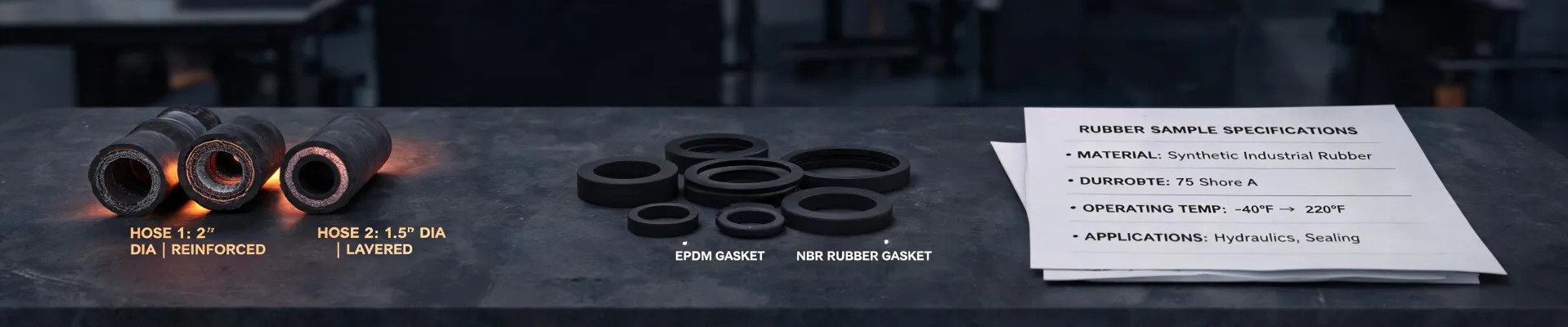
A practical FAQ for B2B buyers covering Cooper Tire's industrial rubber products, from nitrile sheets to interlocking mats, addressing pricing, logos, stores, and material selection.
Everything You Need to Know About Cooper Tire & Their Industrial Rubber Products
I manage purchasing for a mid-sized manufacturing facility—around 300 employees across two sites. We burn through a lot of rubber products: matting for the warehouse floors, gaskets for our pneumatic systems, hoses for washdown. Cooper Tire comes up frequently in my searches, partly because of their name recognition and partly because they carry such a wide range of stuff beyond car tires. Here are the questions I've had to answer for myself (and for my boss in operations).
1. Is Cooper Tire only about car tires, or do they make industrial rubber products too?
Short answer: They're way more than tires.
When I first started sourcing rubber strips and sheet gaskets, I was confused by the name "Cooper Tire and Rubber." Turns out, the "and Rubber" part is doing a lot of work. Beyond passenger and commercial tires, they manufacture a wide array of industrial rubber goods. I've ordered nitrile rubber sheets from them—or rather, through their distribution network—for oil-resistant gaskets, and I've priced out their polyurethane sheets for wear pads. Their product catalog includes everything from conveyor belt accessories to vibration-dampening mounts.
(Should mention: not everything is in stock under the Cooper Tire name. Some industrial products are sourced through their broader supply chain or partner brands. You still get the Cooper quality assurance, but the ordering process can vary.)
2. How do I find a Cooper Tire store that sells industrial supplies—not just tires for my car?
This is a common point of friction. The Cooper Tire stores you see on street corners are independent dealers who carry the passenger tire line. To buy industrial rubber products—say, a 4' x 6' sheet of interlocking rubber mats for a workshop floor—you need to look at their B2B channels.
Your best bets are:
- Their official distributor locator: They have a network of authorized industrial distributors that handles the heavy-duty stuff.
- Online industrial suppliers: Places like Grainger or MSC often carry Cooper-branded or Cooper-sourced rubber products. I found their nitrile rubber sheets this way.
- Contacting their sales team directly: For a large order (we needed 200 mats once), a direct quote can often get you better pricing and a more specific delivery window.
Don't waste time driving to a retail tire shop for industrial matting. That's a lesson I learned the hard way during a 2023 facility upgrade project.
3. I keep seeing rubber vulcanization mentioned. What does it have to do with choosing the right industrial rubber?
Rubber vulcanization is the chemical process that makes rubber strong and durable. Without it, raw rubber is sticky and useless for industrial applications. When Cooper Tire vulcanizes their rubber products, they're essentially curing the material to give it its final properties—elasticity, tensile strength, resistance to temperature and chemicals.
Why this matters for you as a buyer:
- Different vulcanization processes lead to different product hardnesses (measured in Shore durometer). A soft gasket needs one formulation; a hard floor mat needs another.
- It affects longevity: A poorly vulcanized rubber sheet will crack or degrade faster. Cooper's expertise here is one reason their products command a slightly higher price—the cure cycle is tightly controlled.
- Honestly, I'm not sure why some vendors can't seem to get this right. My best guess is they're cutting the vulcanization time to save on energy costs. The result is a product that looks fine initially but fails after six months.
4. Is nitrile rubber gasoline resistant? I need gaskets for a fuel handling system.
Yes, but the specifics matter. Nitrile rubber (NBR) is known for its excellent resistance to oils, fuels, and hydrocarbons. That's why it's the go-to material for automotive fuel system parts, oil seals, and industrial hoses handling petroleum products.
Looking back, I should have verified the specific acrylonitrile content of the NBR before placing a large gasket order for a fuel blending skid. At the time, I assumed "nitrile" was a one-size-fits-all solution. It isn't. Higher acrylonitrile content (around 33-50%) gives better fuel resistance, while lower content is more flexible at low temperatures.
For gasoline specifically: Standard nitrile rubber is generally suitable. However, for modern gasoline containing ethanol blends (like E10 or E15), you may need a special grade of NBR or even a different material like fluorocarbon (FKM). Per FTC guidelines (ftc.gov) on advertising truthfulness, a vendor should be able to substantiate claims like "gasoline resistant." I always ask for a chemical compatibility chart now.
5. What's the deal with interlocking rubber mats? Are they worth the cost vs. standard rolls?
I've installed both. For our warehouse dock area, we went with interlocking rubber mats (2' x 2' tiles). For a long hallway, we used a roll of standard rubber sheet.
Interlocking mats:
- Pro: Easy to replace. If a tile gets damaged by a chemical spill or a hot piece of metal, you swap out one tile. On a roll, you'd have to cut out the damaged section and patch it, which looks messy.
- Pro: Easier to transport and install. You can carry a stack of tiles. A 50-foot roll of 4' wide rubber is heavy and requires two people and a dolly.
- Con: Higher initial cost per square foot compared to sheet goods.
- Con: The seams can collect dirt if the tiles pinch or gap over time. (Should mention: we reduced this by buying a thicker, commercial-grade tile with a tight locking system.)
For a high-traffic area where maintenance is a factor, the extra cost is worth it. For a one-time installation that you won't touch for 5 years, a roll is more economical.
6. How do I find the official Cooper Tire logo for documentation or bids?
This is a surprisingly common office request. My procurement team needs the correct logo for supplier registration forms and approved vendor lists.
The official Cooper Tire logo—which is a registered trademark with that familiar script font and the tire icon—is available on their corporate website's press or media kit page. I've also found it on their SEC filings and investor relations pages. Make sure you grab a version with sufficient resolution (SVG or high-res PNG) for print documentation.
Per federal trademark law, you need to respect the usage guidelines they publish. Don't alter, distort, or use it in a way that implies endorsement. It's for identification purposes only. If you're unsure, an email to their legal or corporate communications department gets a prompt answer—I did this in 2024 and got a reply within 48 hours.
7. I have a tight budget. Is Cooper Tire pricing competitive against generic non-brand rubber?
Here's where I have to be honest. The total cost of ownership isn't just the quote on the sheet. In a 2024 vendor consolidation project, I compared prices for a large order of rubber mats from Cooper's distribution channel against an unbranded supplier.
The numbers:
- Unbranded supplier: $14.50/mat (plus $200 shipping, unknown delivery window)
- Cooper-distributed mat: $18.75/mat (free shipping over $1000, 3-day guaranteed delivery)
The reality: The unbranded mats started showing edge chipping after 4 months of forklift traffic. The Cooper ones (from the same batch we bought for a different zone) were still intact at 18 months. The replacement cost for the unbranded mat area ate up the initial savings.
If your application is low-traffic (like an office entryway), the generic mat might be fine. For industrial use, the reliability—backed by a known manufacturer—pays for itself. The value of a guaranteed, known specification (like from Cooper) isn't the price—it's the certainty.
Cooper Tire editorial note
Rubber sourcing decisions should be tied to measurable application facts. If a post raises a question about material choice, compliance files, or qualification planning, send the use condition and drawing for a practical review.