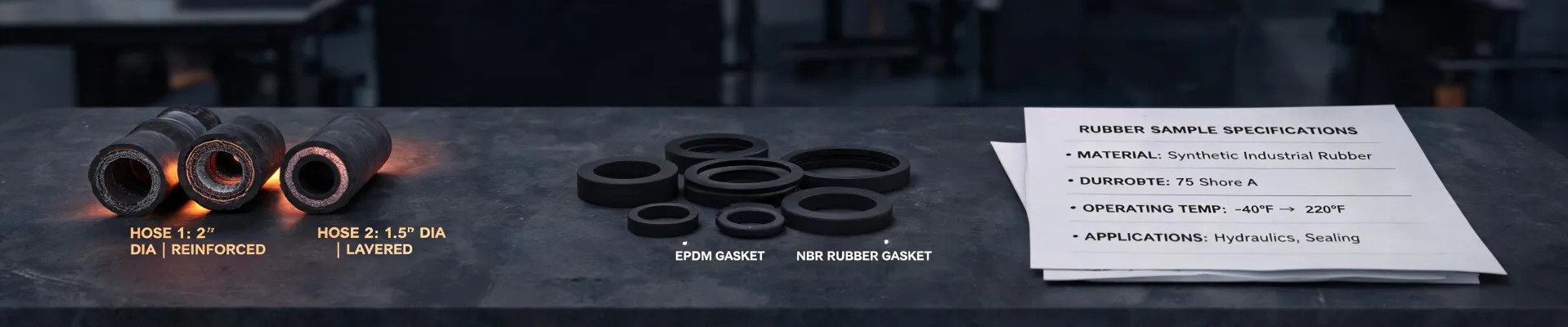
A quality inspector shares a practical checklist for verifying rubber gasket specifications, including nitrile, silicone, and fluorine rubber o-rings, based on real procurement experience.
I review a lot of rubber product deliveries—sometimes 200+ unique SKUs in a single month. Gaskets, o-rings, strips, sheets—you name it. And here's a pattern I've noticed: the stuff that causes the most headaches isn't the exotic material. It's the standard gasket that was almost right.
Over the years, I've settled on three checks I run on every gasket delivery before signing off. They're not fancy. But they've caught problems that would have cost us time, money, and a lot of frustrated calls with engineering. If you're specifying or receiving rubber gaskets—especially nitrile rubber, EPDM, silicone, or fluorine rubber o-rings—this is the checklist I'd hand you.
Why This Checklist
This is for anyone who needs to verify that a received gasket or o-ring matches the specification. It's not a replacement for material data sheets or lab testing. It's the quick, on-the-ground inspection that should happen before anything gets sent to inventory or, worse, installed.
I'm a quality compliance manager, not a rubber chemist. So I can't speak to polymer formulation or cure optimization. What I can tell you, from years of product inspections for B2B supply, is how to spot the mismatches that slip through paperwork.
Check 1: Verify the Shore Hardness on Delivery
You specified a durometer of Shore A 70. The supplier confirmed it on the certificate. But the gasket feels, well, softer. Or stiffer.
We had a batch of gasket rubber for a 50,000-unit order in Q2 2023 where the hardness was visually fine—but off by about 7 points. Normal tolerance for a general-purpose gasket is +/- 5 points. The vendor argued it was 'within reason.' It wasn't. The gasket didn't compress the way it needed to, and it started extruding under pressure in a test assembly.
What I do now: I keep a shore durometer in the receiving area. I test three samples from the lot immediately. If the average is outside the agreed tolerance, I flag it before the lot moves into warehouse.
The time to argue hardness is when the pallet is still on the receiving dock—not after it's been logged into inventory for three days.
Check 2: Check Compression Set With a Simple Test
Hardness tells you something. But for a gasket, the real question is: after it's been squished for a while, does it spring back?
If you're dealing with fluorine rubber o-rings vs silicone for a static seal application, this matters. Silicone often has excellent flexibility at low temperatures, but its compression set can be higher than fluorine rubber (FKM). That means over time, a silicone o-ring might take a permanent set and lose sealing force.
Most buyers focus on chemical resistance or temperature range and completely miss compression set data. The spec sheet might show a compression set value at 22 hours. But that's a lab test. What I want to see is consistency: take a sample, compress it to 25% deflection for 24 hours at room temperature, then release and measure the recovery.
The thing everyone overlooks: Ask the supplier for their typical compression set for the specific batch. Not the material datasheet generic value. The actual batch-specific reading from their internal QC. If they can't produce it, that's a red flag.
Check 3: Confirm Physical Dimensions—Including Thickness Variation
Length and width? Easy to check. But I've seen more rejections over thickness variation than any other single dimension.
Here's the issue. A rubber gasket is extruded or molded. The cross-section thickness can vary by a few thousandths of an inch. On a thin gasket (< 1/8 inch), that variation can mean the difference between a good seal and a leak path.
I recall a delivery of rubber products—specifically a low-profile gasket for an enclosure—where the thickness varied by 0.012 inches across the length of a single strip. That's within some industry tolerances. But for that application, it was a failure point. We rejected the lot and had them recut at their cost.
I now calculate thickness variation as a percentage of nominal spec. If it exceeds 5%, I test more samples. If it's 10% or over, I'm rejecting unless the application explicitly doesn't care about seal compression. Most engineers care a lot.
Extra Attention: Material Confusion on the Receiving Floor
One more thing. I've seen nitrile rubber (NBR) get mixed up with EPDM on the receiving dock more than once. They look similar to the untrained eye. A cooper tire brand grade of NBR gasket might have different oil resistance than an EPDM gasket intended for weather sealing. If they get swapped, the result is failure in the field.
I said 'NBR' on the purchase order. The supplier shipped 'EPDM.' The receiving agent checked the count and signed. We discovered the error during installation three weeks later. That quality issue cost us a full redo and a delayed project launch.
Fix: The simplest method? A flame test or solvent spot test. NBR will swell in gasoline; EPDM will not. But don't trust the color or the 'looks like rubber' test. If you don't have a portable FTIR or a simple kit, require clear, permanent marking on the product.
Common Mistakes I Still See
- Assuming a certificate of compliance is enough. It's a start. It's not an inspection. I've had CoAs that listed correct spec but the actual product was wrong.
- Not testing from the middle of the lot. The first pieces or the top layer can be perfect. The defects often show up in the middle of a production lot.
- Ignoring storage condition impact. A gasket delivered in a hot truck or stored near a UV source can degrade before you even open the package. Latex and some silicones are especially sensitive. Check the packaging temperature and the product appearance on arrival.
To be fair, most suppliers are honest and competent. The problem is usually in the handoff—between the sales quote, the production run, and the shipping dock. These three checks catch the gap.
Cooper Tire editorial note
Rubber sourcing decisions should be tied to measurable application facts. If a post raises a question about material choice, compliance files, or qualification planning, send the use condition and drawing for a practical review.