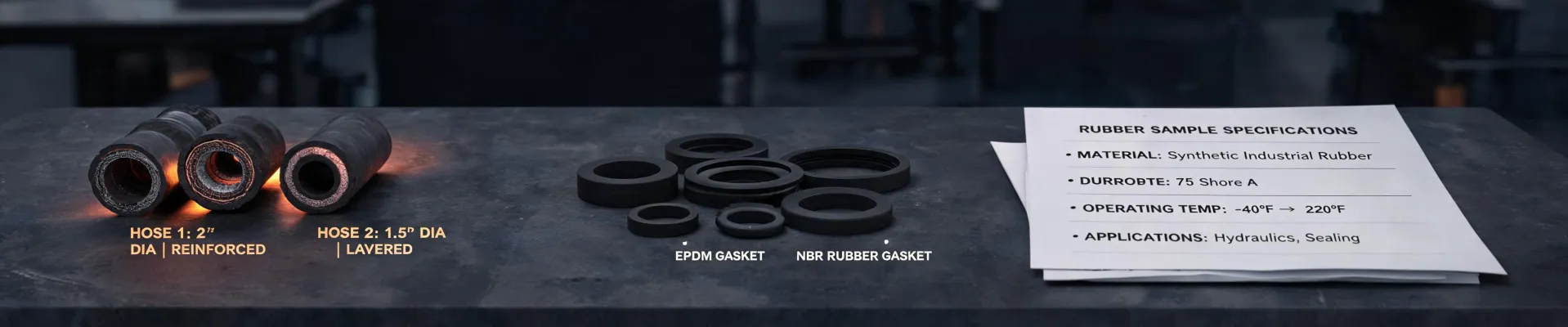
A breakdown of why small plastic orders—O-rings, ABS parts, custom replacements—keep failing despite looking like a great deal, what those failures actually cost, and the pre-check list that finally fixed it.
In my first year handling replacement parts orders (around 2017), I approved a $340 quote for 250 custom O-rings. It came in roughly 30% below everyone else. On paper, it was a no-brainer. I clicked approve without asking a single follow-up question.
Three weeks later the box arrived. The durometer read 70A instead of the 90A we'd specified. Nobody caught it until the parts were already pressed into a pump assembly. That cheap quote turned into an $1,100 teardown, a two-week delay, and a client call I still cringe about.
Since then I've logged every similar miss our team has made—47 of them over the past seven years, probably somewhere north of $14,000 in wasted budget—and the pattern behind small-order failures is almost always the same. It's never really about the price. It's about what nobody explains up front.
The Frustration You Already Know
If you've ever tried to source 200 O-rings, a short run of replacement brackets, or a few custom ABS components, you know the script. The big distributors quote minimums you can't hit. Lead times drift. Half your emails vanish into the void.
It feels personal—like the industry decided your order doesn't matter. And in some shops, that's exactly what's happening.
But here's what took me three years and several bad batches to actually understand.
What's Actually Driving the Price (and the Attitude)
The reasons small plastic orders get expensive and ignored have almost nothing to do with the material itself. They come down to fixed costs that don't scale down.
A mold setup costs the same whether you run 200 parts or 20,000. Resin suppliers have minimum order quantities that don't care about your batch size. And incoming inspection—the dimensional checks, the durometer readings, the material verification—takes roughly the same clock time on a 200-piece run as it does on a 2,000-piece one. Divide those costs by twenty parts instead of two thousand and the per-unit number gets ugly fast.
So when a supplier quotes you something that feels absurd for a small order, they're usually not gouging you. They're amortizing fixed costs across a tiny quantity.
The second reason is subtler, and it took me longer to see. A lot of shops quietly prioritize the accounts that keep their lines full. That's not a conspiracy—it's just how scheduling works when you're running near capacity. Your 300-piece order goes to the back of the queue behind the guy ordering 30,000. From the outside it looks like small orders get ignored. The reality is they get pushed aside by a system optimized for volume.
Here's the part that still frustrates me. Every one of our biggest accounts started as a small order. The distributor who took our $200 prototype batch seriously in 2018 is the one we now send $20,000 purchase orders to. So when a supplier brushes off a small order, they're not just being rude—they're telling you exactly how they'll treat you when you grow. That's worth paying attention to.
Where Material Knowledge Actually Matters
This is what separates good small-order suppliers from cheap ones. A cheap supplier takes your spec at face value. A good one asks questions you didn't know to ask.
Case in point: I used to spec ABS for almost anything that needed to be "tough and cheap." If I'd asked myself honestly, is ABS plastic actually right for this application?—the answer would have been no for at least half those jobs. ABS is great for impact resistance and cosmetic parts, but it's a poor choice under continuous UV exposure, and it's not the right call anywhere you need solvent resistance. I learned that one the hard way after a batch of outdoor brackets chalked and yellowed inside a single summer.
The same thing happens with recycling claims. Per FTC Green Guides (16 CFR Part 260), a product marketed as "recyclable" needs recycling facilities available to at least 60% of consumers where it's sold—so a resin that's technically recyclable in a lab isn't automatically "recyclable" for your customer's compliance people. If a supplier can't walk you through that distinction, they probably can't walk you through the rest of your spec either.
The suppliers worth keeping have what I've come to call a healthy resin obsession—people who'll push back on your spec instead of just filling it. That's true whether you're talking to an O-ring manufacturer about durometer and compound, or to a custom molder about which grade of polypropylene suits a living hinge. That kind of expertise isn't free. It shows up in the quote. But it saves you from the exact situation that cost me $1,100 and a client relationship.
What These Mistakes Actually Cost
I've logged this enough times that the numbers stop being abstract.
The $340 order with the wrong durometer: $1,100 in rework, 14 days of delay, and a customer who now double-checks everything we ship. The wrong-material batch of ABS brackets: roughly $890 in replacements and a redesign that pushed a product launch back three weeks. The order where I missed a dimensional tolerance because the drawing looked "close enough": 60 parts, $450 wasted, and a very direct email from a procurement manager who had every right to be annoyed.
None of those failures came from picking the wrong supplier. They came from not knowing what to ask before I picked one.
And that's before you get to reputational cost, which is the one that actually sticks. A missed material spec doesn't just cost money—it tells your customer you don't know their components as well as they thought you did.
What I Changed (And What Actually Works Now)
I won't pretend there's a clever shortcut here. Small orders are structurally harder than large ones, and no supplier can make that disappear.
What I did instead was build a pre-check list that runs before any small order goes out:
- Confirm the actual application—temperature, UV exposure, chemical contact—before assuming a material family.
- Ask for the resin grade, not just the family name. "Polypropylene" means nothing without a melt flow index and an impact spec.
- Request a first-article inspection on anything custom, even at small quantities.
- Get lead times in writing, not in a phone conversation.
On the supplier side, I stopped chasing the lowest quote and started looking for three specific things: who answers technical questions without transferring me to sales, who shows up with real material data instead of a brochure, and who treats a 200-piece order like it matters. The vendors that pass that test—including the folks at JSP Resins LLC, where the login JSP provides actually shows current stock and lead times instead of a "contact us" form—are the ones I keep.
Bottom line: the cheapest small-order quote is almost never the cheapest small order. It's just the one where the expensive part hasn't shown up yet.
Trust me on this one. I've got the receipts—and the rejected batches to prove it.
Cooper Tire editorial note
Rubber sourcing decisions should be tied to measurable application facts. If a post raises a question about material choice, compliance files, or qualification planning, send the use condition and drawing for a practical review.