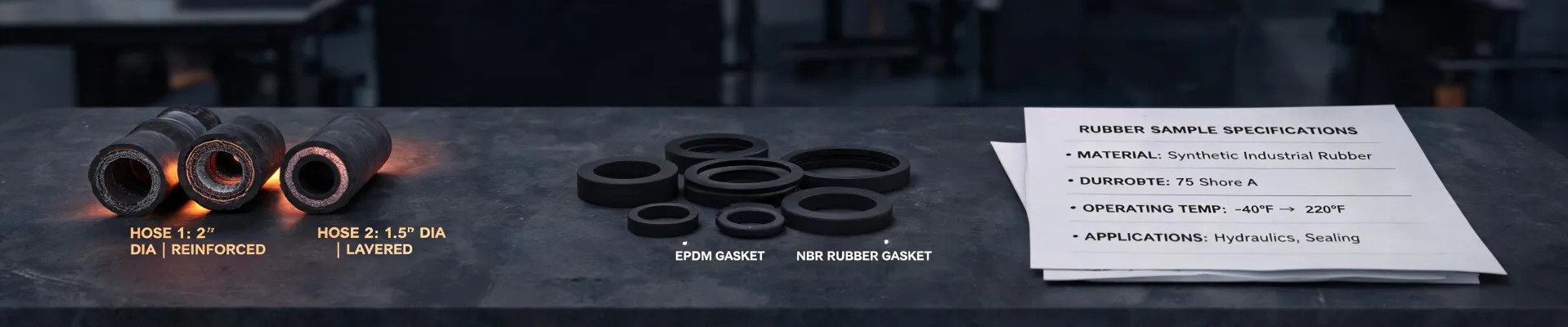
A procurement manager shares real lessons learned from buying rubber products across tire, strip, and sheet categories, and why the true cost is not on the quote.
-
The Project That Changed How I Buy Rubber
-
The Turning Point: A $4,200 Mistake with a Rubber Sheet
-
The Tire Side of the Equation
-
Rubber Hose Drawing: A Lesson in Specialization
-
What Is Hydrogenated Nitrile-Butadiene Rubber and Why I Care More Now Than Before
-
The Vendor Who “Did It All” (Spoiler: They Didn’t)
-
Lessons I’m Still Learning
The Project That Changed How I Buy Rubber
Back in early 2023, I was tasked with something that sounded simple on paper: source rubber components for a line of industrial equipment we were prototyping. Our usual vendor had retired the previous year, and we needed to re-establish relationships across multiple rubber product categories—tires for our in-house carts, rubber strips and sheets for vibration dampening, and a few custom hose assemblies.
Honestly, I thought I had this figured out. I’d managed MRO procurement for five years, and rubber was just another commodity, right? Buy from the cheapest supplier with the fastest shipping. It’s not rocket science. But over the next two years of tracking every invoice (and I do mean every invoice—$340,000 worth), I realized how wrong that assumption was. The true cost of rubber isn’t on the quote. It’s in the hidden details, the material spec that doesn’t match your application, and the vendor who says “we can do everything” but actually can’t.
This isn’t a guide from an industry expert—I’m still learning. But these are the honest, sometimes frustrating takeaways from sorting through 14 suppliers, three reorders, and one very expensive mistake with a rubber sheet that was chemically wrong for our setup.
The Turning Point: A $4,200 Mistake with a Rubber Sheet
In Q2 of 2023, we needed nitrile rubber sheets for sealing a hydraulic assembly. I found a vendor through an online marketplace who quoted a competitive price—around $900 for the batch. The catch? The material didn’t have the exact durometer specification our design called for. I thought, “It’s rubber, it’s probably fine.” (Ugh. I know.)
Fast forward four weeks. The sheets arrived on time, but within two days of installation, three of the seals began weeping fluid. We had to pull the entire assembly, order replacements with the correct spec from a different supplier (who, ironically, was not the cheapest), and absorb a $3,300 rework cost. That original $900 “savings” turned into a $4,200 loss when you factor in labor, downtime, and the rush freight for the second order.
I remember printing out the quote and staring at it. The numbers didn’t lie. But the cost wasn’t visible on the page. It was in the decision to ignore the spec.
“Everything I’d read about sourcing industrial rubber said to prioritize price and lead time. In practice, our application-specific needs made material composition the single most important factor—and ignoring it cost us significantly more than any theoretical savings.”
The Tire Side of the Equation
Around the same time, I was sourcing tires for our maintenance carts. Simple enough, I thought—Cooper Tire brands are well-known, our local distributor stocks them, just buy local. But here’s the kicker: the local distributor’s price was actually higher than ordering direct from a regional supplier. When I compared three quotes for a set of 16 tires:
- Vendor A (local): $2,400 total, standard delivery (3 days, no rush fee).
- Vendor B (online specialty): $1,900, but with a $350 “handling fee” for small quantity, and a 5-day lead time.
- Vendor C (regional distributor I’d never used): $2,100, including shipping, with a guaranteed 2-day delivery.
I almost went with Vendor B to save $500. Then I calculated the total cost of ownership (TCO) for each. Vendor B’s handling fee was hidden in their terms. Vendor A had no hidden fees but the base price was high. Vendor C had a transparent quote and the fastest shipping. We chose Vendor C, and over eight months of tracking, their tires had a lower failure rate than what we used previously. (Not that I’m making universal claims about any brand—just our specific experience.)
Rubber Hose Drawing: A Lesson in Specialization
Another project popped up in late 2023: we needed custom rubber hoses with specific end fittings for a pneumatic system. I contacted a large rubber supplier (one who claimed “full capabilities” across tires, hoses, strips, and custom molding). Their sales engineer seemed confident, but when I asked about their die drawing process for the hose specification—our engineers needed to see the internal diameter and wall thickness tolerances—they couldn’t provide a detailed drawing.
The vendor who eventually won the order was a specialist in hose assemblies. They didn’t do tires or sheets. They didn’t claim to. But they sent me a complete rubber hose drawing within two days, with tolerances, material certs, and a clear explanation of their curing process. That honesty earned my trust.
This is where the “specialist vs. generalist” argument becomes concrete for procurement. The vendor who said “this isn’t our core competency—but we can recommend someone” didn’t lose my business for future orders. Actually, they earned priority status for our next tire purchase.
What Is Hydrogenated Nitrile-Butadiene Rubber and Why I Care More Now Than Before
This is a term that came up during the hose project. Honestly, I didn’t know the difference between NBR (nitrile-butadiene rubber) and HNBR (hydrogenated nitrile-butadiene rubber) until our engineering team explained the application. I’ve never fully understood why some materials cost 30% more until I saw the failure case.
HNBR has better heat and chemical resistance than standard NBR. In our pneumatic system, where compressed air may carry oil mist, NBR degrades faster. Our engineer pointed this out during a spec review—a detail I would have missed entirely. The vendor we selected for the hoses specialized in HNBR applications. Their quote was higher by about 12% than the generalist’s, but the longevity of the part (projected at 18 months vs. 6 months for standard NBR) made the TCO significantly lower.
I don’t claim to understand the chemistry perfectly. But I’ve learned to ask: “What material is this, exactly, and why is it specified for this purpose?” If the vendor can’t answer that clearly, I’m skeptical.
The Vendor Who “Did It All” (Spoiler: They Didn’t)
This is a tricky topic because I don’t want to name names or suggest that a broad product range is always a red flag—it’s not. Cooper Tire and other manufacturers have legitimate expertise across multiple categories. But our experience with a “one-stop shop” for rubber toys (yes, we sourced silicone components for a custom toy prototype—long story) was instructive.
The vendor claimed they could produce rubber toys, strips, and gaskets from the same line. The toys arrived with surface inconsistencies that didn’t meet safety standards for the product. They tried to fix it with a “free rerun,” but the rerun had the same issues. In the end, we went to a specialist in molded silicone toys. They cost more per unit, but they had zero rejects.
My takeaway: I’d rather work with a specialist who knows their limits than a generalist who overpromises. The vendor who says “we do everything” often does nothing exceptionally well. The one who says “this is what we’re great at” is more likely to deliver.
Lessons I’m Still Learning
I’m not a rubber expert. I’m a procurement manager who has tracked over $340,000 in rubber-related spending across 24 months. Here’s what I know for sure:
- The cheapest quote is rarely the cheapest order. TCO includes specs, hidden fees, rework risk, and downtime. Calculate it before you buy.
- Vendor honesty about their limits is a green flag, not a red one. If they say “this isn’t our strength,” believe them.
- Material science matters. NBR vs. HNBR isn’t just chemistry trivia—it’s a cost decision with real consequences.
- Track every invoice. Not just the total, but the post-purchase costs: returns, reorders, rush freight. The numbers don’t lie.
If you’re sourcing rubber products—be it tires, strips, sheets, hoses, or even custom components—invest in understanding the application, not just the price. It took me a $4,200 lesson to learn that. But I’d rather you learn it from this story than from your own invoice.
Cooper Tire editorial note
Rubber sourcing decisions should be tied to measurable application facts. If a post raises a question about material choice, compliance files, or qualification planning, send the use condition and drawing for a practical review.