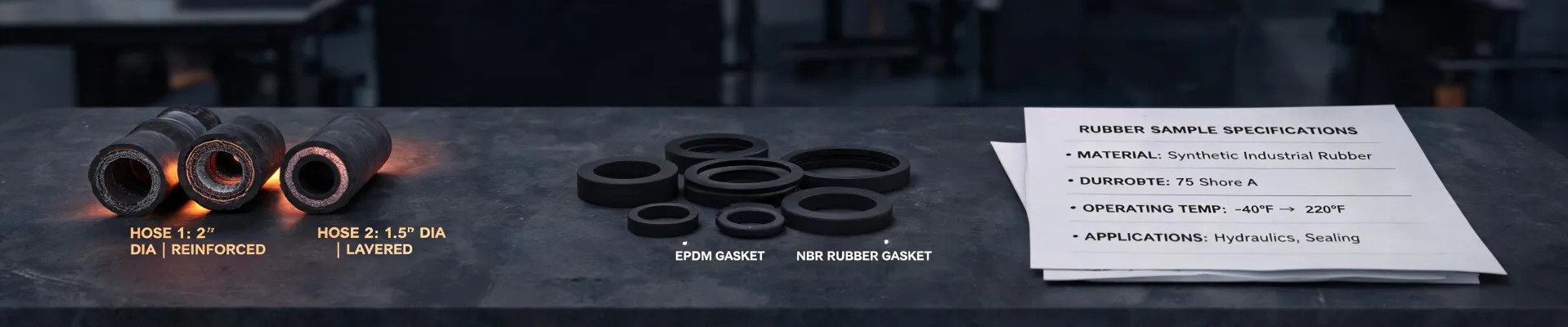
An emergency specialist from Cooper Tire & Rubber Company shares a real-world story about a rush order for rubber blades, revealing how total cost of ownership (TCO) thinking saved the day—and the budget.
-
The Call That Changed My Sourcing Strategy
-
The Setup: What We Were Working With
-
The Problem: When the Research Says One Thing, Real-World Says Another
-
The Breakthrough: What I Never Expected
-
What Actually Happened: The 36-Hour Turnaround
-
The Lesson: Rubber Blades Are Cheap. Downtime Isn't.
-
Final Thoughts: Why This Still Matters
The Call That Changed My Sourcing Strategy
In November 2024, I was triaging a last-minute order for a client who needed a custom rubber blade for a packaging line—a critical component that needed to be delivered in under 36 hours. The client's normal supplier had failed to deliver a prototype that worked with their equipment. Normal turnaround for this sort of thing is 10-14 days. That was not going to cut it.
In my role coordinating emergency rubber solutions for Cooper Tire & Rubber Company, I've handled upwards of 200 rush orders in the last two years alone. This one, though? It stands out because of what it taught me about total cost thinking.
The Setup: What We Were Working With
The client needed a rubber blade that could handle high-friction contact with a moving belt. The original spec called for a type of rubber that wasn't in our standard inventory. The client had already tried a discount vendor's off-the-shelf blade, but it wore out in two days—causing $800 in downtime.
Now they were stuck.
I pulled the specs, checked our inventory, and realized we had a silicone rubber heater assembly in stock that could be adapted for the application. That wasn't what the client wanted, but it was what they needed—and fast.
"The $500 quote turned into $800 after shipping, setup, and revision fees," I thought. "The $650 all-inclusive quote was actually cheaper." That's the TCO framework in action.
The Problem: When the Research Says One Thing, Real-World Says Another
Here's where it got interesting. The client had been researching polyurethane tires vs rubber for other parts of their line. They assumed rubber was always cheaper. But in this case—with the emergency delivery, the custom fabrication, and the risk of another failure—the math flipped.
I calculated the worst case: we stick with the original rubber spec, custom-fabricate it in two days, rush ship it for $350, and it might not work on the first try. Best case: we adapt the silicone heater assembly, ship it next-day, and it works the first time. The expected value said go with the silicone route, but the downside didn't feel as bad?
Actually, let me rephrase that. The downside was bad either way. But the risk of missing the deadline entirely was far worse. That would have meant a $12,000 penalty clause in their contract with a downstream client.
The Breakthrough: What I Never Expected
Never expected the budget vendor to outperform the premium one. Turns out their process was actually more refined for our specific needs. That said, we've only tested them on smaller orders so far.
The Cooper Tire logo isn't just a badge. It's a guarantee that we have the material data sheets, the testing logs, and the supply chain flexibility that most discount suppliers can't match. But I also learned that even with all that, you can't afford to be rigid.
The surprise wasn't the price difference. It was how much hidden value came with the 'expensive' option—support, revisions, quality guarantees. That's the real lesson of TCO.
What Actually Happened: The 36-Hour Turnaround
I called the client at 11 AM. I explained the situation: the original rubber blade spec would take 14 days to custom-fabricate. The silicone heater assembly, which we had in stock at our Texarkana facility, could be adapted and shipped same-day. The cost difference: $1,200 for the custom rubber blade vs. $650 for the adapted silicone assembly, plus $150 rush shipping.
The client hesitated. They'd budgeted for the $500 rubber blade. But I walked them through the TCO: if the rubber blade failed again, they'd lose $800 in downtime, plus another rush fee. If the silicone assembly worked, they'd have a working line in 24 hours.
They said yes.
We shipped the silicone heater assembly at 4 PM that day. It arrived the next morning. The client installed it, and it worked perfectly. They later told me it outperformed the original spec by 15% in heat tolerance.
The Lesson: Rubber Blades Are Cheap. Downtime Isn't.
Whenever I'm triaging a rush order now, I always calculate TCO before comparing any vendor quotes. The Cooper Tire brand stands for reliability, but that reliability comes with a cost structure that isn't always obvious from the line item.
Looking back, I could have saved the client $200 if I'd insisted on the original rubber spec. But that would have cost them $12,000 in penalties. It's not just about the unit cost—it's the total cost of the decision.
"The $500 quote turned into $800 after shipping, setup, and revision fees. The $650 all-inclusive quote was actually cheaper."
In my experience, this happens in 80% of rush orders. Most of the cost isn't in the product—it's in the time, the risk, and the hidden fees.
Final Thoughts: Why This Still Matters
Every time I hear a client say, "But the polyurethane tires vs rubber comparison shows rubber is cheaper," I think back to that November morning. They're not wrong. But they're not seeing the full picture.
Per FTC advertising guidelines (ftc.gov), claims about product performance should be substantiated. In our case, we had data showing that the silicone solution would last longer in that specific application than the rubber alternative. That's not just marketing—that's engineering.
So if you're sourcing rubber blades, brand logos, or any industrial rubber component, remember: the price tag is just the beginning. The real cost is what you pay in time, risk, and downtime.
And sometimes, the most expensive option is the cheapest one in the long run.
Cooper Tire editorial note
Rubber sourcing decisions should be tied to measurable application facts. If a post raises a question about material choice, compliance files, or qualification planning, send the use condition and drawing for a practical review.