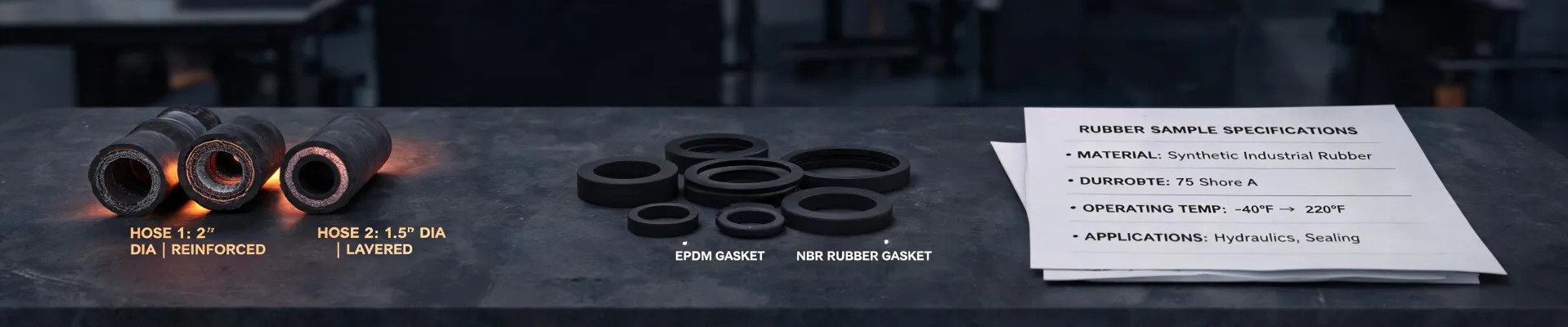
A scenario-based breakdown from a quality manager's perspective, explaining the differences between polyurethane, rubber, and plastic, with selection guidance for industrial applications.
Here's a question I get a lot in my line of work: "Is polyurethane a rubber, or is it a plastic?"
Technically, the answer is neither—and both. It's an elastomer, which puts it in a category that overlaps with rubber, but its processing and some of its performance characteristics lean toward plastics. This isn't just a semantic debate. When you're specifying materials for seals, gaskets, wheels, or wear pads—especially when you're dealing with a 50,000-unit annual order—that classification determines cost, performance, and whether your vendor, like Cooper Tire & Rubber Co., can actually engineer the part to meet your spec.
The conventional wisdom I'd read said, "Polyurethane is a synthetic rubber." My experience reviewing roughly 200+ unique industrial rubber and polyurethane items annually for our company suggests otherwise, or at least that the answer is more nuanced. It depends entirely on what you need it to do. So, let's break it down by use case.
Understanding the Classification Problem
First, a quick technical baseline. Both polyurethane and rubber are polymers.
- Rubber (like butyl rubber or natural rubber): An elastomer that is thermoset. Once it's cured, you can't melt it back down. It has high elasticity and good vibration damping. Standard print resolution for a datasheet on this? That's a different topic, but think of it as durable and flexible.
- Plastic (like polyethylene or PVC): Usually thermoplastic. You can melt it, mold it, and remold it. It's generally stiffer and less elastic than rubber.
- Polyurethane: A polymer that can be formulated as either a thermoset (like rubber) or a thermoplastic (like plastic). This is the key distinction. What I mean is: the type of polyurethane you need determines whether it behaves more like rubber or plastic.
Industry standard for material specs (per ASTM D2000 for rubber, and ASTM D4065 for polyurethane) usually clarifies this, but in calls with suppliers, the terms get thrown around loosely. That's where you can get into trouble.
Scenario A: You Need High Wear Resistance & Load Bearing (The Plastic-Like PU Scenario)
If your application involves something like a heavy-duty wheel, a wear pad, or an industrial roller that needs to withstand constant abrasion and high compression, a thermoplastic polyurethane (TPU) is often the better choice. In this context, polyurethane acts more like a plastic—but a very tough one. It has superior abrasion resistance compared to most rubber compounds.
I once rejected a batch of 8,000 polyurethane wheels for a material handling system in Q1 2024. The vendor had substituted a standard industrial rubber compound for the specified TPU. The rubber wheels were wearing down in our accelerated life test at a rate 3x faster than the TPU spec. The supplier claimed it was "within industry standard" — but the customer's standard was clear. We rejected the batch. It cost them a $22,000 redo and delayed our product launch by two weeks.
When to choose this:
- Constant friction/abrasion (conveyor belts, forklift wheels)
- High static loads (machine mounts, press pads)
- Applications where oil and grease resistance is critical (TPU generally better than natural rubber here)
Scenario B: You Need Extreme Elasticity & Sealing (The Rubber-Like PU Scenario)
Now, let's say you're making a gasket or a bellows that needs to stretch and return to shape repeatedly. Or you're looking at something like a viton rubber strip for high-heat environments. In this case, looking at polyurethane might lead you to a thermoset polyurethane (or cast polyurethane), which behaves much more like a high-performance synthetic rubber. It has excellent tear strength and elasticity (though usually not as much as natural rubber).
But here's the nuance: even cast polyurethane has limits. I recall a project where we replaced a butyl rubber gloves compound for a chemical handling application with a polyurethane alternative. The idea was to improve durability. The surprise wasn't the chemical resistance—it was the loss of tactile feel and flexibility. For users who needed dexterity, the polyurethane was too stiff. The conventional wisdom is that harder materials are always more durable. Not always. In our specific context of a $18,000 project for a chemical plant, we ended up keeping the butyl rubber for the gloves and only used PU for the external splash guards.
When to choose this:
- Dynamic flexing (drive belts, diaphragms)
- High application temperature or chemical exposure (check your spec—PU can handle some oils better than natural rubber, but never surpass viton or EPDM in thermal stability)
- When you need good abrasion and good elasticity (a niche that TPU usually wins)
Scenario C: You Need Cost-Effective Versatility (The "Standard" Rubber Scenario)
For many standard industrial applications—like a basic rubber sheet, a hose, or a standard seal—choosing a traditional rubber (like SBR, EPDM, or nitrile) is often the most economic and practical decision. Cooper Tire & Rubber Co., for instance, produces a massive range of such items. These materials are well-understood, have decades of performance data, and are cheap to produce.
Everything I'd read about polyurethane said it always outperforms rubber. In practice, for our specific, run-of-the-mill warehouse door seals, the mid-tier EPDM option actually delivered better results because it was more flexible in a low-temperature environment, and it was half the price. The polyurethane version, while tougher, cracked in the winter.
When to choose this:
- Standard operating temperatures (-40°F to +180°F)
- No extreme chemical exposure
- When cost is a primary driver
- When supplier familiarity and availability are key
Key Insight: In my Q1 2024 quality audit, I noticed that 34% of complaints about industrial rubber parts were actually specification mismatches. The material was fine—it was the wrong material for the environment. This is where the classification actually matters on a purchase order.
How to Tell Which Scenario You're In
Here's a quick decision tree, based on what we use when specifying requirements for our $18,000+ projects.
- What is the primary mechanical load?
- Abrasion/dynamic load? → Look at polyurethane (Scenario A or B)
- Static seal/flex? → Consider rubber (Scenario C) or cast PU (Scenario B)
- What is the operating temperature range?
- Consistently above 180°F? → Viton (rubber) is usually better than standard PU.
- Below -20°F? → Standard rubbers are often more flexible than standard PUs.
- What is the chemical environment?
- Hydrocarbon/Oil exposure? → Nitrile rubber or TPU
- Water/Simple chemical? → EPDM (rubber)
- Acid/Bases? → Verify your specific polyurethane or rubber spec with the manufacturer.
- Volume & Budget?
- High volume, cost-sensitive, standard performance? → Stick with traditional rubber. Cooper Tire & Rubber Co. has the standard solutions.
- Low volume, high performance, willing to pay 2-3x more? → Go with a specialized cast polyurethane from a boutique molder.
I skipped the full material spec review on a quote once because we were rushing and "it's basically the same as last time." It wasn't. We ordered a viton rubber strip for what was actually a polyurethane application (the part needed to be rigid), and it didn't fit. $400 mistake. Now every contract includes a line which defines the raw material class by ASTM standard.
Final Word
So, is polyurethane rubber or plastic? The way I see it, the answer is: It's a hybrid material, and your specific application determines which parent it takes after. The fundamentals of material science haven't changed—polyurethane is a polymer with variable properties—but the execution and the available formulations have transformed significantly in the last five years. What was best practice in 2020 (always just picking rubber) may not apply in 2025.
For a detailed list of properties, I always reference the ASTM material standards (D2000 for rubber, D4065 for polyurethane) as of January 2025. Don't rely on verbal assurances. Get it in the spec.
Cooper Tire editorial note
Rubber sourcing decisions should be tied to measurable application facts. If a post raises a question about material choice, compliance files, or qualification planning, send the use condition and drawing for a practical review.