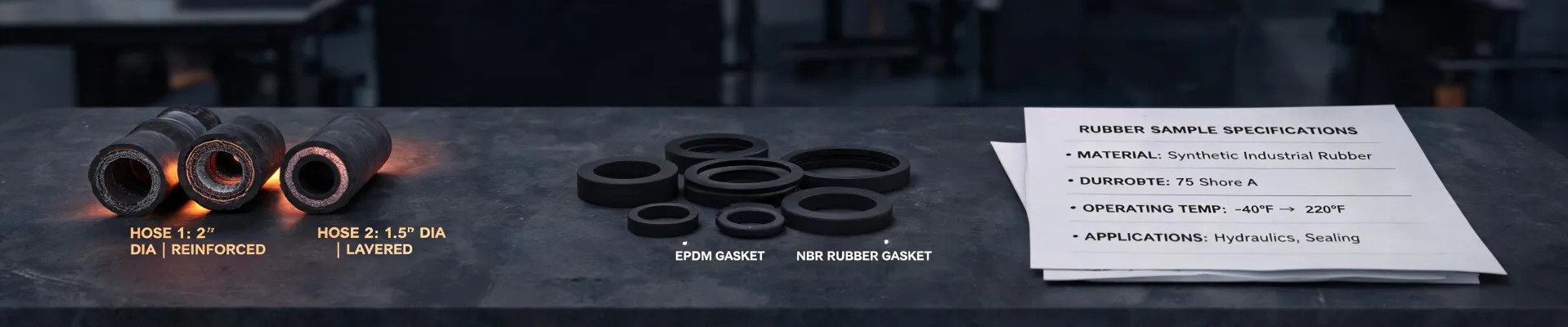
A practical, step-by-step guide for administrative buyers sourcing rubber feet, gaskets, and hoses. Avoid common pitfalls and get the right parts without the headache.
If you've ever been tasked with sourcing something as seemingly simple as a rubber foot for a machine, or a specific nitrile rubber foam gasket, you know it can quickly turn into a headache. Most buyers focus on the per-unit price and completely miss the specs, MOQs, and shipping that can blow up a project. This is a 5-step checklist I've built over the past few years managing supplies for a mid-sized company. It'll save you from making a few of the expensive mistakes I've already made for you.
Step 1: Get Obsessive with the Specs (The 'Oversimplification' Trap)
It's tempting to think you can just search for "rubber feet" and compare prices. But identical descriptions from different vendors can result in wildly different outcomes. The most frustrating part of this step is realizing that "standard" doesn't mean the same thing to everyone.
Here is what you need to pin down before you search:
- Material: Are you looking for nitrile rubber foam (resistant to oils and fuels) or standard EPDM rubber? The chemical composition matters.
- Hardness (Durometer): Measured on the Shore A scale. A 60A durometer foot feels very different from an 80A one. A soft foot might not support a heavy machine; a hard one might not grip the floor.
- Dimensions (with tolerances): Don't just say "1-inch foot." You need the overall height, the base diameter, and the hole size or thread type. A 1/4-20 threaded insert inside the foot is different from a 3/8-16. If the spec is '1-inch', is that +/- 0.01 inch or +/- 0.1 inch?
- Attachment Method: Is it a simple push-on foot, a screw-on foot, or a foot that needs to be bonded to a metal bracket?
Checklist item for this step: Create a spec sheet that includes Material, Durometer, Dimensions, and Attachment. Send this to the vendor, not just a part number.
Step 2: Find the Right 'Shop' (Don't Just Search 'Rubber Shop')
Searching for a "Cooper tire shop" when you need a custom rubber gasket is like asking a bakery to fix your car. They both deal with 'dough,' but the application is completely different. You need to identify the right manufacturer or distributor.
- For standard parts (rubber feet, bumpers, stoppers): Look for industrial supply houses (like McMaster-Carr or Grainger) or manufacturers specializing in rubber molding. They will have catalogs.
- For custom parts or sheet goods (foam, rubber sheets): You need a fabricator or a distributor that carries raw materials like nitrile rubber foam in sheets. They cut it to size or fabricate the part.
- For hose (rubber vs hybrid air hose): A rubber air hose is great for durability and kink resistance. A hybrid air hose (often a thermoplastic elastomer blend) is lighter and more flexible in cold weather. Your application (workshop vs. construction site) dictates which is better.
Checklist item for this step: Search for the type of supplier (e.g., "rubber gasket manufacturer") not just the product name.
Step 3: Verify the 'Small' Costs (The Hidden Price Tag)
In my first year of purchasing, I made the classic rookie mistake: comparing unit prices without looking at the total cost. A vendor quoted a great price on nitrile rubber foam gaskets. I was ready to order. Then I saw the setup fee for the die-cutting tool. It was $250. Oh, and the first 10 samples were $100. Suddenly, my 'cheap' gaskets weren't so cheap.
When you get a quote, ask about these things explicitly:
- Setup/Tooling Fees: A one-time cost to create the die or mold. This is common for custom parts.
- Minimum Order Quantities (MOQs): The vendor might require a minimum of 100 units even if you only need 20.
- Shipping: Heavy rubber parts are expensive to ship. A price for 100 rubber feet is just the start.
- Revision/Engineering Costs: If they need to design a spec, there is often an upfront engineering cost.
Checklist item for this step: Ask for a "Total Delivered Cost" quote that includes setup fees, tooling, and shipping.
Step 4: Validate the Vendor (Check, Then Trust)
Trust me on this one: never place a high-stakes order without a test. A few years ago, I ordered 400 rubber feet for a new line of office furniture. Looked great in the catalog. When they arrived, the hole was 1/16th of an inch too small. The vendor's argument? The spec was within a 10% tolerance. The reality? Our screws didn't fit. We had to ream out 400 holes. The 'savings' was eaten up by labor costs.
Before a large order:
- Order a sample. You pay for the part and shipping, but it's worth it. Ask for the production sample, not a hand-made prototype.
- Check for certifications. Do they have ISO 9001? If you are buying for a specific industry (like food-grade or medical), do they have the necessary FDA or 3-A certifications?
- Get the warranty in writing. What happens if the rubber hybrid air hose fails after 30 days? Is there a warranty against manufacturing defects?
Checklist item for this step: Require a physical sample and a certificate of analysis (CoA) for the material.
Step 5: Build the Relationship (Don't Jump Ships for a Penny)
I have mixed feelings about constantly switching vendors for a lower price. On one hand, I'm supposed to save money. On the other hand, the trust and smooth process built with a reliable supplier is worth something. Part of me wants the lowest price. Another part knows that the time I spend re-qualifying a new vendor costs me about 6 hours of internal admin time. Unless the price difference is massive (>25%), it's often not worth it.
That said, I should note that I keep a backup vendor on file. When our primary supplier had a raw material shortage in 2024, having a second source for Cooper Tire's commercial-grade rubber feet (sourced through a different distributor) saved us a production delay.
Common Mistakes to Avoid:
- Forgetting the MOQ: You order 50 feet, they charge you for 100 because that's their minimum.
- Ignoring the material spec: Buying a rubber hybrid air hose when you need pure rubber for chemical resistance is a disaster waiting to happen.
- Not checking for a standard part first: A custom die might cost $200. Check if a standard stock part from a supplier like McMaster-Carr can do the job first.
Follow this checklist, and you'll avoid the costly reworks and delayed projects that plague most rookie sourcing efforts. It's not about being perfect; it's about being methodical.
Cooper Tire editorial note
Rubber sourcing decisions should be tied to measurable application facts. If a post raises a question about material choice, compliance files, or qualification planning, send the use condition and drawing for a practical review.