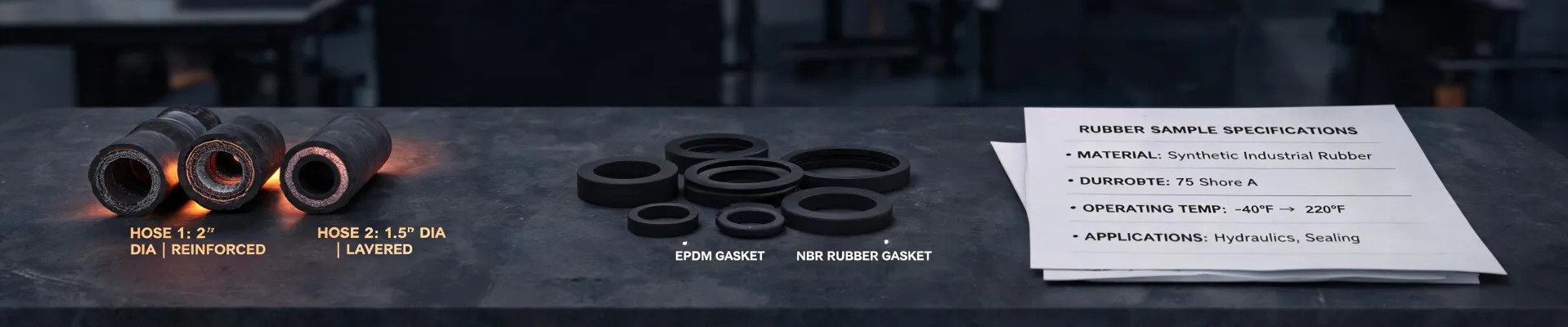
Answers to common questions about Cooper Tire's industrial rubber products, including TPR, nitrile, and rubber sheets, with a focus on total cost of ownership.
What does Cooper Tire actually make? Tires, sure, but also this...
When people hear "Cooper Tire," they think car tires. And that's fair—it's in the name. But in my role sourcing industrial components for a manufacturing company, I've found their rubber division is a different beast. They're a major supplier of custom rubber extrusions, sheets, and molded parts for commercial and industrial applications.
Think rubber strips for sealing industrial doors, nitrile rubber sheets for chemical-resistant gaskets, TPR (thermoplastic rubber) for flexible grips on equipment. It's a whole world beyond passenger vehicle tires.
(Should mention: not all Cooper-branded products are manufactured by them—some are distributed. It pays to check the specific product line.)
Is rubber a thermoplastic? It's complicated, and here's the practical answer
Honestly, I'm not sure why this question is so confusing, but I get it asked almost weekly. The short answer: traditional rubber (vulcanized) is not a thermoplastic. Once it's cured, it's thermoset—you can't re-melt and re-mold it.
TPR, or thermoplastic rubber, is different. It behaves like rubber but can be melted and reprocessed like plastic. That's why you see it in things like weather stripping and tool grips. It's more recyclable but doesn't have the same heat resistance as cured rubber.
From the outside, it looks like TPR is just "better rubber." The reality is it's a different material family with different trade-offs. For high-heat or high-pressure applications—like compressed gaskets in industrial equipment—I'd stick with nitrile or EPDM.
TPR vs rubber: Which one should I choose for my project?
This question comes up because people see "TPR" on a spec sheet and assume it's a type of rubber. It is, but not in the traditional sense. Here's how I break it down for buyers:
- Temperature: TPR softens at around 200-250°F. Nitrile rubber can handle 250-300°F continuous. For steam or hot oil applications, traditional rubber is your friend.
- Recyclability: TPR wins here—scrap can be reground and reused. Cured rubber is waste.
- Abrasion resistance: Nitrile rubber is generally tougher. TPR tends to wear faster in high-friction applications.
- Cost: TPR is often cheaper per pound, but total cost depends on longevity.
I've seen a project where TPR pads wore out in 6 months; nitrile rubber lasted 2 years. The initial savings evaporated. (Ugh. That was a lesson in TCO.)
Where can I find a Cooper Tire store that sells rubber products?
This is a common point of confusion. Cooper Tire retail stores primarily sell passenger and light truck tires. They don't typically stock industrial rubber sheets or strips on the shelf.
For industrial rubber products—rubber knife blades, nitrile rubber sheets, custom extrusions—you'd work with a Cooper Tire industrial distributor or a third-party supplier that carries the Cooper brand. Companies like Grainger, McMaster-Carr, or specialized rubber distributors are the actual purchasing channels. At least, that's been my experience with sourcing from Cooper rubber.
Don't call your local tire shop and ask for a nitrile rubber sheet. They'll look at you funny. (I made that mistake once. Not my proudest moment.)
Nitrile rubber vs polyurethane: When does cost actually matter?
I get this a lot, and I'll admit: I don't love this comparison. They're different materials for different jobs. But here's what I've seen on the sourcing side.
Nitrile rubber is oil-resistant, flexible, and relatively cheap. Polyurethane is abrasion-resistant, harder, and often more expensive upfront. The popular choice depends on what you're doing:
- O-rings and seals in oil environments: Nitrile wins. Polyurethane can swell or degrade in contact with petroleum.
- Wear pads or scraper blades: Polyurethane often lasts longer, even at a higher initial cost.
I worked on a project last year where we switched from polyurethane wiper blades to nitrile because of cost pressure. We saved about 15% on unit cost. But we had to replace them 30% sooner. Did we save money? On paper, yes. In total cost? Not really.
People assume the lowest quote means the vendor is more efficient. What they don't see is which costs are being hidden or deferred—like shorter lifespan and more frequent replacements.
What's a 'rubber knife' and when would I need it?
This sounds like a tool for cutting rubber, but actually, a rubber knife is a blade made of rubber (or bonded rubber to a metal core). It's used in industrial processes where a rigid blade would damage the surface being worked on—think scraping paint off a fiberglass hull or cleaning a conveyor belt.
Cooper Tire doesn't make rubber knives directly, but the rubber used in them—often a medium-hardness nitrile or TPR—is relevant because it affects durability and grip.
If I remember correctly, the rubber knife market is small but specific. Most buyers are in maintenance or cleaning operations. The cost isn't high—maybe $10-25 per blade for industrial quality.
How do I calculate total cost (TCO) for industrial rubber products?
I mentioned TCO a few times. Here's the simple framework I use when comparing rubber materials or suppliers:
- Unit price × quantity: This is what everyone looks at.
- Shipping & handling: Often 10-20% of unit cost if you're ordering heavy rubber sheets.
- Setup or tooling fees: Custom extrusions and molded parts often have a one-time tooling charge ($50-$500 depending on complexity).
- Expected lifespan: A $5 gasket that lasts 2 years beats a $3 gasket that lasts 6 months.
- Replacement cost: Downtime to replace a failed part. That's the real kicker.
I've seen a $1,000 quote turn into a $3,500 total cost when you factor in shipping, tooling, and early failure. The $1,400 quote (all-in) was actually cheaper. I should add that this isn't always true—it depends on volume. But for custom or long-life applications, TCO thinking pays off.
If you're sourcing rubber for a critical application—seals, gaskets, vibration mounts—don't just compare the price per pound. Compare the cost over 3-5 years. That's where Cooper Tire's product range actually matters: they offer a broad selection, which means you're more likely to find the right material for the job rather than settling for a generic one.
Cooper Tire editorial note
Rubber sourcing decisions should be tied to measurable application facts. If a post raises a question about material choice, compliance files, or qualification planning, send the use condition and drawing for a practical review.